
EU Citizen's Company Sent Sanctioned Equipment to Russian Defense Firms
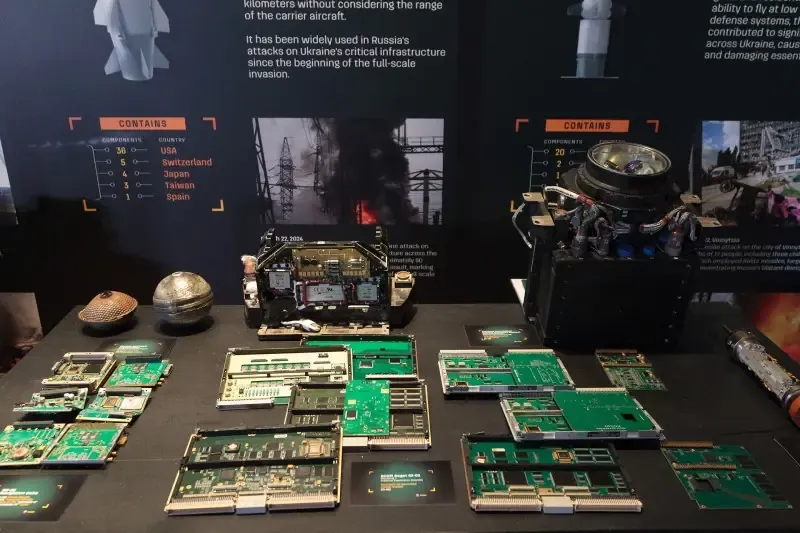
EU Citizen's Company Sent Sanctioned Equipment to Russian Defense Firms Scoop Despite denials from its European co-owner, trade data shows a Turkish company shipped banned E.U. equipment worth millions to Russian companies lined with the arms giant Rostec. Exhibition of downed Russian UAVs containing foreign-made components, presented during a sanctions conference at the National Museum of the History of Ukraine in the Second World War in Kyiv, Ukraine, on 27 June 2025. Banner: Kyrylo Chubotin/NurPhoto/NurPhoto via AFP Banner: Kyrylo Chubotin/NurPhoto/NurPhoto via AFP Reported by Alisa Yurchenko The Kyiv Independent Lorenzo Bodrero IrpiMedia Also published by our partners The Kyiv Independent (Ukraine, in ) and IrpiMedia (Italy, in Italian) Over $5-million worth of European metalworking machinery was delivered to two critical Russian defense firms in 2023 and 2024 despite strict European Union sanctions, trade data shows.The specialized equipment was exported by a Turkey-based company, Redwing Metal Uluslararasi Ticaret Anonim Sirketi, to Russian metallurgical plants Aluminum Metallurg Rus (AMR) and Stupino Metallurgical Company (SMK). The shipments were identified in customs and trade data obtained by the Kyiv Independent and IrpiMedia, OCCRP’s media partners in Ukraine and Italy.Both plants are part of Russia's defense-industrial complex, producing specialized metal alloys required for combat aircraft and cruise missiles. Among these is the Kh-101 — the missile that struck a building in Kyiv on May 14, killing 24 civilians, according to Ukrainian authorities. Credit: Yevhen Kotenko/Ukrinform/NurPhoto/NurPhoto via AFP Rescuers talk beside a damaged apartment block in Kyiv’s Darnytskyi district on 15 May 2026, a day after a Russian missile strike destroyed part of the building on 14 May 2026. Credit: Yevhen Kotenko/Ukrinform/NurPhoto/NurPhoto via AFP Rescuers talk beside a damaged apartment block in Kyiv’s Darnytskyi district on 15 May 2026, a day after a Russian missile strike destroyed part of the building on 14 May 2026. The findings expose a vulnerability in EU export controls allowing companies in intermediate countries to ship critical technology. While the EU bans direct and indirect sales to Russia, experts say it is hard for E.U. manufacturers to know if their products end up there. They may sell to firms operating in countries that have not imposed sanctions, which then export the goods to Russia.A co-owner of Redwing Metal denied the company has shipped sanctioned goods to Russia. AMR and SMK didn’t respond to requests for comment regarding the shipments. The trade data shows that Italian-made CNC lathes used for shaping metal were among the European goods exported to Russia via Turkey. "It is impossible to buy items such as CNC machines directly from the E.U. for delivery to Russia — in this case, sanctions are effective," said Roman Steblivskyi, director of Policy and Advocacy at the Economic Security Council of Ukraine (ESCU).But “countries such as Kyrgyzstan, Uzbekistan, Hong Kong, and Turkey have no sanctions against Russia, making it far easier for companies based there to procure and re-export such goods," he said. Credit: Kyrylo Chubotin/Ukrinform/NurPhoto / NurPhoto via AFP Roman Steblivskyi speaks during a panel discussion on sanctions against Russia in Kyiv, Ukraine, on 27 June 2025. Credit: Kyrylo Chubotin/Ukrinform/NurPhoto / NurPhoto via AFP Roman Steblivskyi speaks during a panel discussion on sanctions against Russia in Kyiv, Ukraine, on 27 June 2025. In addition to CNC lathes, the metalworking machinery delivered to the Russian plants included a metal heat-treatment furnace, hydraulic press, aluminium disc pre-assembly machine, and belt conveyors. The equipment was manufactured by producers in countries including Italy, Germany, Spain, and the Czech Republic."Taken together, this is not a random basket of ordinary industrial goods,” said Alex Bashinsky, co-founder of the U.S.-based Global Sanctions Training Institute (GSTI).“These look like core capabilities for a modern metallurgical production line and can potentially support Russia's defense-industrial base," added Bashinsky, who is a member of the International Working Group on Russian Sanctions, and was shown the list of equipment.“Some of these goods were banned already in the first half of 2022, indicating their early acknowledgement as critical to the Russian war effort," said Erlend B. Bjortvedt, founder of Corisk, after reviewing shipment data.Corisk is an Oslo-based consulting company that researches sanctions and sanction evasion. The European Supplier Redwing Metal, the company behind the deliveries, was established in Turkey shortly after Russia's full-scale invasion of Ukraine in 2022. According to corporate records, Redwing Metal is co-owned by Alexander Tattersall, a Dutch national residing in Switzerland who holds a 40-percent stake. Almost all the remaining shares are held by a Turkish lawyer, Veysel Cengiz Soylemezoglu.In a written response to questions, Tattersall said he was only partially familiar with the operations of the Redwing Metal."I am a part-time consultant for the Turkish company Redwing Metal and have limited knowledge of the operations of this company,” said Tattersal. “To the best of my knowledge, Redwing Metal has never been involved in any ‘schemes’ of shipping sanctioned goods to Russia," he added.In addition to being listed as firm’s co-owner, Tatterstall is also the only contact person on the firm’s website. Soylemezoglu questioned the “source and legality” of the data showing exports to Russia.“The statements and assumptions regarding alleged trade flows appear to be unsupported by any factual information provided,” he wrote.The trade data was collected from four private commercial databases that aggregate customs information from around the world.The data shows that Redwing Metal exported the equipment to two Russian defense plants, AMR and SMK, which are owned by Nikolay Timokhin, according to financial records. Timokhin is the son-in-law of Igor Zavyalov, deputy head of Russia's sanctioned state defense conglomerate Rostec.Those exports were not the only connection between Tattersall with AMR. “I am the CEO of AMR TRADING AG (Switzerland), AMR TRADING INC. (USA) and AMR TRADING GERMANY GMBH and fully aware of their activities,” Tatterstall said in his emailed response to questions.“I note that neither of these companies is, or has ever been, involved in any activities connected with circumventing of Russia-related EU sanctions or contribution to defense-related or military industries in any jurisdiction,” he added.Those companies exported aluminum alloys from Russia to Europe and the U.S, and there is no suggestion they were involved in sanctions evasion.Between 2022 and 2025, AMR and SMK sold metal components to over 40 Russian defense companies, leaked Russian tax data as well as publicly available court records show. Their clients include manufacturers of tanks, artillery, fighter jets, cruise and ballistic missiles, and many other types of weaponry. AMR held a license from Russia’s intelligence service, the FSB, allowing it to perform “work involving the use of information constituting a state secret." These shipments carry legal exposure for Tattersall. Should it be proven that an E.U. national knowingly assisted in bypassing export restrictions through a third-country intermediary, they could face both financial penalties and criminal charges under the laws of the relevant member state, according to Bashinsky from GSTI.Bjortvedt, the founder of Corisk, said such penalties and charges have not been commonly applied."But the legal risk certainly exists," he added. Equipping RussiaCustoms records list the specific models of E.U.-made machinery shipped by Redwing Metal between 2023 and 2024. The exports include four CNC lathes produced by Italian manufacturer M.C.M. MADAR COSTRUZIONI MECCANICHE S.P.A. (MCM), which were delivered to Russia-based SMK in late 2023.In a written response, MCM confirmed that it did sell products to Redwing Metal in 2023, and stated that the agreement explicitly prohibited the "re-export to countries, areas, or entities subject to restrictive measures." The company representative added they have no knowledge of any re-export to Russia of the goods sold to Redwing Metal.Other companies that supplied metalworking equipment to the Russian companies did not respond to questions. In addition to supplying machinery, customs data reveals that Redwing Metal also shipped $1.3 million worth of E.U.-made shipbuilding operational gear to the company known as SMK-Snab until 2024, when it changed its name to Systems of Metallurgical Supply. Based on the equipment descriptions in Russian customs data, ship anchors, mooring winches, ventilation system fans, onboard wastewater treatment systems, and other goods were imported for installation on two ships under construction, which were associated with Russian naval fleet programs. One of them, the Mikhail Kalashnikov, was completed in mid-2025, less than a year after the last deliveries.The Russian companies and their owner, Timokhin, did not respond to requests for comment.Wolter GmbH Maschinen-und Apparatebau KG manufactured the vessel ventilation system fans, according to Russian customs data. But the managing director, Michael Kresse, said "it is difficult to determine who might actually have sold these goods to this Turkish company.” "They could have been sourced from many channels, including stockists," he said. Support fearless reporting.Unlock crucial insights. Donate Your donation powers investigations that expose organized crime and corruption worldwide. As a supporter, you’ll also gain access to events and insights only available to our donors.Give today and get the inside take. Donate Your cookie preferences We use cookies to improve your experience by storing data about your preferences, your device or your browsing session. We also use cookies to collect anonymized data about your behaviour on our websites, and to understand how we can best improve our services. To find our more details, view our Cookie Policy. Audience Measurement Cookies Essential Cookies Accept my choices Accept all Close and accept Help us test and improve the website! Shape how OCCRP tells its stories online. We'd love your input! 👉 Join Test Don't show this anymore