
Iron Fist or Fragile Peace: Colombians Head to Polls in Stark Choice of Candidates
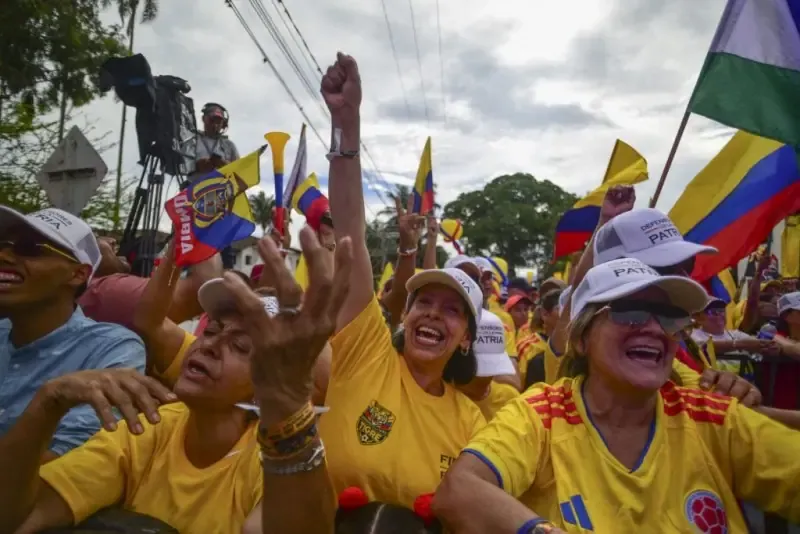
Iron Fist or Fragile Peace: Colombians Head to Polls in Stark Choice of Candidates Feature Millions of voters, deeply traumatized by a legacy of violence and political corruption, will head to the polls on Sunday to decide Colombia’s razor-thin presidential race between a progressive mediator and a far-right defense lawyer. Supporters of Abelardo de la Espriella, presidential candidate for the Defenders of the Homeland party, attend a closing campaign rally in Buga, Valle del Cauca department, Colombia. Banner: Photo by Edwin Rodriguez Pipicano / ANADOLU / Anadolu via AFP Banner: Photo by Edwin Rodriguez Pipicano / ANADOLU / Anadolu via AFP Reported by Jonny Wrate and Nathan Jaccard OCCRP Colombians will head to the voting booths on Sunday driven less by hope for a better future and more by fear that parts of the country might fall even deeper into lawlessness. They face a stark choice: will they trust a left-wing senator who promises to negotiate with the armed groups fiercely vying for territorial dominance, or will they elect a right-wing former lawyer who defended suspects of graft and money laundering or people with links to violent paramilitaries but now vows to crush criminal groups and corruption with an iron fist?Colombia has been plagued by entrenched internal conflict and organized crime for decades. Even though a peace process was signed with guerrillas in 2016, recent incursions by violent armed groups into almost half of the country’s municipalities have left entire communities exposed to massacres, forced displacements, and criminal extortion. According to a survey conducted in February this year, nearly a third of the respondents identified public security as the primary problem in the country. Right behind were unemployment and the economy with nearly 20 percent.The first round of voting on May 31 went to Abelardo de la Espriella, a 48-year-old lawyer whose campaign was based on emotional messages of security and economic growth.Donning a Colombian football jersey on stage and dubbing himself “The Tiger,” he has grabbed attention with videos, playful social media content, and catchy songs in which he promises a sweeping, militarized crackdown on the armed groups, the construction of megaprisons and a retake lost territories from guerrilla groups. He has been endorsed by U.S. President Donald Trump.His official campaign song opens with the sound of a roaring tiger, sounds like a soccer anthem carefully calibrated to electrify his base. "He punishes criminals without being politically correct," a chorus sings to a fast-paced, driving beat. “The tiger that roars and bites / The tiger that fears nothing / The tiger that leaves its mark / Abelardo de la Espriella. Firm for the homeland!”Messages like that brought him 10.3 million votes, or 43.7 percent of the vote in May.In second place was Iván Cepeda, a 63-year-old senator, with 9.7 million votes, representing 40.9 percent of the vote. Cepeda is offering the continuation of the current policy of President Gustavo Petro: a “conditioned dialogue” with the armed groups and drug gangs, while cracking down on their financial flows and improving local economies to offer young people survival options other than joining a gang. The policy has so far been largely unsuccessful and has coincided with record cocaine production and an increase in violence.In this razor-thin race, de la Espriella’s approach to Colombia’s ills as well as his background appear controversial to many.In particular, they are worried about his problematic connections and past as a lawyer who often defended notorious corrupt actors and organized crime figures. One of his highest-profile former clients is Alex Saab, who he represented in Colombia, where the businessman faced various criminal investigations, including money laundering and fictitious exports.De la Espriella has stated that he stopped representing Saab in 2019 as his client was accused of helping to coordinate a sprawling money laundering network linked to corruption within the Venezuelan regime of Nicolas Maduro, which allegedly began in 2011 and made international headlines by 2017.Political scientist Alejandro Chala told OCCRP that any concerns about de la Espriella’s dubious links to Saab should be resolved by relevant authorities as rumors play into his campaign discourse as a victim of a political witch hunt.It should be up to the justice system to “prove and unravel whether de la Espriella continues to obtain contacts and relationships - or whether he benefited to some extent - from the crimes that Alex [Saab] commits during these years,” he said.Earlier in his career, Espriella represented a number of mayors, governors and congressmen some of whom have been found guilty of collaborating with paramilitary groups.In the mid-2000s, he also served as an adviser to the leadership of Colombia’s principal paramilitary group blamed for rampant human rights abuses, land seizures, and massacres just as it was entering disarmament negotiations with the government.Accusations of criminal conduct and illicit connections have emerged during the election cycle. One came from a former client who claimed that de la Espriella charged him five billion pesos (about $2.5 million) to handle his defense, but withdrew from the case the moment he received the money."“I never stole money from DMG,” de la Espriella commented, referring to the pyramid scheme the client was accused of running.The man also claimed that de la Espriella asked for additional amounts to bribe congressmen. “If the attacks against me are due to my professional practice, then there is nothing to it, because I did everything within the framework of the law,” said Espriella in a statement published by his movement, Defenders of the Homeland, in response to the allegations:Political scientist Manuel Camilo Gonzalez Vidas told OCCRP that de la Espriella’s supporters dismiss the reports as an attempt to smear his reputation.“It’ll be fundamental for the electoral mechanism to see how the center and the undecided find these news stories and complaints and really make a decision,” he said.Johanna Amaya-Panche, a Colombian professor in international relations and politics at Liverpool John Moores University, told OCCRP that while social media has been spreading ‘fake news’, facts about candidates that would normally be considered problematic are not reaching voters. And if they are, they may not make a difference. “We’re at a point where people don’t really care about the candidates’ backgrounds,” says Amaya-Panche. “We’re in an environment where criminal activity or criminal legacies of presidential candidates is normalized.” “[Internationally], there’s a normalization of candidates from the far-right hiding their trajectories and their links with criminal organizations or criminals,” she added. Support fearless reporting.Unlock crucial insights. Donate Your donation powers investigations that expose organized crime and corruption worldwide. As a supporter, you’ll also gain access to events and insights only available to our donors.Give today and get the inside take. Donate Your cookie preferences We use cookies to improve your experience by storing data about your preferences, your device or your browsing session. We also use cookies to collect anonymized data about your behaviour on our websites, and to understand how we can best improve our services. To find our more details, view our Cookie Policy. Audience Measurement Cookies Essential Cookies Accept my choices Accept all Close and accept Help us test and improve the website! Shape how OCCRP tells its stories online. We'd love your input! 👉 Join Test Don't show this anymore