
Tracking the Rise of Immigration-Related Habeas Corpus Cases — ProPublica
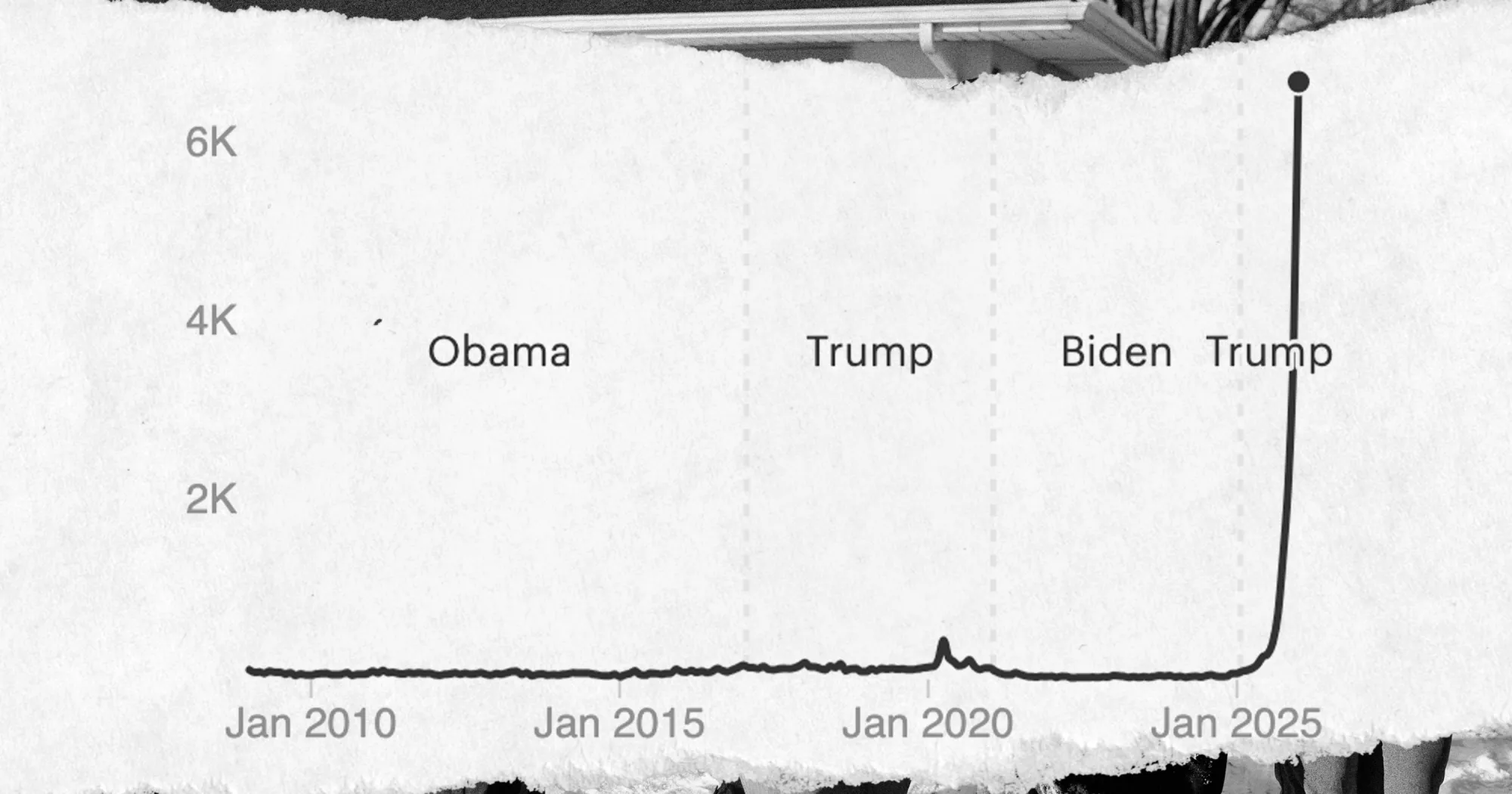
As federal immigration agents surge into communities and detain people, the number of cases filed by those claiming their detention is illegal has risen to historic highs. ProPublica is tracking the volume of these cases, known as habeas petitions, as they overwhelm legal advocates and government attorneys.
Immigrants filed more habeas cases in the first 13 months of the second Trump administration than in the past three administrations combined, including his first. Starting April 2026, new cases have started to slow.
Cases Over Time
Challenges Are Not Evenly Distributed


About the Data
How did ProPublica collect this data?
ProPublica analyzed federal habeas petitions filed by immigrant detainees in district courts across the country using records from Public Access to Court Electronic Records and the Free Law Project. We plan to update the data weekly.
Can I download this data?
Yes. You can download the data nationwide since 2008 or since Jan. 1, 2025. If you use this data, we ask that you credit “ProPublica analysis of court data” and link to this tracker.
If you only need data for a particular state or court district since Jan. 1, 2025, you can use the link at the far right of the corresponding row in the state-by-state table.
What should I know if I plan to use this data?
Each row in the dataset includes a link to the habeas petition’s docket on the Free Law Project’s CourtListener, which is free to access. Reporters can find additional details on each habeas petition filed, including the judge assigned to the case, the contact information for the attorneys on this case and a list of all documents filed.
Not all documents are available to download on CourtListener and may need to be accessed through PACER for a fee. (If you do pay a fee to access a document, consider installing the Free Law Project’s RECAP browser plugin first. The plugin will automatically archive documents that you purchase through PACER, saving other journalists and researchers from paying to retrieve the same records.)
Be aware that habeas cases are only partially public, and most documents including the initial petition and the government exhibits are restricted under FRCP Rule 5.2 (c). A subset of the documents might be available for access through any courthouse terminal in a given district. Some documents, such as government exhibits, might still be restricted, requiring a court order to unseal. However, court orders and opinions are typically still remotely accessible through PACER or CourtListener.
The data includes some cases that were filed more than once for a variety of reasons, such as filing errors or deficiencies. If a case was filed in one state and then transferred to another, the case will be under the state and court district it was transferred to.
A small number of cases, such as Kilmar Armando Abrego Garcia’s habeas petition, are missing from the data. This is because the cases have been misclassified by the court. We are working to resolve this issue.
What do the columns in the data download mean?
Here’s a rundown of the columns you can expect in our csv download:
- court_id - The federal judicial district each case was filed. Each court_id begins with the state abbreviation and is followed by the regional court division, i.e. Texas Western Division is “txwd.” States that don’t have regional court divisions have the state abbreviation along with the letter d, i.e., Rhode Island Division is “rid.”
- pacer_case_id - The unique identifier assigned by each court for a given case. This id is only unique within a given court. So the court_id and the pacer_case_id combined can be used to uniquely identify a case.
- docket_number - The docket number assigned to the habeas case. Like the pacer_case_id, this number is only unique within a given court.
- case_name - The name of the case.
- date_filed - The date the case was originally filed, formatted as YYYY-MM-DD.
- month - The month the case was originally filed, formatted as MM.
- year - The year the case was originally filed, formatted as YYYY.
- date_terminated - The date the case was terminated, formatted as YYYY-MM-DD. If this field is blank, the case was still active as of our most recent update.
- nature_of_suit - The case type. All of these cases should be 463 for “Habeas Corpus (Alien Detainee).”
- ecf_url - The link to view the most up-to-date version of the docket and download documents, which you can access electronically through PACER (for a fee). Note that not all documents are accessible over the internet (see previous question).
- presidential_term - The presidential administration when this case was filed, i.e., 2025_2029_trump_2 for the second Trump administration.
- docket_id - The internal docket identifier assigned by CourtListener.
- courtlistener_url - The link to the case on CourtListener, where you can view the docket and access documents that have been purchased by other users using the RECAP extension (free). Not all documents are accessible over the internet (see previous question).
What could journalists do with this data?
Reporters can use the data to cover immigration enforcement in their community in a variety of ways.
- The simplest idea: What’s the overall trend of habeas petitions filed in your state or court district? Have they increased since the start of the second Trump administration, and if so, by how much? Further reporting can show if the increase in cases has overwhelmed attorneys and judges.
- Which judges have been assigned to the cases in your area? Have they overwhelmingly ruled for or against the federal government?
- How long does it take for a case in your area to be closed? Is it taking longer because of an influx of cases?
While we won’t have capacity to conduct custom data analysis for folks, we're happy to answer clarifying questions and help you use this information. Feel free to email the reporters with any questions. Here are some examples of local stories we’ve seen that cite this data:
- Federal judge orders bond hearing for Nebraska DACA recipient, despite ICE resistance
- As immigration arrests rise, claims challenging unlawful detention soar
- Immigration attorneys challenge ICE arrests in West Michigan
- Orlando judges are releasing migrants from ICE custody, but a showdown is coming
- Immigrants nationwide say Trump’s ICE jailed them illegally. In Kentucky, federal judges often agree
- Immigrants in Central Valley are challenging ICE detentions at record-high rates