
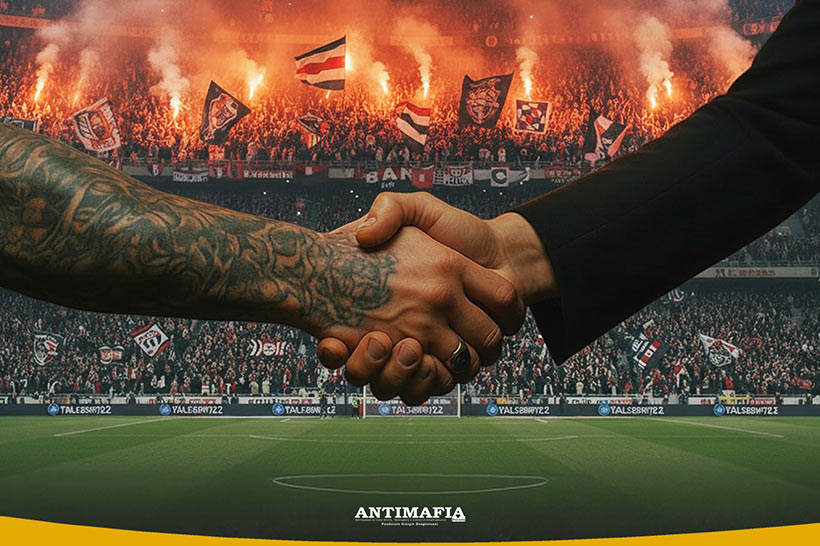
The B side of Serie A: how the mafia entered the football system
The B side of Serie A: how the mafia entered the football system
In relations between clans and ultras, in touting, in opaque finance and in illegal betting, every goal can be worth millions
Already in 2017, the Anti-Mafia Commission highlighted the well-established connection between mafias, common crime and violent fringes of organized support within Serie A and B clubs. A worrying scenario, made up of organized supporters who appear to be direct or at least influenced by the gangs. It is above all inside the stadiums, but also outside - as we will see shortly - that these groups display intimidating methods to put pressure on sports clubs and, at the same time, use the curves for illicit activities such as drug dealing, irregular ticket sales and parallel merchandising of products bearing the brand of the various clubs, such as t-shirts, balls and much more. But the attention of the mafia towards the world of football is not limited to the curves. Over the years, clubs have become a point of reference for criminal organizations, transforming themselves into a privileged channel for money laundering. The long absence of adequate controls on the origin of capital did the rest. As if that wasn't enough, another critical front that has emerged in recent years seems to be that of the ambiguous relationships between footballers and organized crime. Relationships that sometimes serve to gain visibility and support, other times, however, to obtain earnings through the manipulation of match results. Various investigations have extensively documented this: match-fixing that can earn very large amounts of money. In this chaos, those who seem to be particularly affected by organized crime are the amateur clubs, which particularly lack resources and adequate controls. Often the mafias, aware of the precarious conditions of these realities, offer themselves as a valid, if not only, solution to problems, especially those of an economic nature.
The ultras issue with the "blessing" of the 'Ndrangheta
Just over a year ago, some arrests swept through Milan and Inter, bringing to light the existing links between organized support and organized crime. It all started with the murder of Antonio Bellocco, killed on 4 September 2024 by Andrea Beretta outside a gym in Cernusco sul Naviglio, Milan. We are talking about a crime which, as many will remember, had great media coverage, as well as a notable chain of confessions, settling of scores, cross-investigations and internal collapses within the ultra groups.
From that moment on, the two San Siro corners ended up at the center of an investigation which revealed behind the scenes facts of business, violence, opaque relations with the criminal world and a power much more extensive than imagined. © Imagoeconomica Beretta, the central figure of the investigation, began to collaborate with the magistrates, describing the functioning of the economy of the Curva Nord, the internal hierarchies, the system of increased tickets, the importance of merchandising and the network of relationships that allowed the group to control the businesses around the stadium. His repentance also opened a window into the assassination of Vittorio Boiocchi, historic Inter leader: a murder which according to the Prosecutor's Office would have been organized by the men who ended up at the center of the investigation, with the intention of sharing power and profits.
The other half of the city was then overwhelmed by the figure of Luca Lucci, the "Toro" of the Rossoneri's Curva Sud, a charismatic leader feared both in organized supporters and in the criminal world. The accusations against him range from international drug trafficking to attempted murder, with a business network that extended from the curve to the Milanese nightlife and relationships with entertainment figures such as Fedez. Ambiguous figures moved around him, mediators linked to the 'Ndrangheta and event organizers who used his influence to arrange concerts and manage clubs.
But let's go further back in time, to 2007, when the first signs arrived that the 'Ndrangheta was taking an interest in the Juventus ticket business. A remarkable deal, far beyond simple touting. Such an advantageous deal that a few years later, in 2012, something changed. It is during this year that the border between ultras and organized crime becomes much thinner. At the center of this new phase we find the figure of Rocco Dominello: young and apparently far from the usual imagination of the fan from the curve, Dominello is the scion of the Pesce-Bellocco families of Rosarno, one of the most ferocious gangs in Calabria. He will be convicted for mafia, but before then he manages to present himself at the corners as a point of reference, a man "to keep quiet" in case of problems, as the former ultra leader Ciccio Bucci, who committed suicide shortly after the investigation broke out, will say.
Juventus has always maintained that they didn't have the slightest idea of what was going on behind Dominello. Yet, that young boss was usually sitting in the stands and not in the corner, and had managed to approach most of the Juventus top management. He had even managed to corner the lucrative coupon market. Obtaining a monopoly on this flow means managing money, having relationships with the club, deciding who enters the stadium and how. In practice, a form of power that allows you to control the curve from the inside, even for those who, like Dominello, watched the matches from the stands. This is because in the curve, whoever controls the tickets controls the people. It decides who can enter, who can lead the choirs, who can display a banner, who can sit "where it counts" and who can't. It is a de facto power. Thus, in the space of a few years, Dominello did not limit himself to entering the world of the ultras: he became the guarantor of internal order, the mediator of tensions, the point of reference in case of conflicts. © Imagoeconomica
In a world of debt
According to the most recent analyzes of the 2023-24 financial statements, the overall debt of the 20 Serie A clubs is around 4.6 billion euros. Staggering figures which, if extended to all of professional football, lead to an overall debt - according to a FIGC and Report Calcio report - of around 5.5 billion, with cumulative losses over the last 17 years amounting to 9.3 billion.
According to the ranking published by "Calcio e Finanza", the one who seems to be doing the worst is Inter, in first place, with a "gross" debt of around 735 million euros. Juventus follows with 639 million and then AS Roma with 636 million. They follow, from fourth to tenth place: Milan (324 million), Lazio (283), Genoa (266), Naples (243), Sassuolo (200), Atalanta (181) and Turin, among the most virtuous, with 159 million.
Now the question is legitimate: why are Italian clubs so indebted?
The causes are different, although the main ones are intuitive: salaries and sports costs out of control; old stadiums with limited revenues, often obsolete municipal facilities; capital gains and bank debt, within which there is a bit of everything, including debts to other clubs and the accumulation over time of credits deriving from television rights sold to factoring companies, such as Banca Sistema. We are talking about companies that advance liquidity to clubs, money which then must be repaid with interest, commissions and ancillary expenses.
Solutions that bring oxygen in the short term, but in the medium and long term generate a significant accumulation of debt that is increasingly difficult to manage. So much so that in the last two years several Serie A clubs have decided to undertake debt restructuring. It's a shame that even this tool is not always practicable: extending deadlines, changing rates, converting quotas into capital or giving up part of the credit in exchange for a credible plan is not always a viable option. This is where foreign funds come in, and this is where things start to get curious. © Imagoeconomica
The funds that "save" Italian clubs
In 2017, Milan ended up in the hands of the Chinese entrepreneur Yonghong Li, who went into heavy debt with the American fund Elliott to buy the club. The deal is simple: immediate money in exchange for a pledge on the shares.
When, in the summer of 2018, Li fails to repay the 32 million expected for the capital increase, the fund becomes the owner of Milan. From there Elliott behaves as he does with companies in difficulty: cuts costs, fixes the accounts, increases revenues and gets the company back on track. When the Scudetto victory arrives in 2022, Milan is still not a perfect machine, but it is once again an attractive asset. In August, RedBird Capital Partners, an American fund specializing in sports and media, entered the scene and took over control of the club for around 1.2 billion euros, partly financed by Elliott itself through a loan to the buyer. The valuation paid by RedBird - more than double the previous year's Forbes estimate - was seen by many analysts as the sign of a real bubble in European football.
Then there is the Inter case. The Chinese property Suning of the entrepreneur Zhang, which entered into 2016 with great promises of European expansion, finds itself overwhelmed by the pandemic and Beijing's crackdown on foreign investments. The club's accounts explode, the debt increases, and the banks become cautious. In May 2021, Oaktree, a Californian fund specializing in bonds and financing, arrives: 275 million loan to Steven Zhang's holding companies, at a rate of 12%, guaranteed by a pledge on the shares that control Inter. Here too the pact is clear from the beginning: either the debt is repaid upon maturity or the fund takes the club. When the deadline expires on May 21, 2024 and Suning does not repay approximately 395 million in capital and interest, Oaktree becomes the new owner of Inter. The rest that follows is not very different from the Elliott case with Milan.
But there are others like cases like Inter and Milan, albeit with some differences. Like Genoa, for example. The team was saved by the US fund 777 Partners, which between 2024 and 2025 was overwhelmed by legal actions and requests for liquidation, until it lost control of its football portfolio, which also included Genoa. In an attempt to avoid the abyss, the turning point came in December 2024: the club was sold to the Romanian entrepreneur Dan Șucu, already active in European football.
The British Treasury shines a light on the gray areas of football
Let's start with the United Kingdom. Among the first to put down on paper what had been whispered for years was the British Treasury, which placed the massive presence of international finance in football under a magnifying glass as a possible fertile ground for money laundering, fraud and corruption. This was reported by the Times, which published the recent Treasury report on the risks linked to money laundering and terrorist financing, in which an entire section was dedicated to the football clubs that ended up at the center of a system capable of moving billions and attracting investors from all over the world. Football is a giant industry: the Premier League alone generated over £6 billion in revenue in 2023-24. To remain competitive, continuous investment is needed, and this hunger for capital makes clubs vulnerable to individuals ready to offer "easy" money in exchange for access and influence. It is in this gray area that, according to the British Treasury, potential criminal operators fit in.
The most serious problem lies in ownership structures: chains of offshore companies, private equity funds, shell holdings registered in jurisdictions with low transparency. A mosaic of Chinese boxes that makes it complicated, if not impossible, to trace the real beneficiary of the capital. The Treasury report confirms the diagnosis: many clubs use structures based in tax havens, with minimal levels of regulatory oversight. And when the origin of the money is opaque, distinguishing between legitimate investor and front company becomes very difficult.
Then there are the agents and intermediaries. The commissions that pass through their hands are enormous, often poorly tracked. We are talking about a system that still allows double representation, with agents who deal for the player and the club at the same time. This is why the London Treasury has issued a warning: flows that are so difficult to verify can become an ideal channel for laundering money or paying bribes.
Added to all this are older and never disappeared phenomena, such as illegal betting and match-fixing. Even today they resist in globalized football, but they do so by intertwining with much more sophisticated financial architectures. The result is an environment in which organized crime, speculators and unscrupulous intermediaries find ever wider spaces to move with relative ease.
As far as the Bel Paese is concerned, things don't seem to be going any better, on the contrary. There is no shortage of signs that indicate the need to worry. The latest, in chronological order, comes from Castellammare di Stabia, in the province of Naples, where Juve Stabia was placed under police administration for Camorra infiltration. It is the second Italian club closed for similar reasons in a few months: it was in fact Foggia, who play in Serie C, who anticipated it.
Returning to Juve Stabia, his case represents the perfect snapshot of the ongoing chaos. The weekly "l'Espresso" covered it, reporting how the club had opened up to a foreign investor: Brera Holding, an Irish company led by the Italian-American Daniel Joseph McClory, which in recent years has bought teams all over the world. Despite the enormous amount of money that arrived in the club's coffers, the company still ended up in judicial administration. The investigators explained that the new ownership had not developed and implemented adequate controls against economic relations heavily contaminated by organized crime.
The District Anti-Mafia Directorate of Naples has in fact discovered that the D'Alessandro clan, active in Castellammare di Stabia, in addition to having its hands in essential public services - including the hospital service and the 118 service - had also planned to infiltrate the Stabia club, even going so far as to control the catering service of the "Romeo Menti" stadium, one of the most profitable activities during the matches. Milan. Lega Calcio Headquarters © Imagoeconomica As for Foggia Calcio, however, it was placed under judicial administration after the Sinesi-Francavilla mafia group aimed to enter the economic mechanisms of the club: sponsorships, stadium accreditations, hiring and professional relationships. The investigations by the Bari DDA led to the arrest of four ultras linked to the clan and the issuing of 52 daspos against other criminals in the province. To push the management to accept the demands of the Foggia crime group, there was no shortage of attacks and intimidation: car shootings, fires and even a rudimentary bomb placed near the car of the team's vice president, Emanuele Canonico.
Then there is another front which, both abroad and in Italy, raises numerous concerns: that of football betting. From Sandro Tonali in Newcastle United, in the Premier League, to Nicolò Zaniolo on loan to Udinese from Galatasaray, up to Nicolò Fagioli at Fiorentina, there is no shortage of cases of illegal betting. After an investigation by the Milan Prosecutor's Office uncovered a clandestine and consolidated system of online gaming on unauthorized platforms, a dozen Serie A footballers ended up in an affair involving frontmen, dirty money and money laundering.
According to the reconstruction of the Fiamme Gialle, the platforms, all offshore, were managed by a group active in the Milan area, with a payment network designed to hide the origin of the money. The players' debts were paid off with bank transfers disguised as luxury purchases in a Milanese jewelery shop, where watches and jewelery were never delivered, or through PostePay cards and current accounts in the name of nominees. Investigators claim that the players not only used these platforms, but in some cases even advertised them to other colleagues. In particular, Tonali and Fagioli would have played a role as promoters of the system, receiving bonuses for each new bettor brought into the network.
Speaking to the PM, Sandro Tonali said: "I started playing because my day didn't involve many hours. I started when I was around 17 and I was playing for Brescia, in the first team, where there were also adults." Nicolò Fagioli, however, declared: "The organizers of the sites had offered me an advantage if I brought other bettors, but I absolutely didn't want to make money on my friends."
Play your game
According to the Istituto Superiore di Sanità, at least 18 million people have played in the last year and 5.5 million do so regularly. One and a half million are pathological gamblers and, added to those at risk, they reach almost three million. In short, in Italy gambling has become a mass phenomenon, where many are dragged into a spiral of debt and addiction which ends up affecting families too, with enormous social damage that devours quality of life, relationships and economic stability.
And it is precisely on this terrain that the mafias move, having developed qualities and inclinations typical of multinationals for decades. This is also confirmed by the anti-usury foundations, which report how at least a fifth of the people asking for help have fallen into difficulty precisely because of gambling, often after having accumulated multiple debts or having given away part of their salary.
What is further disturbing is the fact that this wound no longer concerns only adults. As Libera, the association founded by Don Luigi Ciotti, who presented a report on the connections between mafias and gambling, also explained, more and more minors end up in the addiction network. In fact, the ISS has reported that underage gambling is growing strongly: over 60% of students have gambled at least once and more than half in the last year, despite the bans. Scratch cards, sports betting, poker and slots are among the games preferred by minors and often accessible without particular controls in lounges and bars. Online then doubles the risks: the probability of developing pathological behavior is much higher. Just as the impact is higher in the South, where poverty, poor prevention and lack of work weigh heavily. Problematic minors are now around 90 thousand and growing. Those who fall into this category tend to frequent risky environments, consume substances and engage in activities in conflict with the law.