
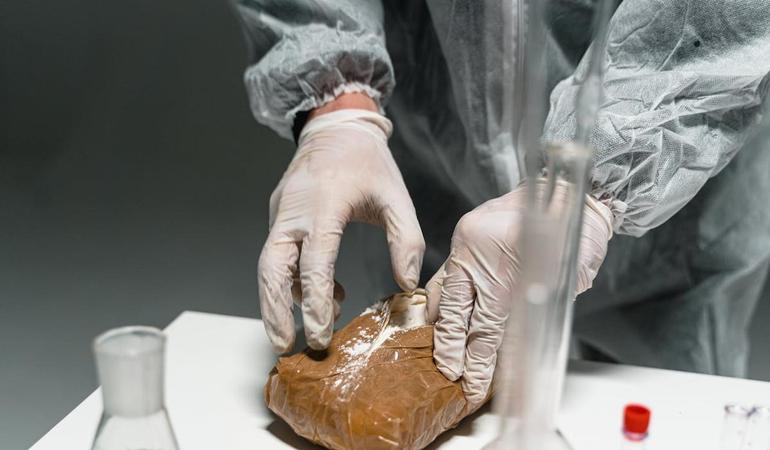
The cocaine refinery in Locride is not an episode, but an alarm that few understand
Cpr - Repatriation detention centers
Islands. Spaces of education and civil disobedience
Cpr - Repatriation detention centers
Islands. Spaces of education and civil disobedience
The cocaine refinery in Locride is not an episode, but an alarm that few understand
T he discovery of a coca laboratory in Sant'Agata del Bianco (Reggio Calabria) demonstrates a qualitative leap in national drug trafficking. In Calabria not only is white powder imported, but it is also produced
Anna Sergi Professor of sociology of law and deviance, Alma Mater Studiorum of Bologna
Finding a cocaine refinery in the Italian countryside is undoubtedly news, the kind that sometimes ends up on the front page of the news. But since it happens in Calabria, only those attentive journalists from local newspapers really deal with it, who often find themselves (even more so when it comes to the 'ndrangheta), for the sake of the record and public interest, covering what the national press does not cover except with articles from news agencies. In general, the mafia only makes news when it comes to Matteo Messina Denaro's treasures or women. In Calabria it's not news unless it's about big numbers and big scandals, not even when it comes to a certain organized crime or some of its developments. This news, that is, that in Calabria cocaine is produced - not just imported - and that therefore there has been an enormous leap in quality and danger in national drug trafficking, seems to concern few.
Vincenzo Pasquino, the Turin narcos who united Calabria and South America
In Locride, a laboratory used as a cocaine refinery
“The investigative activities (...) made it possible, in the early hours of 14 February 2026, to find, within the countryside of Locride, in the municipality of Bianco, a real laboratory used as a cocaine refinery, as is unequivocally clear from the material used for the production, cutting and drying of the substance, from the hydraulic presses for the formation of the blocks, moulds, gas stoves, microwave ovens, lamps, ladles, acid citric acid, packing and packaging material and scales seized".
This is an operation coordinated by the Carabinieri of Civitavecchia for the District Anti-Mafia Directorate of Rome: twelve subjects investigated, four arrested, including three from Colombia, two from the Dominican Republic and the others from Campania and Lazio. But no Calabrian. This should be surprising, but it doesn't seem to be fully registered.
Two individuals are accused of being South American cocaine brokers. One, Dominican, "responsible for contacts with national and foreign suppliers, for the logistical organization of transport and for the management of financial flows, also through the use of cryptocurrency exchange platforms, as well as the main link between the association and Calabrian drug traffickers"; the other, Colombian, "called the 'president', making use of his own compatriots (...), manages the couriers, deliveries and price lists".
Following a frantic search in Pescara, intercepted by the authorities in Civitavecchia, of 200 kg of boric acid (which is used to increase the weight and volume of the narcotic substance giving it the crystalline appearance that distinguishes high quality cocaine, ed.), the Dominican subject and another were "surprised, in the middle of the night, intent, inside the aforementioned laboratory, tinkering with considerable quantities of what appeared to be cocaine paste, which, together with several blocks, also apparently of cocaine, vacuum-packed with a stamp (for a total of 518 kg), was subjected to seizure".
Rocco Morabito, the rise and fall of Africo's Escobar
Drug trafficking in Calabria, but without Calabrians or 'Ndrangheta?
So, in summary, until February 2026, a South American criminal organization, in cahoots with a drug distribution group in Lazio, operates a cocaine refinery in Aspromonte, to be precise in Sant'Agata del Bianco.
But not only are there no Calabrians among those arrested, but there does not even appear to be any mention in the detention decree of who the Calabrians involved are: 'Calabrian suppliers', other 'powerful Calabrians', from the same areas as a subject of Calabrian origins from the Roman group are mentioned. But - as often happens to authorities around the world - the term 'Calabrian' is used to sloppily indicate someone involved in the criminal ring when it is not possible to be more precise. Because obviously, in Sant'Agata del Bianco, everyone expects the 'Ndrangheta to be involved. Locride, and Bianco specifically, are lands of ancient mafia, of families that have made the history of the Calabrian criminal organization. It is unthinkable for anyone that there is a cocaine refinery in Locride and some clan is not involved, perhaps more than one. But the 'Ndrangheta is not talked about in this investigation, it is not even mentioned. So what happens?
The Sanctuary of Polsi, in Calabria, must defend itself from the past and abandonment
Drug trafficking and the 'ndrangheta are not always the same thing
And here comes the crucial point for the analysis. On the one hand there is a narrative that has become mainstream which sees the 'Ndrangheta as an immutable conservative force that controls every inch of life in Calabria, especially in your longest-lived territories, such as Locride. For this narrative, the South American-run Sant'Agata del Bianco refinery does not fall within the narrative of the 'Ndrangheta unless it is said that the ranks of the whole are driven by the local clans. But that doesn't seem to be the case, because if that were the case, the investigation would have revealed a clan or two.
On the other hand, there is a reality that is becoming increasingly complex to decipher, but which shows some reluctance and resistance to the 'ndrangheta-catch-all narrative. In this second perspective, a non-negligible aspect seems to emerge that changes everything: drug trafficking and the 'Ndrangheta are not always the same thing, not even in Calabria. The 'Ndrangheta does not only do drug trafficking, and drug trafficking is not just the 'Ndrangheta.
Discover our magazine!
Investigations, interviews, data, columns: because knowing is a right, remaining silent is a choice. On paper and digital
A business strategy?
From this perspective, the story of the Sant'Agata del Bianco refinery becomes even darker. If it is plausible to imagine a sort of lordship paid by the South Americans-Lazio to the local clans (because it is unlikely that there was no placet, due to issues of control of the territory), it is also plausible to imagine that this lordship is not accompanied by mafia protection and that, above all, it is not associated with joint operations between clans and traffickers. To put it another way, for a group based in Lazio, going to Locride to invest in a refinery makes strategic sense: in addition to geographical isolation, there you are in the heart of the 'Ndrangheta power, there are contacts, possible alliances, the port of Gioia Tauro.
Antwerp and Gioia Tauro, the drug traffickers' deals come to fruition
But there are also risks, as one of the group says, if they find you 'with the Calabrians' "that's a criminal association, they give you the 41bis and you get twenty years" to underline the risk of exposure to anti-mafia investigations (different from drug trafficking investigations). Calabria is a desperate land, one more or less police operation is more likely to be lost in the multitude of investigations and still be attributed to the 'Ndrangheta.
For the 'ndrangheta there are advantages if others set up a business: the local bosses, without lifting a finger but simply giving permission, still earn something and remain sovereign of the territory. They cannot offer protection because perhaps they don't ask for it and because sometimes they can't: the experience at the port of Gioia Tauro teaches us this where for years now the sovereignty of the clans of the Piana has been exercised without protection, but only as they allow it to pass. The lordship therefore does not make this a business of the 'ndrangheta, otherwise the absence of 'specific' Calabrians in the investigation would not be explained, nor the entrusting of the refinery to subjects who let themselves be discovered because they are frenetic in the search for materials, not exactly reliable. It remains probable that the relationships with the 'Calabrians' to which the South American-Lazio group refers are of varied and non-homogeneous affiliation, as is now the case with drug trafficking in Calabria, never under a single direction.
The local transformation of cocaine, a shocking leap
In addition to clashing with the narrative of the 'ndrangheta 'world wide mafia', omnipresent and omnipotent, this analysis gives us two final thoughts.
One, the profit here is enormous and difficult to estimate with precision, but the interceptions offer an illuminating glimpse: the Colombian "president" explains that by purchasing a kilogram of "raw" cocaine at €16,500 and transforming it into a "cooked" product it is possible to resell it for €20,500, with a profit of €4,000 per kilogram. Multiplied by the 518 kg seized in the Sant'Agata del Bianco refinery, we are talking about over two million euros in potential earnings from a single operation. And this is just one refinery discovered, in just one moment. The business of local cocaine processing represents a shocking economic and strategic leap.
And two, there is something even more disturbing that should alarm everyone but instead has gone completely unnoticed. If Calabria becomes a producer of cocaine - that is, if in addition to importing the finished substance it now also imports coca paste to refine it on the territory - the possible damage for the region and the nation is of a level of danger never seen before. Colombia teaches what it means to become a land of production: endemic violence linked to the control of refineries, widespread infiltration of institutions to protect the plants, environmental devastation caused by the chemical products used in the refining process, and above all the transformation of the territory into an area contested between criminal groups for the control of a business with stratospheric margins, for a poor and marginal land.
Local production means permanent rooting and militarization of crime, it means that Calabria is no longer just a transit or sorting point but the beating heart of an industry that generates billions. And all this is happening while the national press looks elsewhere and the public narrative remains anchored to patterns that are no longer able to read reality. The Sant'Agata del Bianco refinery is not an episode: it is an alarm signal that few seem to want to listen to about how drug trafficking changes not only the region, but also its mafia.