
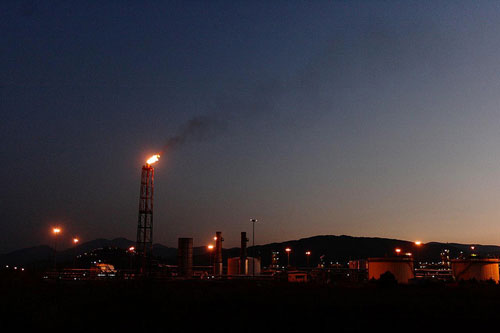
Basilicata Oil to Oil. The great industry made in Italy
Basilicata Oil to Oil. The great industry made in Italy
[by Luigi Politano*] from www.lavocedinewyork.com
The anti-mafia enters the entirely made in Italy heart of Eni, that of the southern district in the Basilicata region. The oil center of Viggiano.
According to investigators, the Italian oil giant illegally disposed of the waste produced, thanks to the complicity of local companies. In the investigation conducted by the NOE (Carabinieri Ecological Operational Unit), eleven warning notices were issued, in Italy and abroad, for waste trafficking. The news finds little space in Italian newspapers, except for a few local press and a few attentive journalists.
Among those under investigation, the names of Ruggero Gheller, Eni's southern district manager, stand out. Michele Somma, president of Confindustria Basilicata and among the notables of the Lucanian "rubbish".
Also investigated together with Michele is his father, Faustino Somma, born in 1935, at the top of Tecnoparco Valbasento spa, a company which according to prosecutors did not adequately treat the waste liquids produced by Eni before being disposed of.
Also under investigation is Massimo Orlandi, former CEO of Sorgenia - the energy company of the De Benedetti group - still in office in 2010, when the investigations began.
And then there is also a local entrepreneur, Giovanni Castellano, who has an arrest in his CV, at the end of 2012, for illegal waste disposal.
The affair, which may appear to be a small case of provincial "judicial" matters, should increase the attention of national public and political opinion on what has been happening for years in Basilicata. And not only because "in the province" those who are also being investigated are local leaders of Eni and the former CEO of Sorgenia.
Leaving aside the detailed account of the events for a moment, waiting for the investigators to do their job, the reasoning must be moved to an only apparently different issue.
The largest onshore oil field in Europe flows beneath Lucania. Italy, through the oil produced on national territory, covers approximately 6-7% of its energy needs. Most of this oil comes from Val d'Agri, where Eni and Shell do excellent business under the careless lens of local administrations which, on an almost fixed deadline, find themselves faced with investigations resulting mostly from omitted controls and attempted corruption.
Many have ended up in the files of the investigations of recent years - many of which have fallen to naught (especially those involving politicians), some still ongoing. From the former president of the Region, Vito De Filippo, to the CEO of Total Italia, Lionel Levha. Contracts for the construction of structures, maintenance, transport, disposal of waste resulting from oil and gas... Everything is finished under the eyes of the investigators, but it seems that nothing or almost nothing has moved. There is only the prevailing doubt of the way in which waste (not just oil waste) is disposed of in the various areas of Basilicata, devastating the territory. It goes without saying that the proximity to Campania and Calabria, the enormous amount of money that moves in this region - only apparently a no-man's land - and the industrial waste business, have caused some lights to be lit in the direction of the 'Ndrangheta and the Camorra, but this does not appear to be the case and this is a story that we will leave aside for now.
We were talking about politics and industry in the Southern Region. For now there seems to be no trace of politicians in this investigation, but far too many political responsibilities. The right to royalties deriving from the extraction (of gas and oil) brings a huge amount of wealth to a territory which, according to Istat data, is extremely poor. Basilicata continues to have the highest unemployment rate ever, remaining the poorest region in Italy, from the point of view of per capita income.
Since 2008, however, according to data from the Ministry of Economic Development, more than 760 million euros have arrived, which in a region with half a million inhabitants should be a truly substantial figure. What was done with this money?
The budget holes made by an incapable political class have been plugged, which then has to choose whether and how to control the same extractive activity that brings them that money. And not only thanks to royalties, but also thanks to related contracts, a small economy in itself that feeds a substantial pool of votes to be protected and kept under control at all costs. And as we know, electoral consensus is always important. Maybe something doesn't add up. Who controls who, and above all how, is always the most interesting topic of the "large industry made in Italy" topic.
There is no point in thinking about public health and environmental protection. Topics considered by time wasters who do not look at the concrete aspects of work and the needs for necessary progress. It's a shame that there is no trace of work and progress in Basilicata despite this enormous wealth. Not a single euro has ever been adequately allocated to decently resurrect the economy of a Region that could be very rich and that could create other jobs thanks to its territory and to the research and development activities that the young residents who have recently graduated could do but who eventually leave. But we are talking about real investments, not spot ones for starting up businesses that will never last.
There are many proclamations, just as there are many floods of funding in view of the electoral rounds. The proof is that last year Basilicata was downgraded again, by Brussels, to a convergence objective area (the former objective one, the one for underdeveloped areas). And the serious thing is that some could define the downgrading as a "political strategy", without understanding what the potential European funds are for and how they will be invested, in addition to those of oil and gas. Clients aside, of course. Not to mention the need to reclaim some portions of territory contaminated by industries and waste disposal scattered across the entire nation. But this is not a priority of Italian politics, nor is organized crime which produces billions of euros, robbing the community, also thanks to the illicit disposal of waste.
This is just the umpteenth investigation in which the Italian industrial system that we cannot leave behind comes to light, based on profits at all costs and no control. To the detriment of work, health and the economic and social return for the people who live around those industrial areas. The petrochemical plant in Porto Marghera and Ilva in Taranto are a clear example.
Of course, these are obvious platitudes. This is why the newspapers in Italy don't talk about it.
* Luigi Politano – anti-mafia association from the South. Journalist. Founder of Round Robin publishing, he is also responsible for current affairs and investigative publications. Winner of the 2010 Siani award, today he works as a freelancer for TV and the web. @lupolitano