
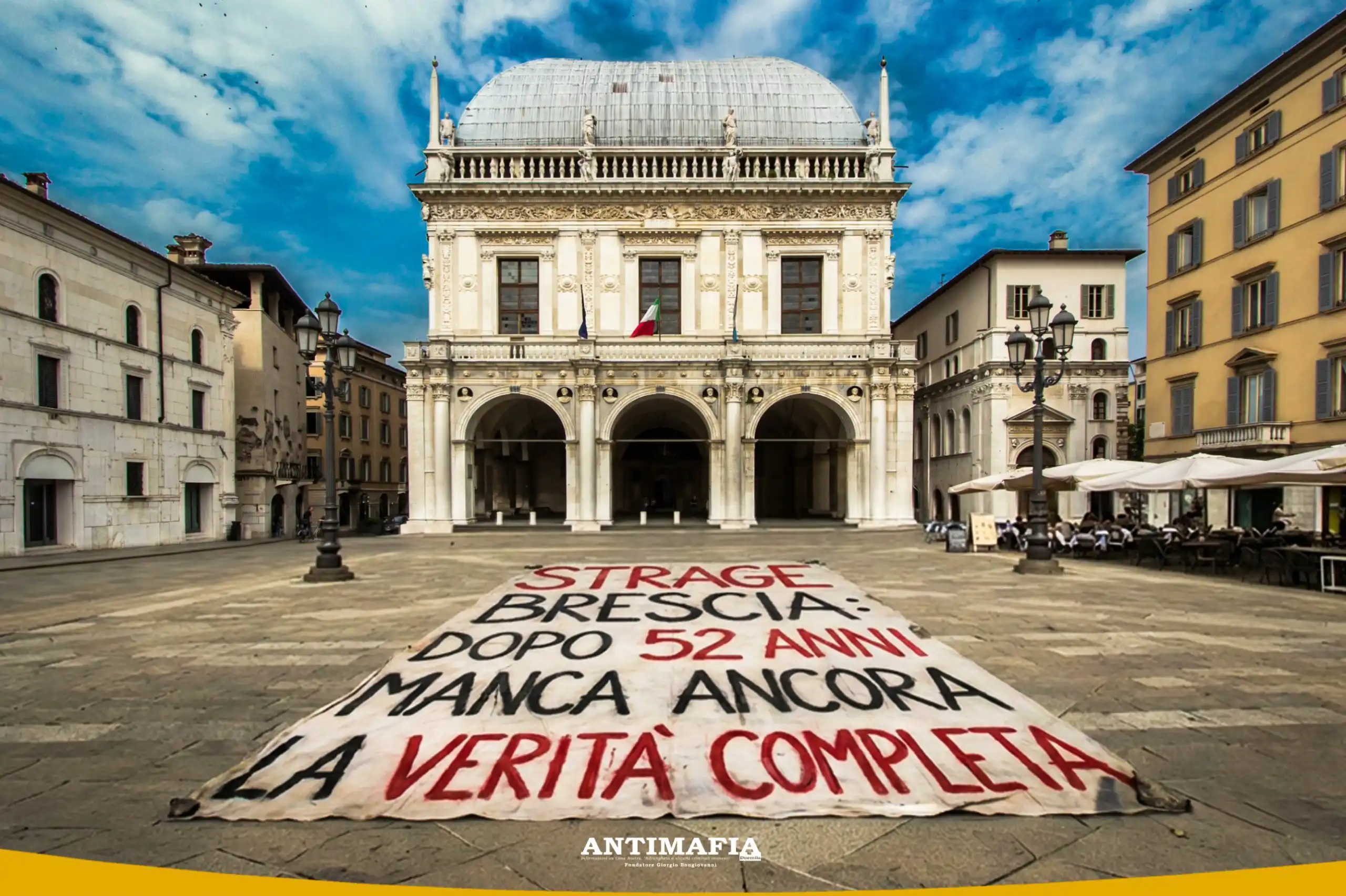
Brescia massacre: fascists, NATO and secret services. The massacres among the state apparatus
Brescia massacre: fascists, NATO and secret services. The massacres among the state apparatus
A black (and American) massacre on Italian territory, in other words the Piazza della Loggia massacre on May 28, 1974. At 2 minutes past 10 a bomb exploded during a demonstration promoted by the Permanent Anti-Fascist Committee at the same time as the general strike called by the unions. The bomb, hidden in a waste bin and containing at least one kilogram of explosives, exploded two minutes after the speech began. Eight victims: Luigi Pinto, Giulietta Banzi Bazoli, Livia Bottardi, Alberto Trebeschi, Clementina Calzari Trebeschi, Euplo Natali, Bartolomeo Talenti, Vittorio Zambarda. One hundred and two other people were injured. From that moment on, 17 trials followed one another, one of which is still ongoing. For now, however, there are three condemned people (one of which is not yet definitive): on 20 June 2017 Maurizio Tramonte, the 'Triton source', considered by the judges to be a former infiltrator of the secret services and member of 'Ordine Nuovo' was definitively sentenced to life imprisonment for complicity in the massacre; with him Carlo Maria Maggi, who died on 26 December 2018, believed to be the 'director' of the attack and head of Ordine Nuovo in the Triveneto area. It was Tramonte, according to the judges, who inspired a report from Sid, the military secret service, in which it was said that in 1974 there had been meetings in which Ordine Nuovo, dissolved the previous year, had decided to clandestinely resume its activities, including meetings. One of these occurred in Abano Terme three days before the attack and from the documents it appears that Maggi told his comrades that it was necessary to continue the massacre strategy begun on 12 December 1969 in Piazza Fontana. In another meeting he explained that the Brescia massacre should not have remained "isolated" but be followed by "other large-scale terrorist actions to be carried out in the short term" to open "an internal conflict that can only be resolved with armed conflict". In the Milanese sentence signed by judge Anna Conforti and reaffirmed by the Court of Cassation we read: "Certain proof emerges from the procedural documents of behavior attributable to the territorial leaders of the Carabinieri and to senior officials of the secret services". So there weren't just 'blacks' in that May of 1974.
For now, there are two trials still open: the one against Marco Toffaloni, now a Swiss citizen (alias Franco Maria Muller), and sentenced in the first instance to thirty years for being one of the perpetrators, he allegedly put the bomb in the bin; and then there is Roberto Zorzi, resident in America where he runs a dog kennel called 'Il Littorio'. Until the hearing on March 20th, Zorzi had an untouched alibi: on the same day as the massacre, the former Ordinovist said that he was in the bar-ticket office of the trolleybus station in Via Mameli in Verona. A circumstance later confirmed in a report dated 7 August 1974 by the then Carabinieri captain Francesco Delfino. This reconstruction was denied 50 years later by the daughter of the Veronese bartender Daniela Bellaro who was heard as a witness in the new trial for the massacre before the Court of Assizes. Toffaloni, we read in the sentence, is described as "a tough, determined comrade, tending to impose himself, capable of using physical violence against things and people, deeply convinced of the Nazi-fascist ideology and its superiority". And it would have been him, based on what Nicola Guarino Lo Bianco said in the hearing on October 30, who would have wanted to raise the bar, to carry out more sensational actions against the communists. Both belonging to the far-right political formation known as 'Ordine Nuovo'. Some former members of this group (such as Stefano Russo and Claudio Lodi) were heard before the Court, confirming the prosecutor's thesis: Russo said that he had decided to distance himself from the comrades because "I began to have strong suspicions that we were being manipulated by the American services". No further details, however, "just an inkling". However, there would be elements: according to what he said, he would have met, while he was in Ordine Nuovo, the Italian army officer Amos Spiazzi of Corte Regia, the man who had the Gladio in his hands in the North, as well as a coup plotter; it was he who was sent on 8 December 1970 to Sesto San Giovanni, during the attempted Borghese coup, to repress workers' resistance. According to Russo, Amos Spiazzi was a "figure that I saw as collateral to Ordine Nuovo": "I was at his house, together with Bosio, among other things, to see his collection of weapons. With Amos we were one day in the Montorio barracks, I think, and we went to the hills of Montorio to shoot with various weapons, and I remember that he brought these cassettes of the famous M shots, which were the failed shots during the exercises, which were then practically eliminated. Then they were put back into arms: 9 out of 10 were shooting." In addition to the cumbersome presence of a coup plotter in uniform, there is also the thorny issue of Gladio and the hidden weapons depots, called Nasco. Mario Bosio, another ordinovist from Verona, had indicated to Russo a point where "there would have been a Nasco, a pit" in which there were "bundles of weapons protected by grease to prevent them from rusting or spoiling, and that these are places where these weapons are hidden waiting to be used" in case of "the hypothetical invasion by the Warsaw Pact". "I believe that the training of the Ordinovists was done by the Americans and depended on the FTASE (Command of the Allied Land Forces of Southern Europe ed.) of Verona", said the former commander of the Carabinieri of the ROS Massimo Giraudo during the hearings.
A massacre marked 'NATO'
The magistrates of Brescia, Silvio Bonfigli, protagonist of the investigation which lasted almost a decade together with his colleague Caty Bressanelli, investigated until they touched the Alliance's threads. From the 280 thousand pages filed by the Prosecutor's Office, it emerges that the investigative trail leads to Palazzo Carli in Verona: after the Second World War it first became the headquarters of the Command of the NATO military forces, and then the headquarters of the COMFOTER Land Operational Forces Command of the Italian Army. In this structure, according to investigators, there were preparatory meetings for a massacre project that aimed to subvert Italian democracy. All with the cover of Italian and American paratrooper generals. In addition to this, there is no shortage of references to the secret services. The state police, at the time still the 'Public Security Service', had among its informants "people from Ordine Nuovo", such as Marcello Soffiati (died in 1988), the "courier" of the explosive from Piazza della Loggia, indicated as the one who transported the bomb from Mestre to Brescia. Soffiati, said Giordano Fainelli, then deputy head of the political police of Verona and now retired commissioner, during the hearing on 2 December for the Piazza della Loggia massacre, had contacts with the Americans and "certainly knew 'Bandoli' at the time, who was officially a driving instructor for the Americans. He was a person from Verona who gravitated towards that right-wing sphere. Marcello Soffiati's restaurant, in Colognolo Ai Colli, was also known, because people from Venice. Everyone from that area”. The Carabinieri and the secret services also had extremely close relations. Giraudo declared in the hearing on 16 December that the members of a center of the SID (in the case in question that of Verona), Defense Information Service, therefore our military intelligence of the time, "were essentially, almost entirely, members of the Carabinieri. This is the reason why those who attempted to carry out coups d'état in Italy turned to us, because we governed the only military police and governed the intelligence. To give you an example, at the time of the Piazza massacre Fontana, in 1969, the Milan counter-espionage center, which had around 60 elements, had only one element who did not belong to the Carabinieri".
Ombretta Giacomazzi and the photos portraying Silvio Ferrari and General Delfino
The central witness for the prosecution is Ombretta Giacomazzi: she was only 17 years old at the time of the events and was the girlfriend of Silvio Ferrari, an exponent of right-wing extremism and confidant of the police. Ferrari was killed in Brescia on 19 May 1974, nine days before the massacre, due to the early explosion of the bomb he was carrying on board his Vespa. In her depositions in the courtroom before the Court of Assizes, the woman reported having suffered heavy pressure, threats and attempts at misdirection inside the Parona barracks in Verona by the investigators and, specifically, by the then Carabinieri captain Francesco Delfino. Between the death of Silvio Ferrari and the massacre, the witness declared that he saw the Veronese people again in the pizzeria that his parents were managing at the time on the day of Silvio's funeral and also between 23 and 24 May, a few days before the attack in Piazza della Loggia: "That famous afternoon where they come, all of them, and talk about avenging Silvio". There were "Toffoloni, Paolo Silviotti, Zorzi", "Nando Ferrari and Arturo Gussago". "They are very close. At two tables, also because otherwise they wouldn't fit, but very close"; and they remained "three quarters of an hour, an hour, no more". Roberto Zorzi (today's defendant) on that occasion said: "What he didn't do, we will do", referring to Silvio Ferrari, who was blown up on the evening of May 19th in Piazza Mercato due to a bomb that exploded while he was transporting her on a Vespa to the Blue Note club. Furthermore, during the hearings Giacomazzi spoke about some photographs that portrayed the Dauphin together with subjects linked to the far right, including Marco Toffaloni. The person who took these photographs during the meetings in the Parona barracks was apparently Rizziero Ziliani (often also written Ziliano or Zigliani in reports) was a neo-fascist from Brescia active especially in the early 1970s, known in far-right circles as a "beater". Ziliano took secret photos during the meetings probably on behalf of Silvio Ferrari "because in Parona, in this barracks, there was a... it's as if... that is, in the back, in the back there was a window and the meetings were held in the basement", the witness had said.
Carabinieri and Delfino in Silvio Ferrari's apartment
The two hung out: "We met a few afternoons, before going to the pizzeria. He had a small apartment in Via Aleardi, and we met there" he said. "I vaguely remember it, however, it was very small, it was on the top floor of this condominium, it was accessed by stairs, I don't remember at all if there was a lift, perhaps not, there were two rooms plus a processing room which could have been a kind of small kitchen, kitchen intended as just for making a coffee, that is to say". "There were a lot of people" in that apartment, he added, "I found out later that they were carabinieri because they were always all in plain clothes and therefore they were older than us and me and Silvio and yet I saw them again little by little in the aftermath, that is when I started to search myself, when they took me to prison, they were always the same". With visitors to the house, sometimes, "we exchanged envelopes, large envelopes or envelopes probably with documents inside which I then saw, I didn't see them, the photographs I then saw and yes sometimes it's true there was also money in the envelope which however Silvio opened when he came back to me." Photographs which depicted "a bit of everything, soldiers, civilians who took lessons from paratroopers". "But I think I also saw many sheets of paper, documents with the stamp of the Carabinieri." Even the former General Francesco Delfino came to that apartment, "he probably came without a hat, with his uniform". We have arrived 52 years after the massacre, many truths have been ascertained, but one towers above all and it was said by the public prosecutor Silvio Bonfigli: "If everyone had done their duty in August 1974, this would have been a solved case".
Piazza della Loggia massacre: pressure from Gen. Dolphin on the Giacomazzi super witness
Brescia massacre, Bosio witnesses: Ordine Nuovo weapons supplied by the underworld and diverted to Gladio
Giacomazzi: Delfino wanted to reassure Mori that I didn't talk about the activities of the force
Brescia massacre: Mario Mori denies any contact with Giacomazzi and Francesco Delfino
Brescia massacre, the witness Nicola Lo Bianco: Toffaloni wanted to raise the bar against the communists
Brescia massacre: 007 Americans, Gladio and Ordine Nuovo. The former Ordinovists speak
Brescia massacre, reasons for the Toffaloni sentence: ''Hardly restrained, capable of using violence''
Brescia massacre: black subversion is to blame, but also secret services and NATO
Piazza della Loggia massacre, Giraudo: Ordinovists trained by the Americans
Piazza della Loggia massacre: witness Daniela Bellaro denies Zorzi's alibi
Piazza della Loggia massacre: Marco Toffaloni sentenced to 30 years as perpetrator
Piazza della Loggia massacre, Giraudo: ''Consistency of omission in police and carabinieri acts''
Brescia massacre: Marchetti rejects Stimamiglio's accusation of being one of the perpetrators
Brescia massacre, Stimamiglio witnesses: there were four in the square. Bomb placed by Marchetti Graphic processing by Paolo Bassani