
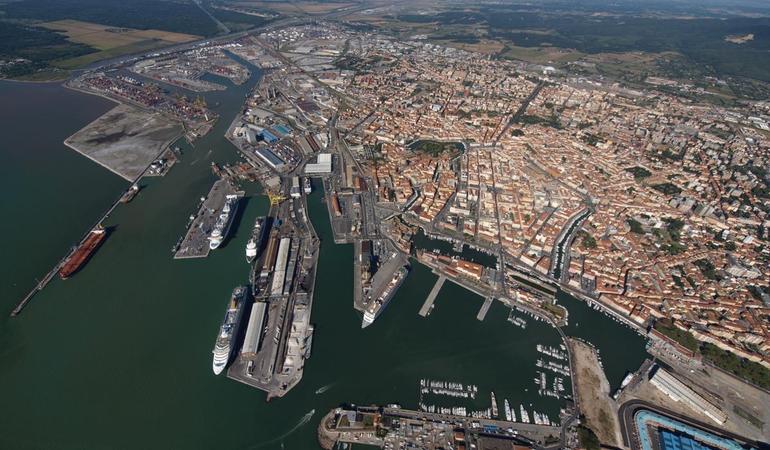
Criminal incidents are increasing in Italian ports. Focus on Livorno, an increasingly crossroads for traffic
Cpr - Repatriation detention centers
Islands. Spaces of education and civil disobedience
Cpr - Repatriation detention centers
Islands. Spaces of education and civil disobedience
Criminal incidents are increasing in Italian ports. Focus on Livorno, an increasingly crossroads for traffic
I n the third edition of "Logbook", Libera's report on illicit activities in Italian seaports, there is an increase in criminal episodes on the piers: illicit imports and exports, smuggling, drug trafficking and cases of corruption. Focus on the cases of Livorno, Santos (Brazil) and Marseille (France)
Lavialibera editorial team
"Ports are one of the main access points for illicit trafficking, starting from drug trafficking, but also for counterfeiting, smuggling, money laundering. Not only that. They are places where forms of corruption occur, where relevant economic and political games are played, where relationships and powers are built. This is why, in the wake of Libera's commitment, this work does not aim to criminalize, but to enlighten. It does not aim to stoke fears, but to build awareness". This was declared by Francesca Rispoli, national co-president of Libera, presenting the third edition of Diario di Bordo. Stories, data and mechanisms of criminal projections in Italian ports and beyond, edited by her together with Marco Antonelli and Peppe Ruggiero.
The study (available at this address), carried out starting from the Assoporti press review and various institutional reports, records a growth in crime incidents occurring in Italian ports of 14 percent compared to 2024 (131 cases occurred in 2025) and an increase in the maritime ports involved (from 30 in 2024 to 38 in 2025). Between 1994 and 2024, 113 clans active in illegal and legal activities were registered in 71 Italian ports. The report, however, also focuses on the situation in Livorno and - through some interviews with Brazilian and French magistrates - delves into two international cases, such as the port of Santos, in Brazil, from which large quantities of cocaine depart towards Europe, and that of Marseille, a city marked in recent years by the violence of drug traffickers.
Ports, illicit trafficking and mafia affairs
Ports and illicit trafficking
The highest number of criminal cases is recorded in the port of Civitavecchia, with 14 criminal incidents compared to the four recorded in 2024. This is followed by the ports of Ancona and Gioia Tauro with thirteen cases each and Genoa with 12 cases. At a regional level, Marche is the reason for the most episodes (16), followed by Calabria, Lazio, Sardinia and Liguria (15 each), while Puglia and Sicily stand at 14. The order changes if a broader period is evaluated: in this case, Genoa is the port where the most cases were discovered, followed by Livorno and Ancona, and at a regional level, Liguria is the region in which the highest share is concentrated (approximately 16%) of criminal events, followed by Sicily and Campania.
The majority of cases (56%) involve illegal activities in the importation of goods or products, while 10 percent involve illegal exports. If we take into consideration only illegal businesses, drug trafficking represents the most recurring case, with 40 events (approximately 31.5% of the total), followed by trafficking in counterfeit products, with 34 cases (26.8%) and smuggling, which accounts for 29 events (approximately 22%).
The hands of the mafias on the ports of Italy
Between 2018 and 2024, 45 episodes of corruption reportedly occurred in the port system authorities. The data emerges from the analysis of the reports of those responsible for transparency and prevention of corruption published on the websites of all sixteen port system authorities. The monitoring therefore involved 16 public bodies over a period of eight years, for matters such as contracts, concessions, inspections and more. However, this is partial data, which only concerns the cases of employees, managers or political leaders of the authorities and does not include those, in the public or private sector, who work inside the airports.
"Where there is opacity, where there is a lack of transparency and control, the mafias find space - adds Rispoli -. This work tells us that the response cannot only be repressive. A broader strategy is needed: more transparency in decision-making processes, more tools for preventing corruption, more international cooperation, more training and protection for those who work in ports. And above all we need a culture of legality that involves institutions, economic operators and citizens. Shedding light, today, means taking on a collective responsibility. This is the meaning of the Diary on board: transforming data and analysis into awareness, and awareness into commitment so that ports are no longer opaque spaces, but places lived according to legality, rights and justice".
Moles of coke. Drug traffickers increasingly strong in Northern European ports
Headlights focused on Livorno
In this edition of Logbook, an in-depth analysis is dedicated to the port of Livorno, among the very first commercial ports in Italy. “From the beginning of the 2000s until the end of 2025, a prevalence of the use of the Labronica port for the conduct of illicit trafficking seems to emerge,” explains Libera. In particular, it seems to have become a crossroads for drug trafficking: from 2011 to 2024, 7,818 kg of cocaine were seized, equal to 74 percent of the total seized throughout Tuscany. In 2020 it was the scene of the largest seizure of the year and one of the largest in recent decades (around 3,300 kg of cocaine), and it was the second port of call, behind Gioia Tauro, for the total amount of cocaine intercepted over the calendar year.
"The port of Livorno - comments Rispoli - has become, over time, a central node in national and international criminal dynamics, particularly in the international cocaine market. The analysis of institutional and judicial sources shows a port used not only as a point of arrival, but also as a space for transit and operational experimentation. Flexible transnational criminal networks emerge, capable of adapting to the opportunities offered by port logistics and intertwining with segments of the legal supply chain. At the center of these dynamics is access to space port, the role of intermediaries and the professionalization of recovery teams".
Drug trafficking, "more than 98% of the proceeds are not traced", says Dutch prosecutor Lucas
The report highlights one of the most influential aspects, namely "the growing internationalisation, which concerns both trafficking and the composition of the actors involved": around the port of Livorno there are both men linked to the 'ndrangheta, contacts for the organization of imports from South America, and Albanian groups active in operational coordination and recovery functions of the goods. "The cocaine trafficking that passes through Livorno does not in fact appear as a homogeneous phenomenon, nor attributable to a single operational model – is Libera's analysis –. The routes of origin, the types of goods used as cover, the concealment techniques and the quantities moved vary significantly, adapting from time to time to the logistical conditions, the resources available and the degree of perceived control. This plurality of methods corresponds to a multiplicity of actors involved, located along a chain that intertwines legal and criminal segments, and which requires differentiated skills in each phase of traffic".
Discover our magazine!
Investigations, interviews, data, columns: because knowing is a right, remaining silent is a choice. On paper and digital
"The results of the research suggest that prevention and contrast policies cannot be limited to a specific control of the port space, but must take into account the entire route of goods and the vulnerabilities that arise along the interface between the port, the backport and the global logistics chain - we read in the report -. In conclusion, the port does not appear only as a place of transit of goods, but as a social and institutional space in which vulnerability, responsibility and possibilities for intervention are concentrated. Understanding these dynamics therefore becomes a necessary step to strengthen prevention and contrast strategies that are up to the complexity of contemporary traffic".
During the presentation in Florence, Giulia Bartolini, representative of Libera Toscana, stated that "the institutions and the police forces must continue to investigate, they must continue to do the work they are doing. Tuscany is not a land of the mafia but it is a land where the mafia makes its investments. The data on Livorno tell us that there are corruption phenomena within the port authorities and those who work within the port". The vice-president of the Tuscany Region Bintou Mia Diop added that "the problem of the port of Livorno affects all port places, which can be fertile ground for criminal organisations".