
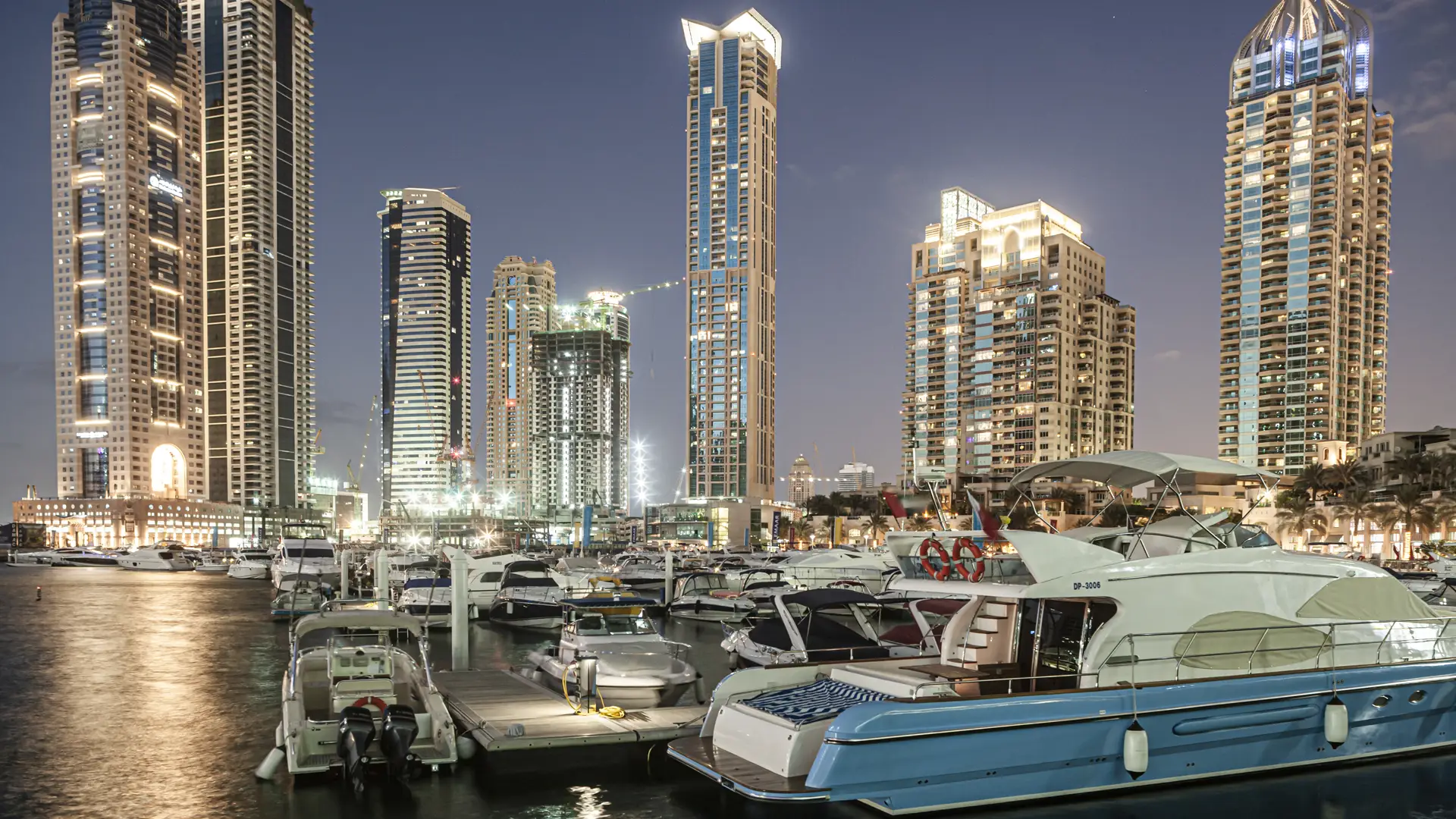
Dubai, the fragile paradise of the gods of Albanian drug trafficking
Dubai, the fragile paradise of the gods of Albanian drug trafficking
In Dubai, in the United Arab Emirates, it appears that four million euros are needed to bribe a judge. Denis Matoshi, one of the most important cocaine traffickers that Albanian crime has at its disposal, paid them to be released from an Emirati prison, according to what emerged from the investigations.
Matoshi - a broker capable of managing loads of up to four thousand kilos of cocaine, considered by other traffickers to be "number one" in the sector - was arrested in Dubai in September 2020, as a wanted man in Italy. The Florence prosecutor's office, in fact, considers him "a top element in the global drug trafficking of Albanian crime". In prison in the emirate, however, Matoshi did not stay there long: after a year he was released, formally due to the expiry of the deadline within which Italy had to submit a request for extradition.
In reality, as shown by two investigations by the Reggio Calabria prosecutor's office and the German police, his release, dating back to 2021, "would be the result of corruption amounting to four million euros". In the documents there is a secret, which remains unpublished, made in an encrypted chat to a Calabrian trafficker by an Albanian resident in Dubai: Matoshi, explains the compatriot, has "320 million euros" in the emirate's banks, and has made a "contract with the State", paying "four million" to be freed and not be handed over to the Italian authorities.
The investigation in brief
Some of the main drug traffickers of the Albanian crime scene – who have been investigated or convicted in Italy – have real estate investments in Dubai. The Emirati city is "the wonderland of international recycling", says an Italian investigator
Dubai is also a city of paradoxes. It enjoys a reputation as a crime-free place but offers protection to dirty capital and drug traffickers. It has among its residents many international fugitives, despite the fact that between 2020 and 2022 the local police extradited 450 of them. The paradise for fugitives has begun to creak. Not for everyone, however: extraditing rich criminals who invest their capital is a question of political will and in Dubai the judiciary is not autonomous
Eldi Dizdari, alias Denis Matoshi, is an Albanian drug trafficker capable of moving loads of four thousand kilos of cocaine. IrpiMedia has discovered that since 2019 it has been investing in luxury properties in Dubai and in 2021 it paid four million to the Emirati authorities to avoid being handed over to Italy
Arben Zogu in Italy trafficked with the Lazio narco-ultra "Diabolik" Piscitelli. Two weeks after being expelled from Italy, at the end of his sentence, he obtained a visa for Dubai. Pioneer of Albanian crime in Rome, Zogu was joined in the emirate by his cousin Dorian Petoku, to whom the leadership of the Roman organization had passed during his imprisonment
Artur Hoxhosmani, arrested in Albania in 2025, was investigated for his drug trafficking network in Lombardy. He has had a residence permit in the Emirates since 2020 and has invested around eight million euros in apartments in Dubai
Renato Muska and his cousin Altin Sinomati are considered "highly capable" drug traffickers. The first has several properties in Dubai, including a villa in the exclusive Palm Jumeirah, while the second was arrested in Abu Dhabi, the capital of the Emirates, because he was accused of instigating a murder by the Rome prosecutor's office
The Emirati authorities have not extradited Matoshi for five years now. As a source familiar with the matter explains, technical times of a few years are normal, due to the complexity of these procedures. Much, however, in the federation of Emirati monarchies "depends on political will", adds the source: in Dubai the judicial power is not independent from the decisions of the authoritarian government of Mohammed Al Maktoum, sheikh of the emirate and vice-president of the Emirates.
If the idea passes that Dubai is too dangerous for criminals who come to invest large capital, its economy - which for decades has also benefited from the influx of dirty money - "loses its attractiveness".
An Italian investigator defines Dubai as "the wonderland of international money laundering": the perfect place to clean up the hundreds of millions resulting from drug trafficking, in a paradoxical coexistence with that rhetoric of the absence of crime and security on which Dubai has built its image - put to the test in recent weeks by the bombings by Iran.
Give the gift of membership to MyIrpi+ and receive our IrpiMedia T-shirt for free.
Become a source. With IrpiLeaks you can communicate with us safely.
Those investigating also recognize that Dubai is no longer the "paradise" it once was, thanks to some reforms to combat illicit financial flows and collaboration with the European authorities. The application of the rules, however, is once again a question of political will, and investing dirty money still remains too easy for criminals.
This is the case of Albanian organized crime, which in the last decade has assumed a prominent role in international cocaine trafficking. IrpiMedia and the Albanian newspaper Shteg have discovered that in Dubai, in recent years, Denis Matoshi has invested millions of euros in luxury villas and apartments. And other drug traffickers, investigated or convicted in Italy, of Albanian nationality have done the same.
Matoshi, the «ghost»
Since 2019, Denis Matoshi, born Eldi Dizdari, has poured millions of euros into Dubai real estate. When he was already wanted by the Florence prosecutor's office, he bought, for around three million euros, a villa of almost 950 square meters under construction in the exclusive community of Mbr City, a city within the city commissioned by the emir Mohammed Al Maktoum himself. Just two weeks after it was completed, Matoshi resold, it is not known to whom, the villa for an extra million euros. After his release, between 2022 and 2023 he sold three other properties on the artificial island of Bluewaters, and rented two luxury apartments for more than 10 thousand euros a month.
The lack of transparency of the Dubai government
Many of the real estate transactions analyzed in this article contain only the name and nationality of the owners. They come from an information leak shared by the C4ADS organization with the consortium of international newspapers of the #DubaiUnlocked project, of which IrpiMedia for Italy is part.
Further details of the transactions cannot be verified because – following the publication in 2024 of investigations into the real estate properties of criminals from around the world – the Dubai government has restricted public access to some sections of the land register.
In Italy, the first investigations into Matoshi date back to 2015. That summer the alleged trafficker - twenty-six years old at the time and still living in Tirana, Albania - had spent a few days at the Al Boschetto campsite in Condofuri Marina, in the province of Reggio Calabria. Here he met with a Colombian and some members of the Mammoliti and Pelle 'ndrine to agree, according to the police, on the supply of large consignments of drugs.
The investigations by the Florence prosecutor's office date back to the same period, which will lead to his arrest in Dubai. In 2016 an emissary of Kompania Bello - an international cartel of Albanian traffickers led by Dritan Rexhepi - had sought him out to do business. The negotiation, after a long distance "arm wrestling" between the two bosses, ended with the joint investment in a shipment of 600 kilos of cocaine departing from the port of Guayaquil, in Ecuador. Matoshi would have guaranteed that containers with cocaine arriving in Belgian or Dutch ports would not have undergone checks. «It was my dream to do a deal like this», commented the emissary to his boss Rexhepi.
Once the negotiation was over, Matoshi had become, according to the investigators, "a sort of ghost". He had in fact started using encrypted messaging systems - instead of the Blackberry phones that the authorities were able to intercept at the time - and investigators had lost track of him.
IrpiMedia and Shteg discovered that, already the following year, Matoshi had obtained a visa to enter the United Arab Emirates, converted into a residence permit and renewed until 2023, despite the extradition request. Those who can afford to move their residence to the Emirates have the advantage of not paying taxes, can travel almost anywhere in the world without the need for a visa, buy properties and open bank accounts with ease. However, UAE law provides that he can be expelled for reasons of "public interest" or "public security". In Matoshi's case it didn't happen.
Newsroom, IrpiMedia's weekly podcast
Newsroom episodes are available on IrpiMedia's Spotify channel.
Matoshi and Rexhepi were considered by the Florence Anti-Mafia District Directorate to be part of a "cartel" of "Albanian associations" active in the cocaine supply chain, from supply in South America to distribution in Italy. The "federation" hypothesis was rejected by the judge but Rexhepi was still sentenced to twenty years with an abbreviated sentence.
In 2024, the Albanian special prosecutor's office against organized crime and corruption (Spak) confiscated from Matoshi - on the basis of the Florence investigation - two apartments, a garage and land in Tirana, as well as a current account with 40 thousand euros. There is no trace of the properties in Dubai discovered by IrpiMedia and Shteg.
Matoshi could not be reached. His lawyer in Italy responded that he was currently unable to forward IrpiMedia's questions to his client.
Doing business in Dubai is not just those who, like Matoshi, are awaiting extradition. This is the case of Arben Zogu, known as "Ricky" or "Riccardino", born in Lehze, on the northern coast of Albania. He is considered one of the pioneers of Albanian crime in Rome, the first leader of that "Ponte Milvio battery" which trafficked drugs on behalf of the narco-ultra Fabrizio "Diabolik" Piscitelli.
Zogu - last arrested in 2015 and then sentenced to ten years for drug trafficking in various investigations by the Rome prosecutor's office - was expelled before serving his entire sentence, with a ban on returning to Italy for ten years. As soon as he was released from prison, after a short stop in Albania, he settled in Dubai, where he had already invested in the past.
The expulsion order from Italy is dated 10 December 2022. IrpiMedia and Shteg discovered that two weeks later, on 18 December, Zogu had obtained an Emirates visa, which was then converted into a residence permit and is still active. In Dubai in recent years he rented a 130 square meter apartment on the 45th floor of a skyscraper in Dubai's business district, for 3,200 euros a month. From what we understand, he would continue to manage drug trafficking from here.
In Italy the Albanians of Zogu's battery had been used first of all as "thugs", to impose betting shops and for debt collection, by the representatives of the Casalesi clan in the Acilia area, between Rome and Ostia. A role of labourers, which - as an investigation by the Naples prosecutor's office in 2010 ascertained - made them feared in the area.
Then, thanks to the relationship with the Esposito brothers - sons of a member of the Licciardi Camorra clan - Zogu and his gang had managed to establish themselves in the northern area of Rome, in particular in Ponte Milvio.
To eliminate the competition, "Ricky" had no problem resorting to threats. On the phone with a manager intending to open a slots room in Guidonia, Zogu ordered in Roman dialect, raising his voice: "Stay and come or we'll come, you have to give an answer to two things, yes or no!". A justice collaborator, referring to the Zogu battery, explained to the investigators: "It was the new, heavy criminal group [...] that was scary in Rome."
The arrests suffered between 2013 and 2015 had only facilitated other contacts. In Avellino prison, Zogu had been invited to lunch and dinner by another inmate, a member of the Bellocco di Rosarno 'Ndrangheta gang. For those who investigated, this is "a very important fact, a club leader of that level doesn't call you like that, there is a necessity". A further "upgrade" for the Ponte Milvio battery which, thanks to the Calabrians, had managed to enter into new drug trafficking.
While Zogu was in prison, his cousin, Dorian Petoku, had become the «leader» of the Albanians of Ponte Milvio. In 2018, after a "punitive expedition", a debtor decided to immediately pay an advance of 40 thousand euros. Fabrizio Piscitelli's right-hand man said to Petoku: «Let's stick (share, ed.) ourselves, let's give some to Ricky», who was in prison in Spoleto at the time. Even the "leader of the Albanians" Zogu, the judges noted, received a share of the "salaries" for the "detained associates".
With two and a half years of his sentence left to serve, Zogu was finally released from prison and expelled from Italian territory in 2022. He relocated to Dubai, where he was joined by his cousin Petoku, who daringly escaped from a recovery community in Nola and was then arrested in Dubai in 2024. He too must serve 10 years for drug trafficking, and - sources from IrpiMedia confirm - today he is free awaiting extradition.
At the beginning of March this year, the 5Star Movement MP Stefania Ascari presented a parliamentary question, citing the presence in Dubai of Arben Zogu and Dorian Petoku. There is a risk, Ascari claims, that in freedom "they could continue to remotely direct drug trafficking activities".
IrpiMedia attempted to contact Zogu for comment through his lawyer, who responded: “Unfortunately I am currently not in contact with my client.”
The rise of Albanian crime in cocaine trafficking
The rise of Albanian organized crime on the international scene began between the end of the 1990s and 2000. These were the years of the Albanian diaspora which, after the fall of the communist regime, played a crucial role in connecting Albanian traffickers around the world. Many also settled in Italy, immediately showing a certain propensity for violence. Instead of fighting them, the Italian mafias exploited their skills, involving them in some of the riskiest activities, such as recovering drugs from ports.
«Highly secretive and ruthless, the Albanians have in some ways emulated the Sicilian mafia of past years, with their code of honor based on a patriarchal system of respect» wrote the analyst Gus Xhudo in 1996. To think, however, that Albanian crime has learned from the Italian mafias is a distortion. "That the 'Ndrangheta, the Sacra Corona Unita or whoever on their behalf taught the Albanians to traffic is unlikely because they have always been extremely good at smuggling", explains Ruggero Scaturro, author of the book The Albanian Mafia and Gi-toc analyst, to IrpiMedia. The Italian mafias, continues Scaturro, «were a point of opening to the European continent for Albania, which in those years was coming from total isolation».
Over time there has been a maturation. At the beginning they were small gangs made up of improvised criminals, dedicated above all to thefts, robberies and exploitation of prostitution. In the space of a few years, particularly since 2010, Albanian criminal organizations have become among the most sophisticated in cocaine trafficking, thanks to their efficiency and flexibility, access to port infrastructure and, above all, their presence in South America. The expansion into Ecuador - a country that shares 500 kilometers of border with Colombia, the largest producer of cocaine - was a strategic intuition.
Between 2016 and 2018 there was a boom in the demand for cocaine and the Albanians consolidated their presence in Ecuador, controlling an ever-increasing share of the market, from the producer in South America to logistics in Europe (and the United Kingdom).
«The organizational structure of Albanian crime is horizontal, based on family relationships. It is not top-down, but confederate, with various groups coming together to increase profits" explains Giovanni Buda, deputy commissioner of the state police serving at the Central Directorate for anti-drug services, to IrpiMedia. On the one hand, Buda reconstructs, there are "territorial" groups - those of brokers who move cocaine from South America, with large economic and financial resources, who deal with producers. On the other there are the large territorial organizations, which manage "open" drug dealing squares, with a more "hidden" control over the territory compared to "closed" drug dealing squares and infiltration into the nightlife.
The presence of Albanian criminal organizations today is visible in all segments of the cocaine supply chain. As an investigative source explains to IrpiMedia, today it is no longer just the 'Ndrangheta that buys cocaine in South America "on parole". Now the Albanians do it too, and it happens that you hear exponents of the 'ndrine complaining that the roles have been reversed: "what the Albanians used to do is now done by their boys, and they would like to take that place back".
There are several investigators who have reported the "hidden" rise of Albanian organizations 10-15 years ago. When still, for many, "they were just thugs, couriers and drivers", while the "entrepreneurial imprinting" was already evident.
Despite the relationships with the "traditional" mafias in Italy, the crime of mafia-type association has not been ascertained for any Albanian organisation. "Is the feeling of intimidation that an organization gives in the area only linked to violence?" asks deputy commissioner Buda. «This is linked to the difficulty of defining a delocalised group as mafia, which detaches itself from the parent company to take root in a different place, that is, of ascertaining its capacity for intimidation. Where there is a silent mafia, can the mafia association be recognised? That mafia is silent at that moment because violence may have already been used previously as a mechanism for asserting itself in the territory, making the legal qualification of the crime more difficult", claims Buda.
The new wholesalers of Milan and Rome
It's not just pioneering figures like Matoshi and Zogu who have invested in Dubai. Here there are also Albanian wholesalers and brokers who in recent years have begun to supply cocaine to the drug dealing centers of Milan and Rome. Like Artur Hoxhosmani alias «Lambo», investigated in 2025 by the Milan prosecutor's office for having supplied 150 kilos of cocaine to traffickers of the Barbaro di Platì family. According to an investigation last year conducted by the Brescia prosecutor's office, Hoxhosmani would have had another quintal left from the port of Gioia Tauro, thanks to his contacts in Calabria, to send it to Lombardy.
The Albanian prosecutor against organized crime has reconstructed that - in just a few months, during the Covid period - Hoxhosmani contributed to the arrival of around four and a half tons of cocaine from South America to the ports of northern Europe.
Hoxhosmani, according to the Milanese prosecutors, was "in fact living in Dubai", but in 2025 he was arrested in Albania, and it was not possible to contact him to ask him for a comment. IrpiMedia and Shteg discovered that he had had a residence permit in the Emirates since 2020 and, in the following two years, had purchased at least seven apartments in Dubai, for a sum of between seven and eight million euros.
His figure, in certain respects, is similar to that of Renato Muska, also investigated in 2025 but by the Rome prosecutor's office. He is considered – together with his cousin Altin Sinomati – a cocaine supplier "of extraordinary ability". The ones who benefited from their skills were Giuseppe Molisso and Leandro Bennato, who took over the Roman drug market after the arrest of the Albanians of Ponte Milvio and the Esposito brothers. Thanks to the imports of Muska and Sinomati, Molisso and Bennato had managed to bring together "the most important drug dealing centers of the capital".
In November 2025 Sinomati was arrested in Abu Dhabi, the capital of the Emirates, because he was believed to have instigated the murder of a compatriot, which occurred five years earlier on the Torvaianica beach. In Dubai, IrpiMedia and Shteg have identified various properties registered to his cousin Renato Muska, including a five-bedroom villa on Palm Jumeirah, the artificial island in the shape of a palm tree, rented for around 600 thousand euros a year. However, due to the restrictions imposed by the emirate government, it is not possible to verify anything other than the name of the owner. To date, it does not appear that Italy has requested Muska's extradition and his lawyer did not respond to IrpiMedia's questions.
The prosecutor's office also accuses the two cousins of a robbery - for which the investigating judge ruled out the mafia as an aggravating factor - which took place almost ten years ago in Casal Lumbroso, outside the Grande Raccordo Anulare. On behalf of Molisso and Bennato, the two Albanian traffickers would have stolen, weapons in hand, 10 kilos of cocaine from the brothers Simone and Fabrizio Capogna, who later became collaborators of justice.
In an interrogation, Simone Capogna declared that Arben Zogu and Dorian Petoku "wanted to kill Molisso and Bennato, considered responsible for the murder of Diabolik", alias Fabrizio Piscitelli, killed in 2019 with a shot to the back of the head while he was sitting on a bench in the Acquedotti park. In June 2023 in Capogna it was confided that Zogu «was planning to return and “kill everyone”» . An investigative source confirmed this to IrpiMedia: in the end Zogu's plan to return from Dubai and avenge the murder of his mentor Piscitelli did not materialize, in the name of business.
A paradise with precarious foundations
To try to extradite fugitives (including those with Albanian citizenship) from Dubai, in recent years Italy has intensified its relations with the United Arab Emirates. In February 2025, the Emirati president Mohammed Bin Zayed Al Nahyan, visiting Italy, and the Prime Minister Giorgia Meloni expressed "satisfaction with the joint initiatives implemented to combat the activities of organized crime". In October, Justice Minister Carlo Nordio met his Emirati counterpart in Rome. “There are many requests from us for rogatory and extradition requests and I am confident that there will be positive developments,” declared Nordio.
IrpiMedia sources confirmed that during these visits, pending cases were concretely discussed, including those of Dorian Petoku and Denis Matoshi.
The Italian government, in response to questions from IrpiMedia, did not clarify what the concrete initiatives are, referring it to the Ministry of Justice. The Nordio ministry, however, did not comment.
Number of fugitives arrested abroad by the Italian Police in 2025
IrpiData | Data: Ministry of Justice, request for generalized civic access by IrpiMedia
«Dubai, in the last two years – says Fatjona Mejdini, analyst at the Global initiative against transnational organized crime (Gi-toc) – has started to be a somewhat precarious paradise. Before it was an absolute paradise, you went there and no one would touch you." For a long time, multiple investigative sources confirm, the Dubai authorities simply did not cooperate with requests for judicial cooperation, not only those sent from Italy: some define it as "a rubber wall".
An agreement between the United Arab Emirates and Europol, the European police agency, had existed since 2016, but did not allow the exchange of information on individual cases. Then, also thanks to international pressure, things started to change. Between 2020 and 2022, Dubai Police said it extradited or repatriated nearly 450 fugitives across dozens of jurisdictions.
Two bigwigs in international drug trafficking understood this: Raffaele Imperiale – at the time a cocaine broker for the Camorra, resident for years in Dubai – and Bartolo Bruzzaniti, drug trafficker of the 'Ndrangheta Morabito gang. In an encrypted chat Bruzzaniti advised Imperiale: «Comrades, go away from there. Listen to me. He's done his time there." He understood that Dubai was no longer safe. "They've created these special units," insisted Bruzzaniti, "and they're taking them everywhere."
Less than a year after the conversation, in August 2021, Imperiale was arrested and then handed over to Italy.
Today the Emirates have liaison officers at the Europol headquarters in The Hague, and some extradition requests have been successful. The reason is that the Emirati authorities have started to get nervous about the presence of some of the most important drug traffickers in the world on their territory: "It is the wonderland of international money laundering, and that must remain, it cannot become the center of international drug trafficking", reasons an investigator.
Extradition cases in the United Arab Emirates
Number of active extradition procedures, i.e. requested by Italy, against the United Arab Emirates in the period 2019-2025. Data on the percentage of acceptance of requests is not available
IrpiData | Data: Ministry of Justice, request for generalized civic access by IrpiMedia | Created with: Flourish
It is clear that Dubai is no longer a paradise for fugitives. However, there are still many difficulties. According to some investigators, collaboration by the Emirati authorities is closely linked to questions of diplomatic expediency and political will.
The Emirates are a state made up of seven monarchies, whose interests do not necessarily coincide: the economy of the capital Abu Dhabi, based on institutional investments, does not want to have reputational problems; that of Dubai, on the other hand, revolves around finance and a constantly expanding real estate sector, and wants to attract investments without excessive controls that would jeopardize its attractiveness.
In fact, it is unlikely that the arrest of a wanted person in Dubai is the result of an autonomous initiative by the local police. The length of extradition proceedings, then, is linked to the necessary formalities: for arrest it is necessary to send a request via the Interpol channel, which can be validated by the local prosecutor only if the crime is prosecutable in both States; to request extradition, then, correspondence between the respective ministries of Justice is required, on the basis of a bilateral treaty: if the request is not received within two months - and it is practically impossible considering the need to translate hundreds of pages of documents into Arabic - the person arrested in the Emirates is released with only the ban on leaving the country.
Once the request has been submitted, appeals and challenges are possible, exactly as in Italy. Long times, even a few years, so they should not be surprising: in Dubai the number of extradition requests is "enormous", reveals a source, to the point that the courts are "clogged". The Emirati authorities did not respond to IrpiMedia's request for comment.
To facilitate cooperation, in February 2026 the Ministry of Justice appointed prosecutor Michele Fini as the first Italian liaison magistrate in the United Arab Emirates. It remains to be seen whether diplomatic pressure and cooperation initiatives will produce the desired effects.