
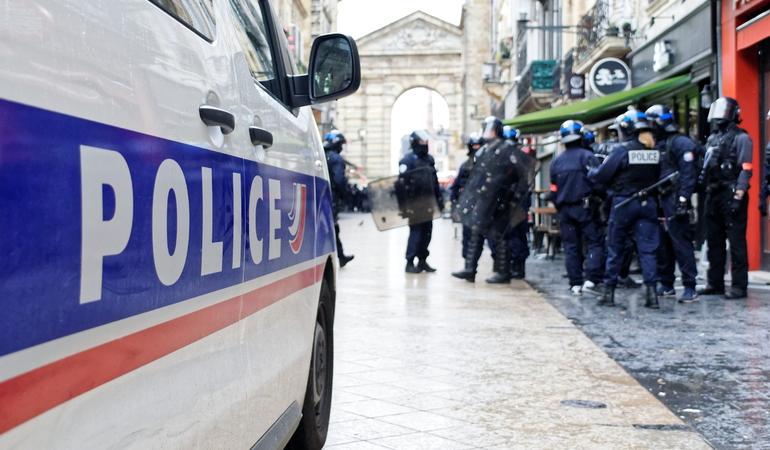
France, "Italian-style" anti-mafia measures against drug trafficking
Cpr - Repatriation detention centers
Islands. Spaces of education and civil disobedience
Cpr - Repatriation detention centers
Islands. Spaces of education and civil disobedience
France, "Italian-style" anti-mafia measures against drug trafficking
New national prosecutor's office, hard prison, repentants: the French parliament has approved the law desired by the government to combat organized crime dedicated to drug trafficking, with some measures inspired by the Italian anti-mafia system. Associations and experts denounce a repressive turn masked by security reasons
Paolo Valenti Editor lavialibera
“Freeing France from the grip of drug trafficking”: this is the ambitious objective, already written in the title, of the law that the Transalpine parliament definitively approved today by a very large majority. Strongly supported by the government, the text aims to be inspired by Italian anti-mafia legislation, as the promoters have declared several times. Among the new features, the establishment of a national anti-organised crime prosecutor's office, a harsh prison regime, the introduction of the figure of repentants and new investigation techniques. “What works in Italy can also work in France,” argued Justice Minister Gérald Darmanin in an interview last March. An assumption criticized by various associations, who see the organized crime alarm as a pretext to justify a repressive turn, and experts: "That there is attention on the topic is positive, but a classic mafia model is mechanically applied in a completely different context", Federico Varese, professor of criminology at Oxford and sociology at Sciences Po Paris, tells lavialibera.
Drug trafficking and crime: the situation in France
The law collects some of the recommendations of the commission of inquiry into drug trafficking established in November 2023 at the French Senate. The final report, published a year ago, paints an alarming picture: "France is submerged in drug trafficking", we read in the text, which highlights how drug flows do not only affect large cities, but also small towns and rural areas, and are often accompanied by "corruption of public and private agents" and by "a particularly spectacular and worrying surge in violence, with real scenes of war".
According to numbers released by the Ministry of the Interior, in 2024 110 people died and 341 were injured in 367 murders or attempted murders linked to drug trafficking, figures slightly decreasing compared to the previous year. However, there has been a surge in seizures, in particular of cocaine (53.5 tonnes, +130 percent) and synthetic drugs.
A new national prosecutor's office
The "keystone" of the new system of repression, as Minister Darmanin himself defined it, is the creation of a national anti-organised crime prosecutor's office (Pnaco), based in Paris, on the model of the anti-terrorism one already existing in France and the national anti-mafia prosecutor's office in Italy. It should come into operation in July 2026 and deal with the "most serious" crimes committed "in organized gangs", from drug trafficking to money laundering, through computer crimes.
A "strange hybrid", comments Varese: "Centralising jurisdiction would make sense if these groups were coordinated with each other. Here, however, we are dealing with neighborhood gangs which certainly, in addition to managing drug dealing, aspire to govern the territory, but do not have the structuring and rituality characteristic of classic mafias. The criminal profile of the drug trafficker, then, is completely different from that of the boy who deals in the neighborhood and interacts with the local community. A different specialization and presence in the field are needed. In this case, however, a magistrate from Marseille who has been following the issue for years should hand over the dossier to his colleagues in Paris." Another risk, underlined by the Syndicat de la magistrature, the second largest association of magistrates in France, concerns "the lack of independence of the prosecutor's office", which would be "subordinated to the political agenda of the executive": it will in fact be the Minister of Justice who will propose the appointment of the prosecutor and direct his work.
Harsh prison for drug traffickers
Another measure strongly supported by the government is the creation of "sections to fight organized crime" in some prisons, where up to 800 inmates considered "most dangerous" can be concentrated in more severe conditions: limited access to communications, interviews with glass partitions, more frequent searches, holding hearings via video link to minimize the risk of escape during travel, measures to guarantee the anonymity of officers. A regime that intends to be inspired by the Italian 41-bis, which the French Keeper of the Seals Darmanin was able to "study" during an ad hoc visit to the Roman prison of Rebibbia last February.
41-bis, a regime beyond the emergency
The measure was strongly criticized by various civil society organizations, such as the League of Human Rights and the French section of the International Prison Observatory, according to which "the question of the meaning of punishment is completely obscured in the name of a security obsession, which pretends to ignore the harmful effects of isolation on health and on the possibilities of building an exit plan". Not only that: the choice to concentrate the "most dangerous" prisoners in a few special sections risks having the opposite effect to that hoped for, paradoxically making it easier for them to communicate with each other: "a sensational mistake that was also made in some Central American states", comments Varese. In recent weeks, several French prisons have been the subject of attacks from the outside, with shots fired and cars set on fire, episodes that the government believes were orchestrated by criminal groups to demonstrate their opposition to the new prison regime.
Repentants, infiltrators, electronic surveillance, "safe file"
The reform aimed at extending and making more attractive the regime of "repentants", who will be able to see their sentences reduced by two thirds if they decide to collaborate with justice, is also inspired by the Italian anti-mafia system. The law also introduces the figure of "civilian infiltrators", paid informants appointed by the National Prosecutor's Office to enter criminal organizations to obtain useful elements for investigations.
Justice collaborators, how the "contract" with the State works
The possibility is then introduced for investigators to remotely activate the electronic devices of people involved in the investigations to record sounds and images and to create a file parallel to the one shared with the suspects and their defenders, with information considered confidential. A "threat to the right of defence", denounced the French National Bar Council, according to which the entire text "puts at risk some fundamental principles of justice and defense of individual freedoms under the pretext of security". Dozens of associations defending the right to live have also spoken out against the measure that allows the eviction of entire families from public or private rented housing in the event that the authorities find unspecified "disorders" and "activities linked to drug trafficking".
A social issue
"The new law embodies a punitive and militaristic approach - concludes Varese -. There is a lack of recognition that drugs are primarily a social problem, which affects poor and marginalized neighborhoods, where there is no trust in the State and gangs then take its place. We therefore need to strengthen the welfare state, not increase penalties and create new bureaucracies, which is the easiest thing".
Stefania Carminati, of the French anti-mafia association DeMains Libres, agrees: "There is a lot of apprehension, the violence linked to drug trafficking is visible and frightening, but organized crime in France is not just this. The idea behind the new law is essentially repressive, of a State that thinks it can get by on its own by making more arrests, without reaching out to the people. There is still a lack of awareness of a social anti-mafia."