
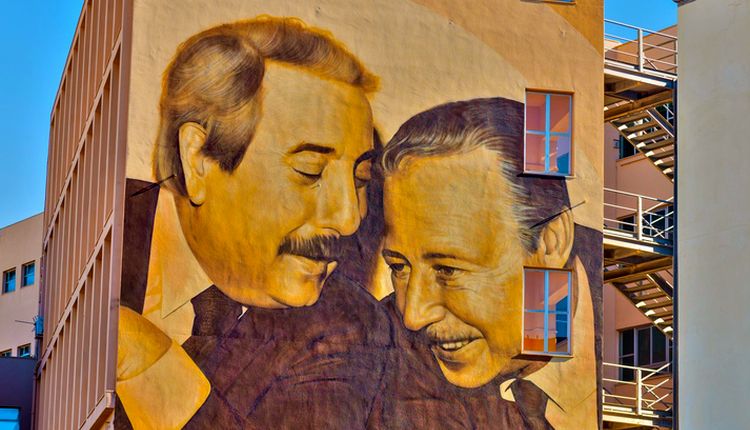
Giovanni Falcone, the story of a great man: from the fight against the mafia to the Capaci massacre
Giovanni Falcone, story of a great man: from the fight against the mafia to the Capaci massacre
The fight against the mafia. The collaboration with Paolo Borsellino and the anti-mafia pool. The maxi-trial. And then the isolation. Until the Capaci massacre on 23 May 1992. Here is the story of Giovanni Falcone, a great man of our times, and the situation of the fight against Cosa Nostra today in Italy
«You generally die because you are alone or because you have entered into too big a game. We often die because we don't have the necessary alliances, because we lack support." Judge Giovanni Falcone said so, killed by the mafia on a Saturday afternoon 26 years ago on the motorway - at the Capaci junction - with 400 kg of TNT. With him, that Saturday afternoon, were his wife Francesca Morvillo and the three men of the escort Vito Schifani, Antonio Montinaro and Rocco Dicillio.
Brief biography of Giovanni Falcone
Falcone was the magistrate symbol of the fight against the mafia. Let's take a step back. In the Arab neighborhood of Kalsa in Palermo, where little Giovanni grew up, there was school, Catholic Action and little entertainment for him. The father was an austere man: travel and holidays didn't exist for him. The mother was also, as the judge said, "an energetic and authoritarian woman".
“With 7s and 8s my report card was considered bad,” the magistrate said. He had attended classical high school. Then the Military Academy of Livorno, then - after having second thoughts - he enrolled in Law. He graduated with honors.
Then his career: he began as a magistrate in Lentini (Syracuse), then in Trapani, where he remained for 12 years. This was followed by a transfer to Palermo, where he dealt with the trial of the building constructor Rosario Spatola, accused of mafia association. Falcone accompanied the investigation with banking and corporate investigations, using an innovative investigation method. Of Cosa Nostra he said:
«The mafia is a human phenomenon and like all human phenomena it has a beginning, its evolution and will therefore also have an end».
Capaci massacre: what happened on May 23, 1992
It was May 23rd, a Saturday afternoon, in 1992. The hands were about to point to 6pm when at the gates of Palermo and in the town of Capaci a roar interrupted everyday life. Followed by the din of crazy alarms and sirens of ambulances, police cars and firefighters traveling towards Palermo airport.
Along the highway that connects Punta Raisi airport, today Falcone-Borsellino, with the Sicilian capital, the judge, his wife and the escort agents found their deaths. That place was chosen to commit the first massacre of 1992, which was followed just two months later by the attack on judge Paolo Borsellino, his dear friend and colleague.
Paolo Borsellino and Giovanni Falcone (via Flickr)
The judge took advantage of the weekends to return from Rome to Palermo and that day he was driving the Croma. On board, on the passenger side, was his wife Francesca Morvillo, while the driver, Giuseppe Costanza, was behind.
It was 5.58pm when the road surface of the motorway from where you can glimpse Isola delle Femmine blew up. The first car with the three escort men on board was destroyed. They were Vito Schifani, Antonio Montinaro and Rocco Dicillio. While behind it was the Croma, in which the judge was traveling with his wife and the driver, which was crushed.
From behind, from the third escort car, the other three unharmed agents got out: Gaspare Cervello, Paolo Capuzza, Angelo Corbo. The three men immediately reached the torn-up car: the judge was still alive, stuck between the sheets of metal.
«If I stay alive, this time I will make him pay...», he whispered while the firefighters were rescuing him together with his wife Francesca.
Death of Giovanni Falcone, his wife and the three agents
The judge, 53 years old, won't make it: he will die before the ambulance can reach the hospital. While his wife Francesca died 5 hours later, in the operating room.
The driver, who was sitting in the back, was unharmed. Far away, in a field, were the remains of the escort Croma, the one that preceded the judge, with the mangled bodies of the three agents.
While about 400 meters from the site of the massacre, on a hill, there were the three men who acted: one of them is Giovanni Brusca, the piccio of Totò Riina, instigator of the murder, who was arrested on 16 January 1993.
The moral testament left by Falcone's life
Falcone left the community a moral testament: legality, humanity, rights, courage and love. He taught everyone that you should never give up. He taught others respect, sacrifice, limiting his freedom.
The only thing he allowed himself in his now armored life was swimming, giving up the sea and falling back on the municipal swimming pool in Palermo. Again, with difficulty: he couldn't go there during rush hour. The choice was to go at dawn or very late in the evening, naturally at always different times.
He could no longer go to the cinema: an obligatory decision, since every time they had to free up four rows of seats. And he had to give up restaurants: it happened that people got up to change tables.
Yet he loved these people, his people, he loved his land made of sun, sea, oranges. His land made of worries, weapons and deaths. He left a void and a lot of bitterness for what his death revealed: our country hindered "inconvenient" magistrates, precisely because they observe and fulfill their duties without bending to anyone's will.
The mafia war: Totò Riina against everyone
Since 27 September 2017 the new Anti-Mafia Code has been law. To understand how the law on the subject has changed, however, it is necessary to start from 1981 and the first months of 1982. Those were the years in which the mafia war began: one death every three days, for a total of 1,200 victims, which struck the ranks of the enemy gangs of the boss Totò Riina.
It had emerged that behind these murders were the "viddani", the farmers, of Corleone, a town near Palermo, and that Riina was their leader. These were the times of the Palermo Maxi Trial.
The murders of Pio La Torre and Dalla Chiesa
This war ended in 1983, but this did not prevent the Corleonesi from lashing out against the State a year earlier: it was the morning of 30 April 1982 when Pio La Torre, regional secretary of the Communist Party and member of the Anti-Mafia Commission, was killed in Palermo. It was time to respond to mafia violence.
So the government sent Carabinieri general Carlo Alberto Dalla Chiesa to Sicily as anti-mafia prefect. A few months passed and on 3 September Dalla Chiesa was also killed together with his wife Emanuela Setti Carraro.
The birth of the anti-mafia pool and the season of repentants
Riina was now engaged in a head-on clash with the State. And on 29 July 1983 a car bomb killed Rocco Chinnici, head of the Education Office of the Palermo court. The Superior Council of the Judiciary chose Antonino Caponnetto, 63 years old, as his replacement.
Chinnici himself had had the idea, in 1980, of establishing an anti-mafia pool, which would be led by Caponnetto from 1984 to 1990. The first chosen was Giovanni Falcone, followed by Giuseppe Di Lello Finuoli, then, on Falcone's advice, Paolo Borsellino. Some time later, prosecutor Leonardo Guarnotta also joined the magistrates in the fight against Cosa Nostra.
Photo: Francesco Gazzola (via Flickr)
The pool's work progressed quickly and the number of repentants gradually grew. Starting with Tommaso Buscetta, who decided to speak only with Falcone. The result was 366 arrest warrants.
New attacks and maxi-trial of Falcone and Borsellino
Meanwhile, Riina worked in the shadows to prepare new attacks. On 28 July 1985, Beppe Montana, head of the Fugitives section of the Palermo police, was killed. Then it was the turn, a few days later, of Ninni Cassarà, deputy director of the flying squad, as well as a close collaborator of Falcone.
Falcone and Borsellino were transferred with their respective families to Asinara, a prison island located in the north-west of Sardinia, where they were responsible for concluding the investigation of the maxi-trial. A period that lasted 33 days.
This led to the maxi-trial with 475 defendants, the largest attack on the mafia, which began on 10 February 1986 and ended on 16 December 1987 with 360 convictions and 114 acquittals.
Change at the top: the isolation of Giovanni Falcone
Caponnetto, sure of being replaced by Falcone at the helm of the anti-mafia pool, left his experience in Palermo. But his place was taken by Antonino Meli, who had little experience in mafia trials. Hence Caponnetto's reflection: from that day "Falcone began to die".
Meli began to assign mafia investigations to external magistrates. While investigations into pickpocketing, bag snatching and bad checks ended on the desks of Falcone and his colleagues.
Falcone's candidacy for high commissioner for the anti-mafia fight was rejected. The government appointed Domenico Sica instead. Falcone's alternative was to run for the CSM, but he was not elected.
An attack against the magistrate in Addaura was foiled in June 1989.
A harsh clash was then triggered between Meli and Falcone over an investigation linked to the confessions of the repentant Antonino Calderone. While Meli wanted to divide the process between 12 different prosecutors' offices, following territorial jurisdiction, Falcone insisted that the pool should take care of it. This was to prevent the investigations from dispersing, given that the mafia matrix was the same. In the end Meli won. And this decreed the end of the pool.
Falcone goes to Rome, but the fight against Cosa Nostra continues
Other attacks and disappointments followed, which led the Palermo magistrate to accept the proposal of the new Minister of Justice Claudio Martelli: he left Palermo for the direction of Criminal Affairs in Rome.
From the capital Falcone continued his commitment against Cosa Nostra. He devised a decree, which sent the Cosa Nostra defendants released from prison back to prison thanks to a sentence by Corrado Carnevale, nicknamed "Sentence Killer", and president of the first criminal section of the Court of Cassation.
Thus, to avoid his possible influence on the final outcome of the Maxi Trial, Falcone also devised the rotation of the Supreme Court judges. What followed was Carnevale's assignment to another role. Then the Supreme Court confirmed the convictions.
Borsellino and Falcone still together against the mafia
In the meantime, Paolo Borsellino had returned to Palermo as assistant prosecutor and had taken on a management role in mafia investigations, while from Rome Falcone obtained approval from the government for a plan to reorganize the fight against the mafia.
Riina was given a life sentence and her revenge was another murder: on 12 March 1992, in Mondello, Salvo Lima, head of the Andreotti current in Sicily, was killed. Hence the Capaci massacre.
The sentence on Falcone's murder
Between misdirections, diversions and false repentants, a judicial truth was reached: all the men of the Cupola received life sentences for the massacres. In all of this, however, "other instigators" are missing (the ruling of the Capaci bis trial says so), those who, together with the mafia, had a single plan: to kill Falcone.
The new law: the anti-mafia code
On 27 September 2017, the new Anti-Mafia Code was definitively approved in the Chamber with 259 votes in favour, 107 against and 28 abstentions. Among the new features, particular attention was paid to the seizure of assets: the confiscation of assets no longer applies only to mafiosi, but also to those who have committed crimes of corruption, extortion, terrorism and stalking.
This is a reform that aims to speed up asset prevention measures, making the choice of judicial administrators more transparent and includes corrupt people, stalkers and terrorists among the possible recipients of the measures.
The decree provides for the adoption of a single set of rules, which has been divided into four books: Book I, prevention measures; Book II, the anti-mafia documentation; Book III: Information and investigative activities in the fight against organized crime. The administration and destination of assets seized and confiscated from organized crime; Book IV: Amendments to the penal code and complementary criminal legislation. Repeals. Transitional and coordination provisions.
History of the mafia phenomenon
In the Italian language, the first use of the term "mafioso" dates back to an 1863 comedy, entitled "I mafiosi della Vicaria", set in the prison of the vicariate of Palermo and written by Giuseppe Rizzotto and Gaetano Mosca.
The term mafia, however, combined with criminal association and organized crime, is found in an 1865 report by Filippo Antonio Gualtiero, chief prosecutor of Palermo. It is a historical phenomenon and, according to sociologists and scholars, even before defining it as a criminal organization, it must be defined as a social phenomenon, an organization of power. A phenomenon in which the great pre-Risorgimento landowners, statesmen and also part of the bourgeois population participated, after the industrial revolution.
Sicilian organized crime sees the Bourbon viceroys as protagonists, even before the unification of Italy. Sicily has undergone various dominations for centuries and has not had a sovereign state. This did not make it possible to guarantee justice and protection for citizens.
In this situation, forces have developed capable of replacing the State, of distributing favors and violence. Characters with the titles of “Don” and “Godfathers”.
It is an invisible world with its rules, its wars and its leaders. A world capable of transforming and tearing children away from their parents to direct them and turn them into violent, murderous children, through affiliation, a sort of ritual. Furthermore, the mafia calls its organizations "families".
«We find ourselves faced with highly refined minds who attempt to direct certain actions of the mafia. There are perhaps points of connection between the leaders of Cosa Nostra and hidden centers of power that have other interests. I have the impression that this is the most reliable scenario if you really want to understand the reasons that pushed someone to murder me" (Giovanni Falcone)