
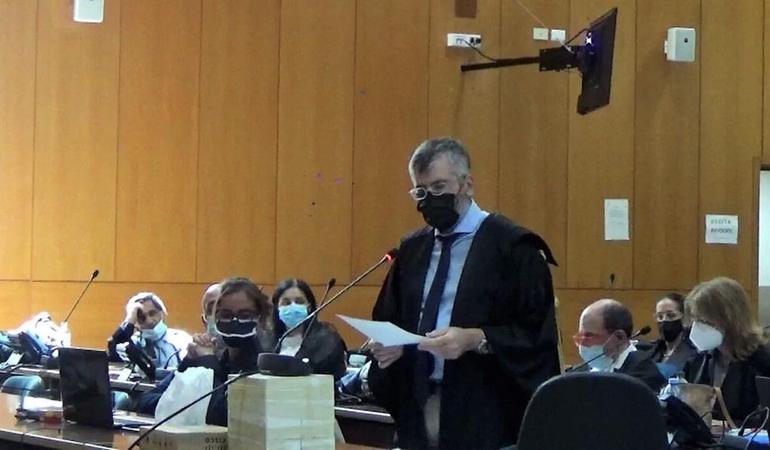
Gotha trial: this is how the invisible members of the 'Ndrangheta act
Cpr - Repatriation detention centers
Islands. Spaces of education and civil disobedience
Cpr - Repatriation detention centers
Islands. Spaces of education and civil disobedience
Gotha trial, this is how the invisible members of the 'Ndrangheta act
Two years after reading the first degree sentence, the Reggio Calabria court reveals the reasons for the convictions and acquittals. For magistrates, there is a system of deviant power, through which the Calabrian mafia manages to replace the institutions
Francesco Donnici Journalist
Paolo Romeo, lawyer and former parliamentarian of the Italian Democratic Socialist Party (PSDI), was the thinking mind of the 'Ndrangheta, the puppeteer capable of moving the strings of crime and politics, managing to control tenders and influence elections thanks to his relationships with the Freemasons. After two years of writing, the court of Reggio Calabria filed the reasons for the Gotha trial against the leaders of the 'ndrangheta in Reggio, from which this portrait of the main defendant emerges, sentenced on 30 July 2021 to 25 years of imprisonment for mafia association. The highest sentence for the man who justice collaborator Seby Vecchio, former policeman and municipal councilor in the Scopelliti council, defined as "the God of the 'Ndrangheta and politics".
Over 250 years in prison
Approximately two years after 30 July 2021, the day the first degree sentence was read, the Calabrian court filed the reasons for the provision with which the Panel chaired by Judge Silvia Capone ordered 15 convictions and 15 acquittals for the defendants who had chosen to be tried with the ordinary procedure. The sentence had arrived after several hours of deliberation, when the street lamps outside the bunker courtroom in the Calabrian city of the Strait illuminated the comings and goings of the last defendants left to listen to a verdict that had spared no surprises. In addition to the individual responsibilities of each accused, the trial - born from the meeting of the Mammasantissima, Reghion, Fata Morgana, Alchimia and Sistema Reggio investigations - is called upon to prove the existence of the so-called "reserved component of the 'Ndrangheta".
"Only very few could create a top component of the 'Ndrangheta as extraneous to the associative context. And those very few are accused here", said the deputy prosecutor Giuseppe Lombardo in one of the thirteen hearings dedicated to the indictment which had seen him alternate with the various members of the prosecution pool: Stefano Musolino, Walter Ignazitto, Sara Amerio, Giulia Pantano and Roberto Di Palma. The requests for conviction (for a total of over 250 years in prison) invoked by the chief prosecutor Giovanni Bombardieri on 25 May 2021, arrived approximately three years after the first hearing, held on 20 April 2017.
The main defendants in the maxi-investigation are the lawyer Giorgio De Stefano, tried with an abbreviated trial (where the Court of Cassation annulled, partly without postponement, the previous conviction), and Paolo Romeo, also according to the accusation a member of the so-called "invisibles", those "hinge subjects" who populate the 'Ndrangheta "overworld". For the prosecutor's office, Romeo is "the thinking mind of the 'Ndrangheta", representative of an "ambiguous system of power", to use the expression used by the new deputy prosecutor Stefano Musolino, so evolved that it has become an institution.
A 13-year sentence was pronounced for the former regional undersecretary Alberto Sarra, while senator Antonio Caridi, for whom the prosecution had asked for 20 years, was acquitted. Other alleged members of the gray area that fuels the interests of the gangs of Reggio Calabria are indicated in the public manager Marcello Cammera, sentenced to 2 years, and Carmelo Giuseppe Cartisano, sentenced to 20 years in response to the prosecution's request for 16. For the rector of the Polsi sanctuary, Don Pino Strangio, a sentence of 9 years and 4 months was instead received which, a few weeks later, led him to resign from the historic position.
It took about two years to find out the reasons behind the sentence. A few months after the reading of the device in the ordinary procedure, the Supreme Court had pronounced a sentence which in some way upset the prosecution system, resulting in the annulment of nine convictions among those ordered by the Court of Appeal. In particular, emphasis was given to the position of Giorgio de Stefano whose sentence had been annulled without postponement with reference to all the conduct contested up to 2005. The second degree sentence of 15 years 4 months had been accused of "illogicality".
'Ndrine in Val d'Aosta, for the Cassation it is there but it is not structured
"If the invisible structure - write the judges of the Supreme Court - must be made up of individuals whose membership in the 'Ndrangheta is unknown to those who make up the visible and operational structure of the criminal association, in order to prevent the members of the invisible structure from being indicated as belonging to the criminal association by any collaborators of justice, it appears illogical to maintain that Giorgio De Stefano could simultaneously be part of both the invisible structure and the visible and operational structure in his capacity, moreover, as head of the De Stefano gang".
In essence, the accused had already been convicted for external complicity and had been judged in the Reggio case trial for the contribution he provided to the association until 2005. For this reason it would be "illogical" to also recognize him as one of the "invisibles" and to condemn him for this, especially if the judges ruled on a period already covered by a final sentence. In March 2022 - due to the expiry of the terms of precautionary custody - De Stefano was released from prison.
The evolution of the 'Ndrangheta
In the first Gotha ruling, the court of Reggio Calabria retraced decades of history of the 'ndrangheta, recounting the extraterritorial expansion - including international - of the association and the progressive contamination of "public affairs" which in the territory of Reggio Calabria, also thanks to the historical aftermath following the 1970 uprisings, seemed at least more evident than elsewhere. “Having allowed highly secretive “laypeople” to join the 'Ndrangheta has allowed the crime leaders to transform themselves while remaining themselves,” prosecutor Lombardo commented at the end of the indictment.
At the base there was an ambitious project born in the Seventies, which had pushed the known leaders of the association to face an evolutionary process that would have led them to "become, in short, the representatives of a criminal system so evolved as to have become an institution". Aspects which would explain, in the words of the magistrate, "why the 'Ndrangheta is known as the richest and most powerful criminal organization in the world", supported by a system "that operates and has operated in this land, interrupting sovereign functions of the Italian State".
"Eureka", international operation against the 'ndrine
The Reggio judges, starting from the reconstruction of the accusation and previous trials, recall how the structure of the organization is "equipped with a complex criminal apparatus which is also characterized by a secret or confidential structure, which is often referred to as 'holy', 'mammasantissima' or 'dome', called to operate in particularly relevant areas of the organisation".
As an integral part of this structure, the judges of first instance therefore recognize Paolo Romeo who has the "role of promoter, manager and organizer, inherited upon the death of Paolo and Giorgio De Stefano", assassinated respectively in 1985 and 1977. His procedural position is "completely comparable" to that of Giorgio De Stefano given the conviction for external complicity already served at the outcome of the Olimpia trial and the acquittal in the Reggio case trial. For this reason, the judges explain, the facts that occurred within the year 2005 are "unprosecutable", while the same cannot be said for what happened afterwards, as they are "new and different" conduct from those already judged for which "the identity of the fact does not exist".
Some of the passages contained in the Mammasantissima investigation (and before that in Olimpia) are then retraced, which refer to the episode of the escape of the black terrorist Franco Freda, at the time accused in the trial for the Piazza Fontana massacre. 42 years later, during the Gotha trial, Romeo confessed to having covered up Freda's inaction "as a gesture of political solidarity".
Votes from the 'ndrine in Piedmont, former councilor Rosso condemned
The Reggio judges therefore reiterate the "primacy role played by Paolo Romeo", which in the previous trials had not however earned him a conviction for 416-bis. The well-known lawyer and politician is depicted through the declarations of the repentants, and by the supporting evidentiary material, "as a subject belonging to Freemasonry, as a member of the De Stefano clan, with the task of infiltrating the political-institutional contexts and of guaranteeing the De Stefanos, and the 'ndrangheta of Reggio Calabria according to the dividing logic agreed on the occasion of the mafia pax to which Romeo had also made a significant contribution, the perception of extortion proceeds through the guarantee to colluding entrepreneurs of the award of public contracts".
To this the judges also add his operation "in the secret Freemasonry", which would have allowed him to influence a series of electoral rounds held at the beginning of the 2000s. At this point, the narrative surrounding the conviction of Alberto Sarra takes over, indicated as one of the "'bridge' subjects belonging to the institutional apparatus". His cursus honorum began in 1992 when he was elected president of the second constituency of the Municipality of Reggio Calabria and, in 2010, he was appointed regional undersecretary for reforms and administrative simplification by governor Scopelliti.
The judges describe him as belonging to the "occult context", already involved in a large number of criminal proceedings also investigated through wiretaps which often see him speaking "on an equal footing with individuals who turned out to be top exponents of the various 'Ndrangheta gangs". The same ones who would also have guaranteed him the necessary political support during the various electoral competitions in which he participated.
The 'Ndrangheta turncoat Domenico Agresta: "I'm not afraid to collaborate"
“Against the background of the electoral campaigns, and of Sarra's candidacy itself – we read – the direction of the lawyer Paolo Romeo alongside the lawyer Giorgio de Stefano was constant”, capable of “forming real coalitions in a political sense which then favored the rise of Giuseppe Scopelliti (not investigated in Gotha, ed.) first to mayor of Reggio Calabria and then to president of the Calabria Region”. In the reconstruction through which the judges qualify the responsibilities of Sarra and Romeo, Scopelliti is described at the same time as a "hostage and yet a beneficiary" of that system which "will ensure the top 'Ndrangheta infiltrates the investee companies of the Municipality of Reggio Calabria". Sarra, in this case, is described as "the 'mule' who should have pulled the trigger for the collection of votes", as well as the "instrument with which to start the subsequent conditioning of the administration headed by Scopelliti", about whose subservience to the system Romeo would have had doubts.
Conversely, the wait for the reasons was also focused on the analysis of the position of the former senator elected in the People of Freedom coalition, Antonio Stefano Caridi, acquitted by the Reggio court despite the heavy requests made by the prosecution. During the indictment, prosecutor Giulia Pantano had discussed her position in the discussion of the thread linked to the Alchemia investigation, focused on the affairs of the Raso-Gullace-Albanese clan between Calabria and the capital.
In the magistrate's story, upon hearing the news of Caridi's candidacy "the gang took to the field to support him" and "the power of this gang was so strong that it forced the secretary of a party that could not have supported Caridi to review his position in light of agreements made previously". Vito Schifani went so far as to propose his inclusion in the Parliamentary Anti-Mafia Commission, "but there was - the judges write - a press campaign that precluded this position, as news had been published on a series of connections that Caridi would have had with some territorial branches of the 'ndrangheta" of Reggio.
In acquitting him for lack of elements that could lead to affirming his participation in the secretive structure of the 'Ndrangheta, the court of Reggio Calabria did not disdain to underline his unscrupulousness such "that on the occasion of electoral competitions he did not disdain cultivating relationships and acquaintances with subjects of the most important criminal cliques for clear electoral purposes". Aspects that would have earned him "the electoral support of the De Stefanos" in the 2002 elections, according to the declarations of the justice collaborators, which in his case remained uncorroborated. We are now awaiting appeals from the prosecution and the defense to write a new chapter in this important judicial matter.