
Unclessify
Unclessify
Language
How the Vatican helped legitimise the autocracy in Azerbaijan
IrpiMedia

How the Vatican helped legitimise the autocracy in Azerbaijan

IrpiMediaItaly2026investigative
#azerbaijan#vatican#autocracy#corruption#human rights#politics

Source: IrpiMediaItaly

Go to original source
Share:

Legal Notice

This content was published by IrpiMedia. All rights, responsibilities and accuracy of the information are the exclusive competence of IrpiMedia. Unclessify only indexes and makes declassified content accessible.

Read Full Disclaimer →

Full Reportage

Relations with Baku are emblematic of how the Holy See is trying to gain credit in the Caucasus as a peace mediator. With some privileged relations

How the Vatican helped legitimise the autocracy in Azerbaijan

Source: IrpiMediaGo to original source →

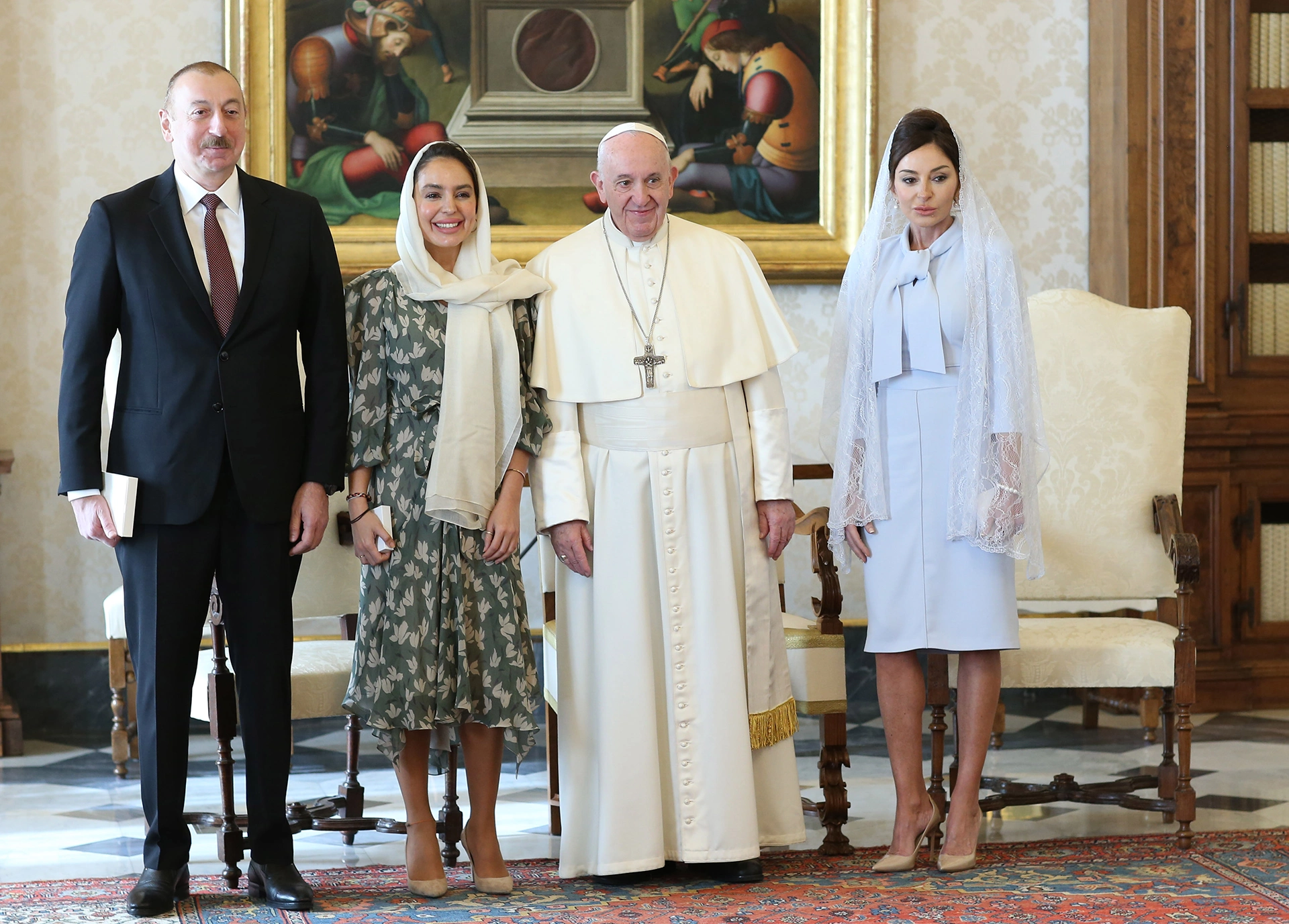
February 22, 2020, Apostolic Palace, Vatican City. The day before the first Italian case of Covid-19 was diagnosed at the hospital of Codogno, in the province of Lodi. The Holy See seems to be thinking of something else. An official visit is happening: the autocrat of Azerbaijan, Ilham Aliyev, is being received by Pope Bergoglio, the Secretary of State Cardinal Pietro Parolin, and the Secretary for Relations with States, Archbishop Paul Richard Gallagher. Together with the Azerbaijani president, who inherited the title from his father Heydar, there is his wife, Mehriban Aliyeva, who also holds the post of vice president of the Caucasian Republic – a case that is unique in the world.

Anything but marginal in her country’s politics, Aliyeva is in Vatican City to receive the highest honor awarded to lay people by the Holy See: the Grand Cross of the Order Piano. The title, given to Dames and Knights, is proposed by diocesan bishops as a sign of appreciation and gratitude for services to the Church or to society, and it’s reserved for heads of state, ministers, ambassadors, and crowned heads. In Italy, several presidents of the Republic received it and, in less merciful times, also fascist dictator Benito Mussolini and his son-in-law Galeazzo Ciano.

The investigation in a nutshell

  • The Vatican has awarded important honors to both the vice president of Azerbaijan, the wife of the President Mehriban Aliyeva, and the Armenian prime minister, who emerged a loser from the conflict over control of the Nagorno-Karabakh region, Nikol Pashinyan. Hoverever, there is nothing ecumenical about it: the Vatican has been closer to Azerbaijan
  • Major players in the Catholic Church’s relationship with Azerbaijan, a Muslim country, have been Cardinal Gianfranco Ravasi, assigned to interreligious dialogue, and Claudio Gugerotti, apostolic nuncio – now cardinal – who, over the years, has met with all the most controversial figures in Russia and the post-Soviet world 
  • The Vatican-Azerbaijan connection is also explained by the unquantifiable financial support provided by the Heydar Aliyev Foundation for the restoration of important Christian monuments. The Holy See says it appreciates Azerbaijan’s openness and peaceful attitude toward different faiths
  • There are consequences, however, for those who maintain a critical attitude toward the Holy See’s attitude towards Azerbaijan. Father Russyen was expelled from the Pontifical Oriental Institute because he was critical of those who didn’t want to use the term «Armenian genocide». Yet he is one of the advisers to the Dicastery for the Eastern Churches headed by Gugerotti
  • The Holy See is trying to take a leading role in peace talks. In Ukraine and Armenia, nonetheless, openings toward the Russian and Azerbaijani autocracies raise concerns

The Holy See statement, which summarizes the dialogue between the Alyievs and the Vatican high hierarchies, refers to «the importance of intercultural and interreligious dialogue in favor of peaceful coexistence among different religious and ethnic groups».

This is a theme that the Azerbaijani regime – often considered a place for peaceful coexistence among people with different beliefs – has considered of great importance since its independence from the USSR in 1991. However, this position conceals an aggressive approach toward neighboring Armenia and, from an internal point of view, little respect for human rights and freedom of information.

Calls on the international community to stop Azerbaijan

Only a few months after the Vatican visit, in September 2020, the second (or third, including the four-day conflict of 2016) Nagorno-Karabakh war broke out in the Armenian-majority Azerbaijani region. For the European Parliament, the conflict marked the beginning of an «ethnic cleansing». A year later, hoping to gain international recognition of the ongoing atrocities, Armenia opened a case for violations of the International Convention on the Elimination of All Forms of Racial Discrimination before the International Court of Justice (ICJ) in The Hague, the main UN legal body to settle disputes between states.

The case is still pending and the next hearings, after the Armenian prosecution and Azerbaijani defense exhibits, are expected in April.

However, the ICJ has already ruled: on December 7, 2021, it issued an order, calling Azerbaijan to respect war prisoners’ human rights after the 2020 conflict, to take appropriate measures to prevent an escalation of racial violence, to implement countermeasures to defend Armenia’s artistic and cultural heritage.

These requests were disputed by Azerbaijan in its reply. In October 2022, the Court ruled that the demands had not yet been met, and in February 2023, it approved a second demand by Armenia, asking Azerbaijan to take «appropriate measures to ensure the passage of people, vehicles and cargo from the Lachin corridor».

This transit, after the 2020 war, was the only route connecting Karabakh to Armenia. Its disruption led first to a humanitarian crisis and then, in September 2023, to the final victory of the Azeris. Baku’s army thus defeated the Armenian forces that administered the region, causing over 100,000 Armenian refugees. 

While the exodus was still ongoing, the Pope prayed for the inhabitants of Karabakh, hoping «that talks between the parties, with the support of the international community, will foster a lasting agreement that will end the humanitarian crisis». Even in 2020, the Church had proved unable to go beyond generic appeals «to all the parties involved and to the international community» to «lay down arms».

The dispute over monuments identity

In the past, many strikes caused the destruction of Christian monuments by the Azerbaijani regime, as happened in the early 2000s to  tens of thousands of stelae in the cemetery of Jolfa, an Azerbaijani city founded by Armenians. Those artistic artifacts were protected by UNESCO. 

Today – in a more subtle way – there is an attempt to redefine (or erase) the identity of monuments in the Azerbaijani territory, which are attributed to the Caucasian Albans (or Albanians), a populitation that, since the pre-Christian antiquity  – in a period of history still difficult to place in time – also lived in the now disputed region of Nagorno-Karabakh.

The politicization of history and th4 presence of the Albans is one of the ways to spark the nationalistic spirit of Azerbaijan and claim the territory of Karabakh.

There are two revisionist theses supported by Azerbaijani historians close to the Aliyevs that have been used by Baku, despite being contested by much of the international community, to justify Azerbaijani Karabakh. Researcher Igor Dorfmann-Lazarev wrote in a 2020 article published in DoppioZero:

«The first thesis rests on the idea that the Turkic-speaking, Shiite Azerbaijani people are directly descended from the ancient kingdom of Caucasus Albania, while the second thesis claims that the set of Christian monuments located on the territory of the self-proclaimed Republic of Artsakh [the way Armenians name Karabakh], not unlike those located on the territory of Azerbaijan, are Albanian monuments».

After the defeat, Armenian Prime Minister Nikol Pashinyan, for the second time since 2020, was called a «traitor» by his opponents, who accused him of failing to defend the Armenians in Karabakh. A month later, on October 24, 2023, Pashinyan, defeated and disputed,  received from Apostolic Nuncio Jose Avelino Bettencourt the award given three years earlier to Aliyeva, vice president of Azerbaijan.

Not so ecumenical, however, is the spirit with which the Holy See honored the leaders of each of the two countries. While Aliyeva was received by top Vatican officials, Pashinyan was honored by an apostolic nuncio who is no longer on mission in the region today. In the Caucasus, Vatican diplomacy followed other advices and helped consolidate the power of the Aliyev family, despite human rights violations in Karabakh.

The narrative of the policy followed by the Vatican in the region and its implications for peace was reconstructed by IrpiMedia by cross-referencing information provided by six sources. These are people who are familiar with the Holy See diplomacy in various roles but could not speak to journalists. That is why we granted them anonymity.

The Baku Connection

The #TheBakuConnection project, an investigation led by a consortium of 15 media outlets (including IrpiMedia for Italy) and 40 journalists, aims to continue the work of AbzasMedia, which was interrupted after the arrests in the months leading up to the February elections.

Coordinated by Forbidden Stories, the reporters discovered how, since 2014, the Council of Europe (CoE, whose goal is to ensure respect for democracy and human rights) has transferred more than 23 million euros into Baku’s treasury, funds that came mainly from the European Union budget. On paper, the resources were supposedly intended to bring the Azerbaijani justice system up to CoE standards, but monitoring of the actual use of these funds is opaque.

Since Azerbaijan joined the CoE in 2001, it has violated its protocol 263 times, including as many as 33 for «torture» and «inhuman and degrading treatment». The launch of programs like SPERA, aimed at reforming Azerbaijani prison institutions, is controversial: participants can «go visit prisons in Norway or elsewhere. But nothing changes. It is all useless», Arif Mammadov, former Azerbaijani ambassador to the Council of Europe and now dissident, told Forbidden Stories. «The system remains the same».

The architects of friendship with Baku

Cardinal Gianfranco Ravasi, honorary president  of the Pontifical Council for Culture and chairman of the Pontifical Commission for Sacred Archaeology, is the highest Vatican official who has made most efforts to open a dialogue with Azerbaijan, a Muslim-majority country.

Awarded in 2013 by the Azerbaijani authorities with the Order of Friendship – a high honor offered for a «special contribution to the development of friendship, economic and cultural relations between Azerbaijan and a foreign state» – Ravasi is in fact committed to dialogue with other religions, as well as with science and the secular world, looking with interest and sympathy to the Islamic world. In 2007, Pope Benedict XVI appointed him a member of the Pontifical Council for Interreligious Dialogue.

He is not the only name circulating, however, among those who have facilitated relations between Baku and Vatican. There are those who consider Cardinal Claudio Gugerotti from Verona to be a mere intermediary, and those who consider him to be the protagonist of the privileged channel established with Baku.

Highly educated and polyglot, ambitious and power-loving, Cardinal Gugerotti has known the Aliyev family since 2002, when the progenitor Heydar, in power since 1969, was still alive. In Vatican circles Gugerotti was known as «Don Stambecco» («Father Ibex») because of his precocious as well as unbridled careerism, as revealed in the successful 1999 book Via col vento in Vaticano by some prelates who remained anonymous. 

In the early 2000s, Gugerotti met with Azerbaijani authorities as nuncio for the South Caucasus, a position he assumed in 2001. Before then, this nunciature for the Holy See included only Georgia and Armenia. Those were the years when Russia was guaranteeing a cease-fire in the region, after Armenia had defeated Azerbaijan in the first conflict. The ethnic hatred that is still fuel of the conflict was beginning to settle, but Nuncio Gugerotti called Azerbaijan a «country [that] is a symbol of peaceful coexistence between people of different religions».
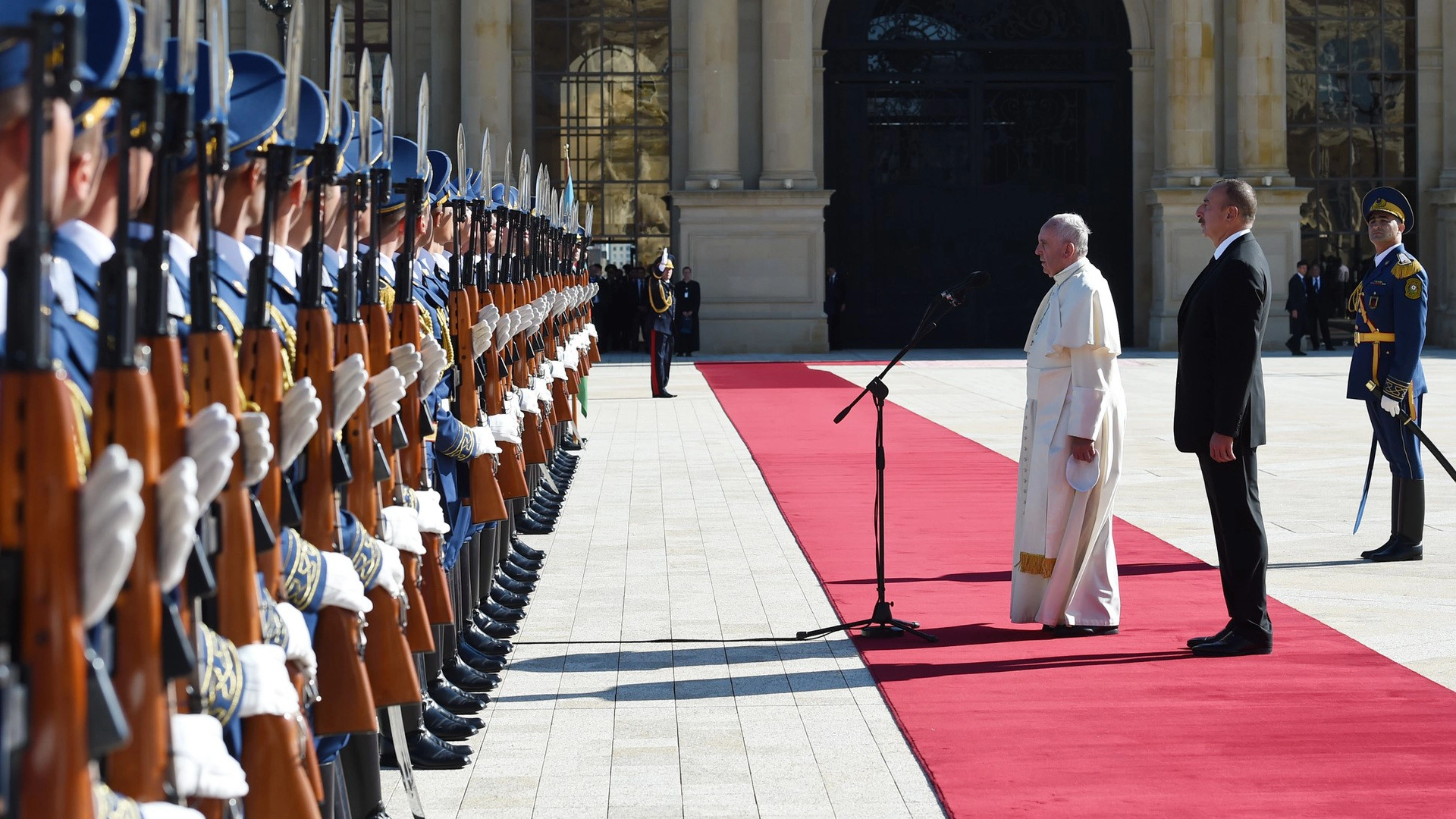
Pope Francis with the President of Azerbaijan, Ilham Aliyev, on a visit to Baku in October 2016 © Azerbaijan Presidency/Getty

Ten years after he began his mission as apostolic nuncio in 2011, Gugerotti signed the historic agreement that, for the first time, regulates relations between Baku and the Catholic Church. At the time of ratification – recalls a 2019 book produced by the Moral Values Promotion Foundation from Baku, entitled Christianity in Azerbaijan – Gugerotti «expressed gratitude to the [Azeri] government for creating the conditions that made possible [the agreement], emphasizing that our country always remained committed to the principles of tolerance, and noting that the agreement was the first document of its kind, because the Vatican had never signed such an agreement with any state before».

«Azerbaijan», Gugerotti’s is quoted saying in the book, «has proved its tolerance once again. Now the whole world has witnessed it. I am sure that this document will receive a positive response in the international world and will be remembered as a great historical event. The reaction of the press from the first day gives us reason to say that. On behalf of the Holy Throne and Crown, I extend my deep thanks for all this to President Ilham Aliyev and the government of Azerbaijan».

After his Caucasian experience ended in 2011, the  prelate born in Verona continued to work in former Soviet republics. He served as apostolic nuncio first to Belarus and then to Ukraine. He met for the Vatican with Moscow Patriarch Kirill and Belarusian dictator Alexander Lukashenko. Thanks to Pope Francis, he was made cardinal, then prefect of the Dicastery for the Eastern Churches, and then the Pope’s special envoy for Russia and Ukraine along with Cardinal Matteo Maria Zuppi.

He was supposed to meet on behalf of the Holy See with Vladimir Putin in Moscow last year, when the Vatican was set to negotiate a peace between Russia and Ukraine. The meeting, however, never took place. Eventually, thanks again to the Argentinian Pope, he was appointed to the Council of the Vatican Secretariat of State in February.

The proximity to Moscow has been a key to his career. In 2013, indeed, he received the Movses Khorenatsi Medal – Armenia’s highest honor – from then-President Serj Sargsyan for his important contribution to Armenian studies, but also for the effort to strengthen relations between Yerevan and the Holy See. Sargsyan, forced to resign in 2018 due to demonstrations against corruption and his excessive closeness to Putin, still in 2023 called Moscow «“Armenia’s best ally».

Although as apostolic nuncio to Britain he declared that «we are all Ukrainians» in March 2022, Cardinal Gugerotti has been very lenient toward Russia’s stances. He called the annexation of Crimea, the cause of the first sanctions against Russia established in 2014, a «handover». He defined the West’s attitude toward the Russians «arrogance» and spoke of «squabbles» he had with Washington diplomacy. In 2023, he was supposed to participate in the Holy See’s diplomatic mission to achieve peace between Russia and Ukraine, only to end up at the center of heavy criticism from Kyiv itself as being considered too close to Moscow.

Related content

Comments (0)