
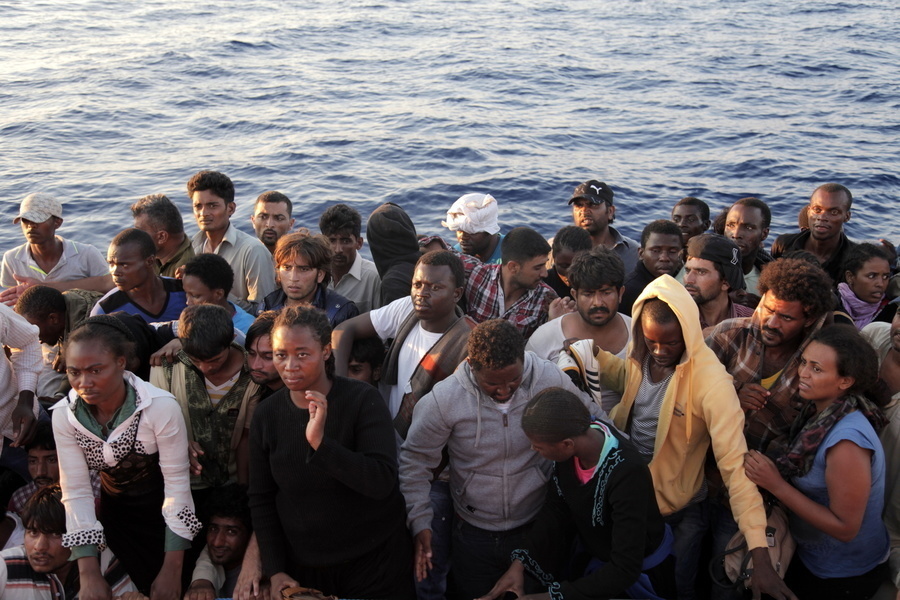
Human trafficking that comes from the sea
Human trafficking comes from the sea
In the latest report from the World Organization for Migration you can find the story of Blessing, Precious, Nina and many others. All victims of human trafficking across the Mediterranean. Women sexually exploited. Often minors. Which we may have seen on the side of a road. In 3 years, potential victims have increased by 600%
Blessing (the name is fictitious, but the story is true) is 18 years old and was born in Nigeria. Having landed last year in a Sicilian port, the woman was hosted in a reception center in a city in Northern Italy. From the station in that city, one day Blessing contacted the International Organization for Migration (IOM). And, crying, he told the operators:
«I was deceived. A woman from my town promised me that I should work in a grocery store. I trusted her. He had also paid my ransom when I was kidnapped in Libya. When I met her one evening in Italy, she gave me some very provocative clothes, that's when I realized I had been deceived."
At the end of that phone call, IOM staff immediately contacted the anti-trafficking association of that area, which searched for the girl at the station. Since then Blessing has been hosted in a protected facility, where she received a residence permit and is now attending an Italian course.
From prostitute to cultural mediator
During an anti-prostitution check along a suburban road in Sicily, a police car encountered Precious. The girl was 17 years old, crying and scared.
«I had never had sexual relations with a man before coming to Italy. Now I'm on the street prostituting myself twelve hours a day. I'm afraid I got sick. I can't sleep at night. I often knot the sheets to throw myself from the building. Or, I pack my suitcase to escape, but I get stuck in front of the door. I'm afraid to go back on the street. Help me", he told the IOM operators.
A few weeks after that story, the young woman reported her exploiters, despite the heavy threats she suffered from her relatives who remained in Nigeria. Today Precious speaks perfect Italian and is studying to become a cultural mediator.
Read also: Become a prostitute in 30 days
Nina's story, from Benin City to Lampedusa
Nina's is also a story of slavery and subjugation. She was 17 years old when she arrived in Italy from Nigeria. She had run away from home a few years earlier due to her father's abuse and found herself on the streets working as a prostitute in Benin City. Then, one day, a man named Kenny, a client of hers, told her that he had fallen in love, asking her to follow him to Europe. Nina accepted, hoping for a better life and committing during a voodoo ritual to pay the sum of 25,000 euros as a reward for the help received. After a month, however, he found himself in Babha, where his hell began - once again.
In Libya Nina was forced to prostitute herself for about two months, until she decided to leave for Italy. And in October 2015 she was rescued at sea. Upon landing in Lampedusa, Nina listened to the IOM information on human trafficking, but did not express any request for help.
Prostitution and Nigeria: Bodies for sale: the time of the Nigerians Nigerian mafia to conquer the North
Human trafficking in the IOM report
Dozens of stories like these are contained in the report "Human trafficking through the central Mediterranean route: data, stories and information collected by the International Organization for Migration", published a few days ago by the IOM, the main intergovernmental organization in the field of migration, as well as an agency linked to the United Nations. The report reads:
«In the space of three years the number of potential victims of trafficking for the purpose of sexual exploitation arriving by sea in Italy has increased by 600 percent. It is an increase that involves increasingly younger girls. It is a phenomenon that affects 80% of girls arriving from Nigeria. There were 1,500 in 2014. However, in 2016, there were 11,00 Nigerian women landed at risk of exploitation."
“Trafficking is a transnational crime that disrupts the lives of thousands of people and causes unprecedented suffering,” says Federico Soda, director of the IOM coordination office for the Mediterranean. The latest report, explains Carlotta Santarossa, IOM project manager, "describes the difficulties encountered in the protection and protection of victims, and the main vulnerabilities identified".
Furthermore, Santarossa continues, «trafficking is a painful form of slavery. Therefore, it is necessary that the data analysis is accompanied by a reflection on the evidently growing demand for paid sexual services."
Multi-agency working against human trafficking
«The difficulties that we operators often encounter in the work of identifying victims of trafficking can be attributed to the nature of the complicated network of exploitation, which is increasingly organized and widespread in the different territories», explains Pina Di Bari, legal operator at the social and humanitarian protection office of the Municipality of Venice. “It is difficult to position ourselves as antagonists to these organizations that offer every type of service to their victims.”
But solutions exist. Di Bari further says: «One of the possibilities for governing exploitation lies in multi-agency work, that is, joint operations between judicial authority and social action. A working methodology that has brought forward important complaints against criminal networks and the establishment of civil proceedings for several victims."
Therefore, the tools to combat exploitation are there. Starting from the National Action Plan against trafficking and serious exploitation of human beings adopted by the Italian Government for the years 2016-2018. A provision that identifies potential victims of trafficking in the different contexts in which it can occur. But it must not remain just a declaration of intent, given the urgency posed by the phenomenon of new slaves.
For further information: Internet and human trafficking Fight against trafficking: here's where we go wrong Libya, the slave trade is back
Migrants: there is a "humanitarian crisis" in Rome
Yemen in pieces: no more weapons for Saudi Arabia
Human trafficking: Russia accused of inaction and complicity
Human trafficking: the situation in Italy
3 October: Remembrance Day in the analyzes of IOM, UNHCR and Unicef
Terrorism Nigeria, forced abortions and massacres of children: the secret hellip plan;
Your email address will not be published.
Save my name, email, and website in this browser for the next time I comment.
Military spending or welfare state: in Italy rights remain broke
Masafer Yatta, Mediterranea denounces a "laboratory of ethnic cleansing"
Taser, at least eight dead: Francesco Pelle's sister speaks
Guantanamo, the US prison where the rule of law disappears
American consulate in Milan: dozens of bricklayers victims of "para-slavery"