
Italy-Libya agreement: this is how migrants' rights are violated
Italy-Libya agreement: this is how migrants' rights are violated
Two years after the Italy-Libya Agreement, Oxfam and Borderline Sicily release a report denouncing the violation of the human rights of migrants and refugees: 5,300 deaths in two years, of which 4,000 only in the central Mediterranean route and 143 deaths out of 500 arrivals in 2019
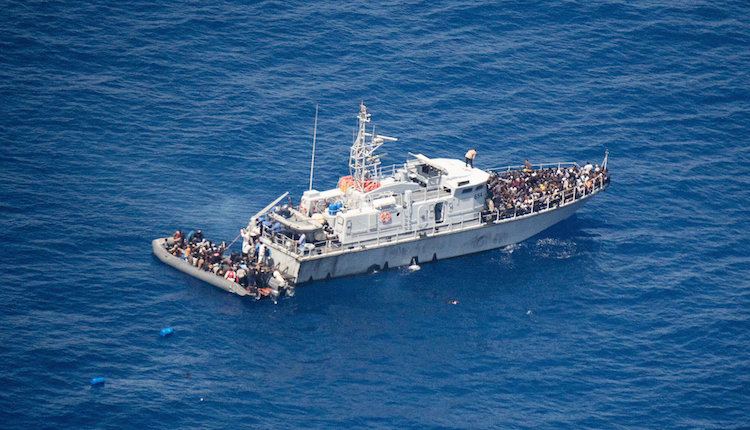
«The signing of the Italy-Libya Agreement was the first step with which Italy implemented a strategy aimed at circumventing the constraints of international law regarding the protection of life at sea». Oxfam Italia and Borderline Sicily do not mince too many words in releasing the new report which denounces - two years after the signing of the Agreement - the widespread violation of human rights on the topic of migration.
The report speaks of 5,300 deaths in two years, of which 4,000 only in the central Mediterranean route and 143 deaths out of 500 arrivals in 2019 alone. Without forgetting the thousands of people detained in Libyan prisons, women and children fleeing war and hunger, and the 15 thousand migrants brought back by the Libyan Coast Guard, thus fueling human trafficking.
Italy-Libya agreement: here's what it provides
Reduce the flows of migrants trying to reach Italy from the Libyan coasts. This is the objective of the agreement reached between the Italian government (at the hands of the then prime minister Paolo Gentiloni) and the Libyan government of national unity (by the prime minister of the Fayez al Sarraj government) in February 2017.
The agreement effectively provides for new aid from Italy to the Libyan authorities involved in reception operations and combating illegal immigration, therefore to the Libyan Coast Guard, with the aim of reducing illegal trafficking by sea and improving the conditions of the "reception centres" on Libyan territory, financing the purchase of medicines and medical equipment, as well as the training of the staff employed.
«A turning point that authorizes hope for the future of Libya», were Gentiloni's words on 2 February 2017, commenting on the signing of the memorandum (never ratified by Parliament). But Oxfam and Borderline Sicilia do not share the same opinion.
«There are four – states Paolo Pezzati, policy advisor for the migration crisis of Oxfam Italia – the moves which according to our analysis have caused a real setback to human rights, generating disastrous effects on the mortality rate in the central Mediterranean route which went from 1 victim for every 38 arrivals in 2017 to 1 for every 14 in 2018».
Crime against humanity. This is how Paola Ottaviano, lawyer of Borderline Sicily, defines the migration policies of Italy and Europe, commenting on the Italy-Libya Agreement reviewed by the report.
«We consider it very serious – states the lawyer – that two years after the signing of the memorandum, in light of the countless international reports that have denounced the lack of respect for human rights, Italy and Europe are persevering in migratory policies that will be remembered by history as a crime against humanity».
Immigration: how the Agreement circumvents international law
Bringing migrants back to Libya only increases human trafficking. The report reaches this conclusion in exposing the first move with which it is believed international law to protect the human rights of migrants is circumvented. There are currently 6,400 people in official places of detention in Libya and many others are held in unofficial prisons, some run by Libyan armed groups. And if you consider that - according to the UN - even the official centers in many cases are "managed - says Pezzati - by the same people involved in human trafficking and human trafficking, it becomes clear that bringing migrants back to Libya only fuels human trafficking".
Read also: • Italy-Libya: rain of appeals for violation of migrants' rights • Libya: hell beyond the sea
In short, Libya - the report specifies - is not a safe haven. And in light of this evidence we ask ourselves how we can "continue to consider it a legitimate actor in a search and rescue area with its Coast Guard, considering the systematic and daily violations, torture and abuse of all sorts, in detention camps comparable to official and unofficial concentration camps".
«The prison in Bani Walid was a hangar while in Sherif we were locked up in an underground tunnel where we lived constantly in the dark – is the testimony given to Oxfam and Borderline operators by a 28-year-old Eritrean kidnapped from one of the many Libyan banks – In total I lived a year and a half of detention in both prisons, where we all lived in terrible conditions, with many people falling ill, without receiving treatment. Many died and were buried like animals. The women, however, were raped in front of us. We were beaten every day by prison guards, who forced us to ask our families for ransom."
Migrants in Italy: fewer landings, but the risks increase
Months after the pressing Italian requests to regionalize rescue at sea, Frontex (the European Border and Coast Guard Agency) launched Themis, changing the mandate of the Triton operation. The innovation introduced by Themis at the request of the Italian government provides for the obligation to disembark rescued migrants and shipwrecked people in the port closest to the point where the rescue at sea was carried out and no longer automatically in an Italian port, as happened with the Triton mission.
Read also: • Human trafficking: UN proposes six sanctions in Libya • Walls in Europe: fear of immigration builds a thousand km of barriers
Furthermore, the patrol line of the naval units involved was placed at the limit of 24 nautical miles from the Italian coasts, reducing the operational area (Triton reached 30 miles). Only for people rescued within the limit does disembarkation in an Italian port become automatic.
«A condition – we read in the report – which consequently exposes migrants to further risks. All this, while the central Mediterranean route confirms itself as the most dangerous in the world, with 937 dead and missing between June and December 2018 out of a total of 1,311 in the entire year and 143 victims out of 500 arrivals to date in 2019".
Minister Salvini and the "closed ports": from the Aquarius to the Sea Watch
The current government - according to the analysis presented in the report - accepts the approach of the previous government and takes it to the extreme, starting a hand-to-hand fight both with other member states and with the boats that rescue shipwrecked people. The report cites the case of the Lifeline, the German NGO vessel which, during some operations off the coast of Libya, in June last year, rescued 229 migrants, but found the ports closed in Italy, which had even threatened to seize it (an affair which ended with the migrants disembarking in Malta and their reception in eight European states). The second case, that of the Lifeline, after that of the Acquarius, forced to head to Valencia after a push and pull between the various European governments.
That of the Lifeline «represents – we read in the report – the precedent that led the European Council of last June to include in its conclusions the faculty for member states to subordinate disembarkation to a prior agreement on the redistribution of migrants on board. A measure which establishes the renunciation of seeking structural solutions and which inaugurates a phase in which decisions are made on a case-by-case basis."
And again. The case of the Diciotti ship, a patrol vessel of the Italian Coast Guard, with 177 migrants on board rescued off the coast of Lampedusa, which arrived in the port of Catania in August. Malta refused to welcome them and Italy refused to let them disembark in the absence of an EU agreement on the distribution of refugees. The affair ended with the reception of the migrants in Church structures, partly in Ireland and others in Albania (although subsequent investigations later demonstrated that no agreement was ever made with Albania, which therefore never welcomed any migrants from Italy). And with the investigations by the Court of Catania against the Minister of the Interior Matteo Salvini for kidnapping, illegal arrest and abuse of office, who however asks the Council for elections and parliamentary immunities to deny authorization to proceed.
«On board the Diciotti ship – this is the testimony of a 29-year-old Eritrean who disembarked from the Diciotti – the conditions were terrible. It was impossible to stay in the sun but there was only one awning. There wasn't enough shade for everyone and when it rained we got wet. There were only two bathrooms. After two days of arriving in Catania they handed us some clothes and told us we had to take a shower. There was a sailor with a hose who sprayed water for a minute on ten people at a time, placed naked behind a plastic sheet. Practically no one got a drop of water. That was the only opportunity for us men to wash ourselves."