
Mafia and politics, what the results of the recent administrative elections teach us
Cpr - Repatriation detention centers
Islands. Spaces of education and civil disobedience
Cpr - Repatriation detention centers
Islands. Spaces of education and civil disobedience
Mafia and politics, what the results of the recent administrative elections in the South teach us
In the last elections, thousands of municipalities went to the vote, even among those under mafia control. The electoral results in the south signaled record abstentionism and the still strong role of political clientelism, the driving force of mafia control. In addition to the little usefulness of the law on the commissionership of infiltrated municipalities
Isaia Sales Professor of Mafia History
On the day of the European elections, thousands of Italian municipalities went to vote to also choose the mayor. Among those interested in the renewal of administrative positions there were also some who were returning to the polls after several months of commissionership following a dissolution due to mafia infiltration. Seven in total, of which three in Campania (Castellammare di Stabia, Torre Annunziata and San Giuseppe Vesuviano), two in Calabria (Soriano Calabro and Portigliola) and two in Puglia (Trinitapoli and Neviano). Adding to the seven those that have been subject to multiple dissolutions in the past, or whose name recalls dark times in which the control of the mafias was very pressing (think of Casal di Principe, Corleone, Gioia Tauro, Manfredonia, Casapesenna, Castel Volturno, Castelvetrano or Mesagne itself, birthplace of the founder of the Sacra Corona Unita), the picture is broad enough to draw some evaluation on the way in which the political system deals with the issue of the relationships of the mafias with the municipal administrations and some considerations on the usefulness of the law approved in July 1991 on the dissolution of the municipal and provincial councils which had the aim of sanctioning criminal influences on local life and at the same time discouraging relationships between political exponents, public officials and mafiosi.
Municipalities dissolved due to mafia: numbers, reasons and consequences
The real defeat: the absence of candidates
Meanwhile, a preliminary question must be clarified: the fact that some anti-mafia flagship mayor was not elected or that the side that most tenaciously advocated a commitment against the gangs lost does not automatically mean that a mayor or a side favorable to relations with the mafia won. Defining every vote that does not reward those who declare themselves anti-mafia as mafia is an offense to common sense and a damage to the anti-mafia movement. In municipal elections there are many factors that influence citizens' behavior.
For example, I believe that the failure to present any list in the paradigmatic country of a certain excessive power of the 'ndrangheta in Calabria, namely San Luca in the province of Reggio Calabria, is the most worrying episode for the anti-mafia compared to the failure of some candidates and groups involved in the fight against the mafia to win. In that municipality, adding the years of commissionership due to 'Ndrangheta influences to the years of commissionership due to lack of aspirants to the role of mayor, we discover that there are more years in which state officials lead administrative life than those in which a democratically elected mayor was in office. For a long period the democratic life of an entire community was effectively suspended. Can the anti-mafia movement as a whole ever allow something like this without an adequate reaction?
Abstentionism above all records
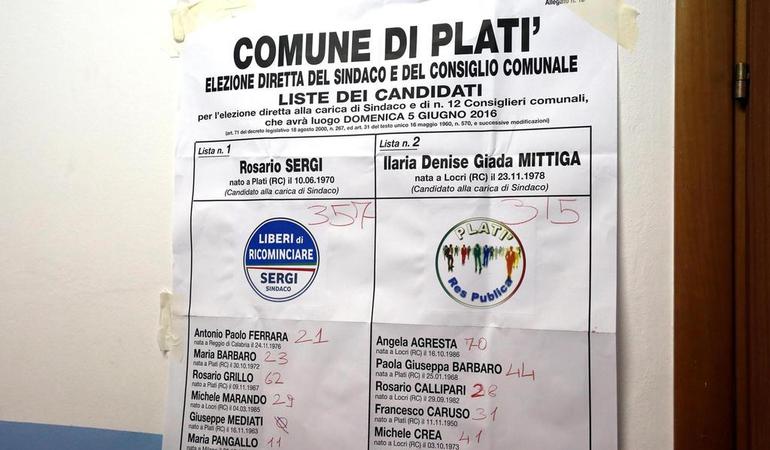
Equally disturbing is the fact that in several Calabrian municipalities impressive levels of non-participation in the vote have been reached. In Platì, another municipality symbol of 'Ndrangheta power, only 13.45 percent of those entitled to vote voted in the European elections, while in San Luca just 16.17 percent! What is left of the State or of a minimal idea of democracy when less than 20 percent votes in the European elections? What if there are municipalities where there is no candidate for mayor willing to stand for election for fear of mafia clans or for fear of ending up under the spotlight of the judiciary or the prefectures with the possibility of dissolution due to the mafia? And if we consider the fact that many municipalities where there is such a minority participation in the vote were led by officials from the prefectures and the Ministry of the Interior, we are obliged to make a serious examination of the usefulness of the law itself if in the end it produces a total disaffection from democratic life and an estrangement from the State and its prerogatives of these proportions.
Discover our magazine!
Investigations, interviews, data, columns: because knowing is a right, remaining silent is a choice. On paper and digital
The spotlight of national politics on San Luca
Stefano Massini, the only Italian intellectual to ask himself the question, wrote an article worthy of being framed on the front page of La Repubblica about the situation of San Luca, the birthplace of Corrado Alvaro (and dear to his many admirers) which instead has become the place par excellence of the feud between 'Ndrangheta families and emblem of the State powerless to guarantee the practice of democracy in places of mafia. His proposal that Giorgia Meloni and Elly Schlein present themselves in the next elections in that municipality at the helm of two alternative lists has the charm of an enlightening provocation.
Pointing the spotlight of national politics on San Luca would be a demonstration that we are not deaf to the desperate cry of many citizens who have not voted for their mayor for years, and every time they do so there is a risk that the person chosen by them could end up killed, in prison or run away so as not to end up in prison, under investigation or killed. And it would be appropriate for the Minister of the Interior and the Minister of Justice to also present themselves as candidates for San Luca. Returning in memory to the words pronounced in 2007 by the then national anti-mafia prosecutor Piero Grasso before the parliamentary anti-mafia commission ("In certain towns such as Africo, Platì and San Luca, it is the State that must try to infiltrate"), we can safely say that the State in San Luca has not yet made it!
Municipalities dissolved by mafia, from difficulties to the "third way"
The results are not unique
Going into the merits of the most striking results in these towns "under observation", one cannot help but highlight a certain ambiguity of signals. In any case, we cannot speak at all of the defeat of the anti-mafia, much less of its success. Let's look at Casal di Principe, after ten years of administration of an exemplary mayor like Renato Natale, with interesting administrative and civil results, none of the mayoral candidates from his side went to the runoff. Can this result be considered as a sign of going back to when the meetings of the Camorra clans were held at the home of the Christian Democrat deputy mayor of the town? No, although it is disturbing that the evening before the elections machine gun shots were fired right in the center of the country. The fact is that, if the "progressive" camp had presented just one candidate (and not three as later happened, all part of the Natale administration) the result would have been very different.
Different situation in Castellammare di Stabia, a town of more than 60,000 inhabitants, historical cradle of the Neapolitan and southern left. Well, after the dissolution of the city council due to the Camorra, which deeply affected public opinion, Luigi Vicinanza, former director of l'Espresso, a weekly that made the history of mafia investigations in Italy, won. The result still worth reading carefully is that of Torre Annunziata, a town of 40,000 inhabitants also with solid left-wing traditions, where after a Democratic Party mayor was sent home by an inspection by the ministry which had ascertained several episodes of Camorra influence on local administrators, another representative of the Democratic Party was elected in the run-off also thanks to the fact that his challenger (a university professor doctor) had had to withdraw due to some shameful statements against gays.
While in Corleone the candidate supported by Totò Cuffaro, the former president of the Sicily Region sentenced to seven years in prison for relations with the mafia, won over candidates who were historically expressions of the redemption phase of the country of origin of two leaders of Cosa Nostra, Salvatore Riina and Bernardo Provenzano. While in Gioia Tauro a woman was elected mayor for the first time and in Roccella Jonica and Mesagne there was the reconfirmation of a model of good governance, demonstrating that in the South it is possible to have effective administrations by fighting the mafias. In short, if in Sicily, thanks also to the long phase of reorganization of the mafia power system, politics seems to have returned to the ease of the past in dealing with this topic, in other regions the signs are not univocal. The fact is that even in countries where mafia control has been suffocating, the issue does not seem to excite voters and even less political forces, but this does not mean at all that we have returned to a passive acceptance of the inevitability of these relationships.
In conclusion, I try to highlight three issues that seem central to me when addressing the topic of relations between mafia organizations and politics at a local level.
From Dia a proposal to stop the mafias, but not the economy
Don't let your guard down about conditioning
The first. The need to keep this concern alive is still widely supported by an indisputable fact: the mafias' objectives are to take over or influence many economic activities directly managed by municipal administrations. Lowering our guard on this aspect by claiming that the mafias with their profits no longer have an interest in influencing local economic and political life means staying out of touch with the world. This does not mean that we have returned to the times when that domination was absolute, inextricable and unpunished. Many things have changed, starting from the formation of a stable public opinion capable of discouraging any political or civic formation from establishing clear relationships with exponents of the mafia clans. The latter must also operate with greater discretion than in the recent past.
But the anti-mafia fight is not a matter of hordes of fanatics, of boasters who have invented a danger that doesn't exist or who have artfully exaggerated it, or who have taken advantage of the mafia danger for their professional career. Of course, someone did it, but how can we forget that the mafias have influenced local political life and the history of Italy more than any other strictly criminal phenomenon, and have caused more victims than any other form of violence from 1861 onwards, excluding the two world wars. In any case, an excess of attention is better than the denial about them that has characterized the entire national history and certainly the first thirty years of republican Italy.
The mafia danger has changed in intensity, of course, but the surrounding society has also changed. The action of breaking the old balance between mafia and politics, brought about by the action of the judiciary, met with the profound changes that occurred in southern society which had not previously managed to emerge even though they had been flowing under its skin for some time. And it was undoubtedly the anti-mafia movement, or if you prefer the attitude of Southern society towards the mafias in recent decades, that marked the largest and most significant civil and cultural "shock" in contemporary Southern Italy. In just a few decades, mafiosi have gone from men of honor to criminals in the opinion of the majority of southern public opinion. A very important cultural revolution, this one, quite consolidated even if it does not always manifest itself plastically in electoral orientations.
Some investigations into various local administrators damage the relationship between elected officials and voters because they indicate an incorrect way of gathering consensus
A fight against the patronage systems that are still widespread, even in the Democratic Party
The second. In the South the profound changes in common sense and in the perception of criminal phenomena find a limit in the patronage system. The belief that customers do not in themselves expose themselves to the danger of mafia influence is widely spread. It could be said that, if the aversion to mafia systems of control of local resources is quite consolidated, it is not equally consolidated to patronage systems of gathering consensus. In recent decades, the Democratic Party has also become less intransigent on this aspect and many of its local representatives manage public affairs with the same methods as the politicians they once contested.
Now all scholars are aware of the blurred boundary between the two systems and the inevitable interconnection that occurs at a local level. You can be a clientelist without being a mafia member, but you cannot exercise mafia control of economic resources without going through the clientelist system of managing them. The anti-mafia battle will be more complicated in the future if support is not given to a mass campaign against clientelistic management of public affairs. In the South you cannot be anti-mafia if you do not also fight political clientele. The Democratic Party has a great role in this battle, starting with the marginalization of its most compromised political exponents on this front.
Mafia bourgeoisie and gray zone: where mafias, business and politics meet
Rethink the law on the dissolution of municipalities
Thirdly, we need to ask ourselves a question: is the law on the dissolution of municipal councils due to mafia still useful? Of course, this law does not enjoy great empathy not only among the politicians involved but also among the population and voters. Of all the anti-mafia regulations passed over the years, it is certainly the least effective and the least popular. Has it contributed to eliminating or reducing the problems that justified it? In my opinion no. We have reached the fourth dissolution for some municipalities and for many we have surpassed the second and third. In these conditions the law conveys a sense of the state's impotence to meet the objective it had set itself. And when this sense of impotence of the institutions is transmitted, everything becomes more difficult.
Isaia Sales, Introduction to The dissolution of the municipalities due to the mafia. Analysis and proposals. Public Notice Report edited by Simona Melorio, Altraeconomia 2019.
Isaia Sales, History of the Camorra, Rubbettino 2022
Isaia Sales, Simona Melorio, History of corrupt Italy, Rubbettino 2019
Isaia Sales, History of the Italian mafia, Rubbettino 2015