
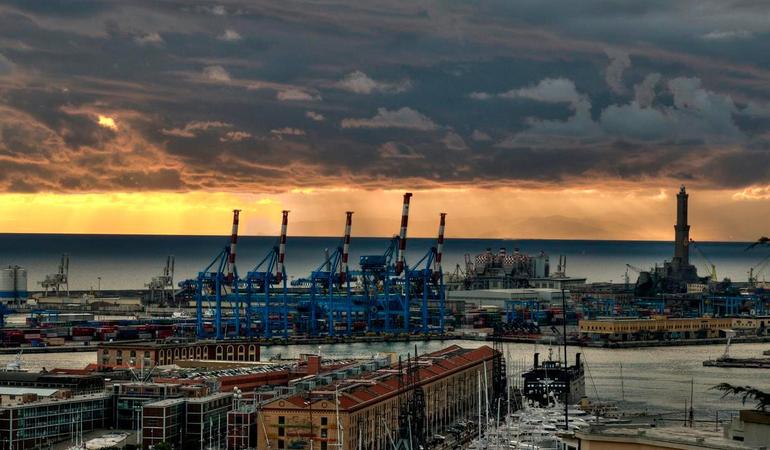
Ports, illicit trafficking and mafia affairs
Cpr - Repatriation detention centers
Islands. Spaces of education and civil disobedience
Cpr - Repatriation detention centers
Islands. Spaces of education and civil disobedience
Ports, illicit trafficking and mafia affairs
In seaports, business can take place, legal or illicit, which attracts the interests of organized crime, capable of acting as a service provider or intermediary. This also applies to Italian ports and our mafias. An extract from the book "Ports and mafias", written by Marco Antonelli and published by Rubbettino University
Marco Antonelli Research fellow in political science at the Scuola Normale Superiore
We publish an excerpt from the first chapter of the book Ports and mafias. Criminal interests in the ports of Genoa and Gioia Tauro, written by Marco Antonelli and published by Rubbettino Università.
In addition to being a strategic infrastructure for illicit trafficking, seaports can also be an opportunity to invest in legitimate activities. Some studies have analyzed the connections between organized crime and the sectors of the legal economy, focusing attention on the relationship with the labor market.
Among the best-known cases is that relating to the port of Marseille, where since the early years of the twentieth century the development of groups has been found which, assuming ever greater importance at an international level in illicit markets, have been able to exploit the widespread corruption of the local government and forge links with the local political system thanks to their presence in the port area (Monzini 2003). These factors made it possible not only for the continuation of illicit activities - which were not prosecuted by the authorities - but also for some members of the criminal families to assume top roles among the economic actors of the port, as in the case of the leaders of the Syndicat des Inscrits Maritimes, one of the port workers' unions. These groups, through the dual role of trade union representatives and criminal exponents, were able to "monopolise the daily work of the port workers" (Monzini 2003, p. 181), becoming, in fact, guarantors of the entire port socio-economic system (Monzini 1999).
New York Harbor
Similar evolutionary dynamics have been recorded in New York Harbor since the beginning of the twentieth century (Jacobs 2006). Some research has looked at the interests of some mafia families, whose bosses, after having operated in the illegal alcohol trade and accumulated economic capital, transformed their business by starting to play the role of mediators, which allowed them to forge links with politicians and entrepreneurs, necessary to also infiltrate the legal economy (Lupo 2008).
In the port this is clearly visible when looking at the composition of the time of the International Longshoremen's Association (Ila), the longshoremen's union, and of the City Democratic Club of South Brooklyn, where the leaders of the local criminal groups were present. In that context the gangster network was addressed "as the guarantor of economic activities or the redistributor of resources" (Lupo 2008, p. 97). The ILA, in fact, was the entity that institutionally managed and coordinated in a monopolistic way the approximately 30 thousand port workers, divided into 31 union locals, each of which managed a quay and dealt directly with the individual company for the supply of manpower. This "mix of monopoly and competition, guaranteeing precarious employment and low wages, was well appreciated by businesses" (Lupo 2008, p. 99) and guaranteed criminal groups broad power, which translated into the possibility of establishing a dialogue also with the world of politics.
Other research has highlighted how in the study of ports too much importance has been given to the structure of the labor market within them, while what is useful to analyze - at least in the case of New York in the twentieth century - is "the relationship between organized crime and private enterprise within a regulated and organized market" (Block 1982, p. 373). This dimension must be linked with a study on the impact of regulatory agencies such as the Waterfront Commission of New York Harbor, created specifically to control organized crime, although not always effectively (Levy 1989). According to this analysis, the main activity of the criminal groups was the professional management of protection and regulatory services in response to a need of the port's business market, which requires the absence of protests from workers. In this case, therefore, corruption in the selection and control processes of personnel becomes an institutionalized practice within the port, the main mechanism for regulating the labor market and, as a consequence, also of port operations (Block 1991).
Libera shines a light on crime in ports: "Shy policy"
A study relating to the port of Genoa highlighted how "the different segments of the port economy are opportunities that the economy of a city offers to organized crime" (Sergi 2021, p. 9). According to this analysis, these phenomena can also be expressed to "exploit the opportunity of contracts for services in the port, for example for construction, the supply of machinery, catering services and so on" (Ibidem).
In the Ligurian port this seems to have happened, highlighting how there is a strong connection between the urban economy and the port economy, and how the spaces for operating in these intersections are characterized by strong competition in which organized crime can play an important role. This perspective is useful because it helps to frame the port in a local vision, strongly interconnected with the urban fabric and, consequently, with the legal and illegal economies present in it. Other studies that have looked at private economic actors, in particular port management, as subjects who can facilitate criminal presence or who are potential roles of interest for criminal organizations to fill (Storti et al. 2023) also fall into this wake.
The ideas that have emerged thus far suggest, therefore, looking at the phenomenon by analyzing not only the structure of the markets (in particular the labor market and the relationship between criminal groups and businesses) restricted within the port space, but also at the connections, links and implications that these define with the opportunity structures offered by the territorial context. This therefore leads us to also deal with the functioning - and malfunctioning - of port governance, local politics and the economies linked to the ports.
Genoa, dock workers in the pay of narcos
The great variety of illicit activities in ports
On the other hand, illicit markets linked to maritime activities can also be multiple, including piracy, terrorism, illegal fishing, environmental pollution, theft of ships or human trafficking (Klein 2011; Edgerton 2013; Massari 2017; Carnì 2024). What is of interest in this analysis, however, concerns exclusively those markets that find some type of event within the airports. In ports, in fact, there are illicit projections which in some way present a certain link between the maritime dimension and the terrestrial dimension, which requires adopting an analytically more limited perspective.
In many of these cases, illicit trafficking exploits logistics networks and infrastructures already intended for legal markets. From this perspective, the concept of structural embeddedness is of interest. Ports, in fact, lend themselves to being places where criminal activities are structurally established within legal circuits: "offering a combination of nodes, routes and borders, some professions offer excellent opportunities for organized crime activities, particularly in relation to the supply of illegal goods and services. For example, knowledge of international maritime routes, international road transport, import and export routines and the social contacts that are established on these routes are useful to both criminal entrepreneurs and businessmen legitimate" (Van de Bunt et al. 2014, p. 328).
The port, therefore, is not only a place of connection between commercial and exchange networks for actors in the legal sphere, but also for illegal ones. It is important to note how the concept of embeddedness is applied here both to evoke the spatial and social dimensions.
The European alliance of ports against narcos is signed in Antwerp
Supporting this close link between illegal markets and infrastructures, at the same time, does not exclude the creation of parallel and alternative supply chains and routes in maritime routes (Antonelli 2024c). Ultimately, organized crime presents itself as an agent that exploits consolidated flows and pre-existing economic channels, but is also capable of creating its own. This dual dimension is extremely interesting both in theoretical terms and for its practical implications: depending on the level on which they manifest themselves, criminal organizations are induced to resort to different instrumental, human and professional resources, often external to the organization itself. For example, transporting a load of cocaine on a container ship from one port to another requires very different skills and organizational capabilities than transporting a similar load on an owned vessel (Antonelli 2024a).
The fact that criminal organizations use existing trade routes makes them in some respects dependent on their functioning or malfunctioning, as well as on the changes that occur both in the world of shipping and within the individual port of call (Antonelli 2024a). According to some authors, criminal groups "are strongly influenced by variations in the commercial factors of seaports and the routes and commercial programs of shipping companies" (McNicholas 2008 p. 192).
Minimize risks
At the same time, it is undeniable to recognize that the supply of transport is so high and interconnected that it is often possible for criminal organizations to identify an alternative trade route or a different port of call even during these changes. In fact, some studies show how traffickers are less influenced by the geographical position of the airport compared to the territorial area of origin of the criminal group, while there is greater attention to the fact that the risk of loss of the illicit substance is minimized (Zaitch 2002).
In other words, for criminal organizations it is preferable to move in territories geographically distant from the place of destination of the goods (or where the group operates) rather than continuing to operate on a route which, for various reasons, could be compromised. As also recognized by some institutional actors, the choice of the port "regards the criminal area of interest and the territory controlled by the organization, but takes place on the basis of the membership that the organization can guarantee, including abroad, as well as the logistical, control and management capabilities of goods transport companies, not only by sea" (Central Directorate of Anti-Drug Services, 2019 report, p. 16).
Drug trafficking, the importance of Guinea-Bissau
The more goods that pass, the better
The dynamics highlighted seem to be particularly evident in studies on drug trafficking. Although security and policing actions "lead to the dilution and fragmentation of drug importation" (Sergi 2022, p. 674), there is a close connection and, in some ways, an overlap between the two levels - legal and illegal - which makes law enforcement activity more difficult, also in terms of possible controls.
Research, in fact, identifies "the large volume of the port – in terms of traffic and capacity – as the main reason for using it for cocaine trafficking" (Zaitch 2002 p. 243). The fact that a port is characterized by a high number of movements and a large quantity of goods makes the control and monitoring action by institutional actors more complicated, which necessarily takes place on a limited portion of the transported goods.
Looking for an opening
The main problem that organized crime groups face in this context has to do with the formal inaccessibility of the port: a closed place, forbidden to those who do not work there or are not authorized to enter (Antonelli 2024b).
Criminal organizations are forced to constantly look for a "door" to access it (Sergi 2022). For this reason they need to have individuals directly linked to the group or in any case available to enter into some form of collaboration within the airport, which means "finding someone with a useful function, corruptible for a myriad of different reasons" (Sergi 2022, p. 687). This tends to happen where the labor market is unstable, since, as some authors argue, drug trafficking deals with "port staff that are not stable but rather transitory" (Eski 2011, p. 418).
To obtain this resource, criminal organizations often resort to corrupt exchanges to which port operators are attracted because they are in debt from a financial point of view (due to drug use or gambling), or to financially support family life, or because they are involved by colleagues (Eski 2016) or even, more simply, to accumulate profits. In other cases, however, criminal networks involve professional figures with managerial qualifications within the port to ensure safe transit of the narcotic.
There therefore seems to be a need for a support network, more or less localised, which makes trafficking possible and contributes to the arrival of the goods, networks which criminal organizations or their affiliates can turn to individually, depending on the organizational level. We note, therefore, that the activity of criminal groups in illegal trading in ports depends to some extent on contextual factors such as the port economy and the labor market.
The resources of the mafias
[...] In ports, therefore, mafias find themselves in the position of having to expand the network of ties with other actors to collect various resources (Antonelli 2024a). This has repercussions not only for the internal dynamics of the port and for the criminal organization, but also on the territorial context and the local criminal context (Sergi 2021). As some studies on cocaine trafficking in the port of Antwerp argue, this "is a global phenomenon that has a local impact on crime in the port and its surroundings" (Easton 2020, p. 115).
From the analysis of published reports (such as those of the National Anti-Mafia Directorate and the Anti-Mafia Investigative Directorate, ed.), it seems that in recent years some ports – such as Ancona, Cagliari, Genoa and Gioia Tauro – have constantly been the subject of criminal projections, while others – such as Livorno, Savona and Vado Ligure – have assumed relevance over time (Antonelli 2021a; Antonelli et al. 2023). Also, the Parliamentary Anti-Mafia Commission (Cpa) has on several occasions recalled the centrality of ports for the mafias, since a 1976 report. Over time, attention on the topic, although not constant, seems to have found more and more space, also through the launch of specific hearings for public and private actors operating in the port sector (Antonelli 2021b).
In several reports, the Parliamentary Anti-Mafia Commission has recognized ports as gateways and meeting places for illicit activities. For example, in the case of Liguria, it has been written that the maritime connections offered by the Ligurian port system "mean that the regional territory has been chosen by organized crime" (Cpa 1994a, p. 141) for illicit drug and weapons trafficking.
In a partially indirect way, the theme of mafia interests in ports also emerges in other reports, where the commissioners analyze the case of Gioia Tauro, in which over time the local 'Ndrangheta gangs and others obtained the assignment of transport of inert materials, and were awarded (directly or through consortia) the contracts announced for the construction of the structure (Cpa 1994b). The Calabrian port is among the most popular. The Commission's effort highlights the dual nature of the port, both as an opportunity for the 'Ndrangheta gangs to traffic illicit goods and as an area in which to infiltrate the legal economy. By way of example, the Commission focuses, among others, on mafia interests in the lashing and unlashing of containers, diesel fuel supply, cleaning services and water supply on the dock. In describing this capillarity of the 'ndrangheta, a few years after the opening of the port, we speak of "resistible mafia occupation of the port of Gioia Tauro" (Cpa 2000, p. 184).
The reports of the Parliamentary Anti-Mafia Commission also allow us to focus attention on the inefficiencies and underestimations of public entities. The commissioners recall how the prefecture of Reggio Calabria had defined the presence in port activities of companies close to the 'ndrangheta as a simple ""stretch" (Cpa 2001, p. 59) and that "no significant prevention action could be ascertained in the territorial bodies belonging to the prefecture of Reggio Calabria" (Cpa 2001, p. 61).
The Cpa's gloss speaks of: "the total absence of coordination and planning of administrative control which, far from assuming those characteristics of attention and rigor that certain environmental circumstances would impose, precisely in the contexts most exposed to mafia infiltration becomes evanescent and in fact, rather than constituting an obstacle to mafia enterprises, facilitates them, with silence, connivance, negligence" (Cpa 2001, p. 62).
Discover our magazine!
Investigations, interviews, data, columns: because knowing is a right, remaining silent is a choice. On paper and digital
The most recent picture in Italian ports
More recently, the parliamentary anti-mafia commission has paid particular attention to the issue of ports, however, declining it in terms of security. A specific report is drawn up, which starts from considerations relating to the "high porosity of the Italian springs, highly exposed to the illicit activities of criminal organizations and in parallel to possible threats of a terrorist nature; the effectiveness of the preventive security measures adopted by the various bodies or agencies responsible for combating the infiltration of organized crime in port areas and the related illicit trafficking from which they derive huge profits" (Cpa 2022, p. 9).
In this debate on ports, the issue of drugs is central for law enforcement agencies. The Central Directorate of Anti-Drug Services (Dcsa) annually presents updated data on investigations and seizures of narcotics that have occurred at borders, including maritime ones, and in particular ports, which continue to be relevant, especially for cocaine (Dcsa 2023).
Although not free from some methodological limitations, this official documentation allows us to explore a peculiar point of view on the topic, as well as to take a snapshot - albeit partial - of the phenomenon. In fact, according to a recent report published by Libera, in which the reports of the Anti-Mafia Investigation Directorate are also analysed, between 2006 and 2022 there were 58 Italian ports of interest to the mafias, with the participation of at least 66 criminal groups, of which 41 are 'ndrangheta groups that operated in various illicit markets: waste trafficking, arms trafficking, cigarette and tobacco smuggling, product trafficking counterfeiting, extortion and usury, and above all drug trafficking (Antonelli et al. 2023).
Marco Antonelli, Ports and mafias, Rubbettino University, 2025
Libera's “Logbook” report
Criminal Networks in EU Ports: Risks and challenges for Law Enforcement, Europol, 2024
Sergi, Anna and Reid, Alexandria and Storti, Luca and Easton, Marlee Ports, Crime and Security Governing and Policing Seaports in a Changing World. Bristol University Press, 2021
Sergi, Anna, Playing Pac-Man in Portville: Policing the dilution and fragmentation of drug imports across major seaports. European Journal of Criminology, 19 (4). pp. 674-691, 2022
'Ndrangheta Spa, the criminal system that has infiltrated Europe, episode of Presadiretta (Raitre) of 13 October 2024
Gioia Tauro. A bet on the future to "overturn" the geography of the Mediterranean, Webdoc by Report (Raitre)