
The lessons of the OPL245 case - ReCommon
The lessons of the OPL245 case
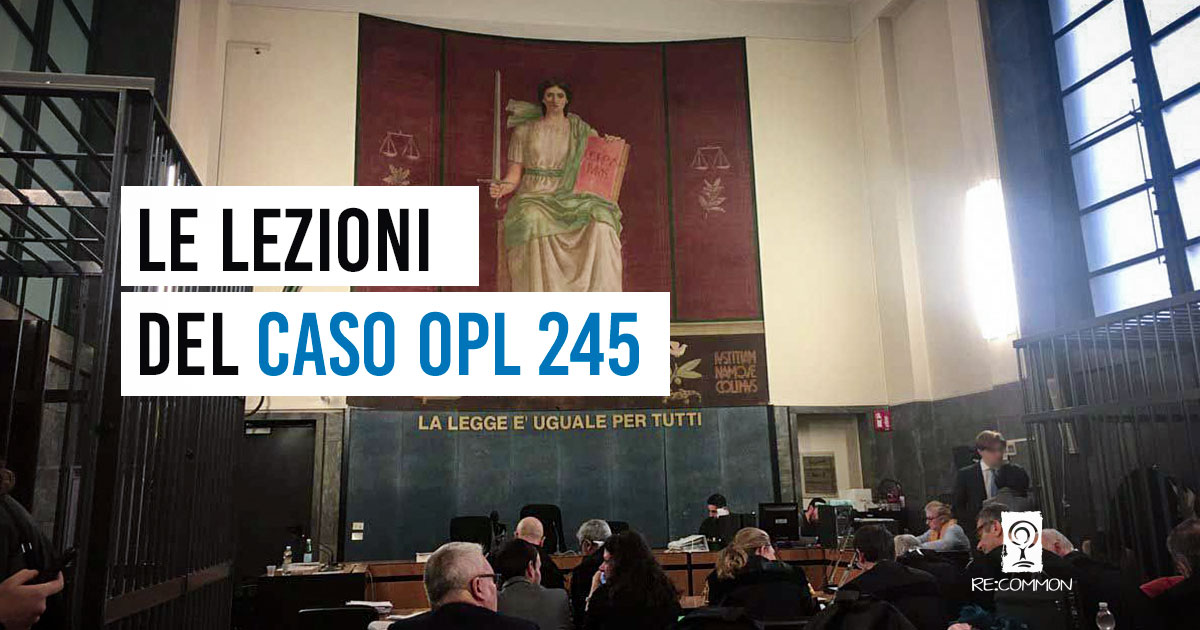
On 17 March, or alternatively on 31 March, the sentence of the trial is expected at the Milan court in which Eni, Shell, several of their top managers, prominent intermediaries and a former Nigerian oil minister are accused for alleged international corruption in the acquisition of the immense OPL245 oil block, located in the waters off Nigeria.
Some observers have defined it as the "trial of the century", not only for the magnitude of the alleged bribe paid - more than a billion dollars - but for the involvement of the largest European multinational (Shell) and the Italian one (Eni).
A first reflection to draw from this international judicial saga is that when there is the courage of civil society that brings criminal complaints, that of the prosecutors who investigate without fearing the big fish and international criminal cooperation works - in this case Nigeria supported the Milan Prosecutor's Office, as well as the Swiss and American authorities - then it is possible to bring to trial even iconic and emblematic cases of the oil industry and malfeasance, such as the alleged corruption of OPL245.
Of course, it is right that justice takes its course in Italy as elsewhere. But today we can already draw lessons from the disturbing insight that emerged from the preliminary investigation held in the Court of Milan regarding the actions of Eni and Shell in complex countries such as Nigeria.
It would be limiting to read that of OPL245 as a simple hypothesis of international corruption. History shows how there is a real problem of democratic control over the actions of energy giants and of the profound infiltration of their interests into the deepest apparatuses of states. A reality that goes beyond the imagination of those who have long criticized the actions of multinationals. Among many, there are three salient points that strike us deeply in this story and they are the following:
The ability of these companies to influence democratic processes in countries like Nigeria, but also here. The OPL245 affair saw a central role of what the Milan Prosecutor's Office defined as the "axis of spies": two English ex-MI6 paid by Shell, the head of Nigerian intelligence, a former Russian ambassador close to Shell and an Italian intelligence man, who in the course of the investigation also became the main accuser of Descalzi Co. Subjects who without problems wrote in their emails of the awareness that the OPL245 money was expected by Nigerian politicians, of the ability to produce the negotiating texts also for the Nigerian government, bypassing the relevant technical agencies, of regular intelligence on each of the actors involved to guide them in the best possible way. A true Parallel State, with a transnational dimension, capable of influencing every process and decision. According to what was reported by the witnesses heard in the Court in Milan, it is normal for this to happen and for the partnership between society and states to advance common interests in every way. Let us then ask ourselves why the OPL245 issue in its seriousness has not been present in public opinion and why this parallel state is able to shift the debate and influence the media and public opinion so much in Italy as in other countries.
Although the fight against corruption is on the lips of all top managers, it emerges from the OPL245 affair that companies' internal anti-corruption standards and procedures are regularly interpreted at discretion. Leaked internal emails and other documents reveal a history of repeated failures to address “red flags” (warnings) about corruption. In this way it was normal for the CEO and number two of Eni to speak regularly on the telephone with a multiple criminal offender - such as Luigi Bisignani - regarding the management of the negotiations on OPL245. Eni's internal anti-corruption structures, unlike those of Shell, reminded their managers until the last day that relevant documentation from Malabu was missing, but then in the end they gave their approval to the agreement. Even when this procedure is considered legal by the various courts, it is right to ask how corruption can be stopped if these are the concrete practices to prevent it in Eni as in Shell.
The denial of evidence, always and in any case. Eni and Shell knew well what a character Dan Etete was, the former oil minister who, at the time of the Abacha dictatorship way back in 1998, had in fact self-registered the OPL245 license through the shield company Malabu Oil and Gas. Etete was convicted in 2007 in France for money laundering linked to corruption in the Bonny Island affair, also in Nigeria. Despite everything, the two companies strenuously continued to maintain that before we did not know that Etete was really behind Malabu - even though independent reports from 2007 and 2010 clearly pointed this out to Eni - and then, once admitted, they entrenched themselves behind the argument that the final agreement signed in 2011 only provided for payment to the Nigerian government, and not to Etete's Malabu. What The Economist defined as "safe sex in Nigeria", done with the "condom" provided on the screen by the leaders of the Nigerian government, who would then pocket large bribes.
In conclusion, guilty or not, of the billion and one hundred million dollars paid by Eni and Shell nothing ended up for the Nigerian government and people. If Nigeria is successful with its damages lawsuits against the companies, it will be important to monitor with the country's independent civil society to ensure that the money is best spent. But in the meantime we can all ask ourselves whether the evidence emerging from the Milan trial reveals companies that can ultimately be trusted. Can these giants be reformed and controlled - regardless of the fact that the Italian government already controls 30 percent of Eni and appoints its top management? Or is their use of revolving doors, infiltration of state apparatus and involvement of ex-spies an integral part of their way of operating?
Shell and Eni are probably irreformable and their business model, written in their DNA and their history, is incompatible with democracy. Therefore they should have no place in the just and democratic transition that should lead us to an ecological society.