
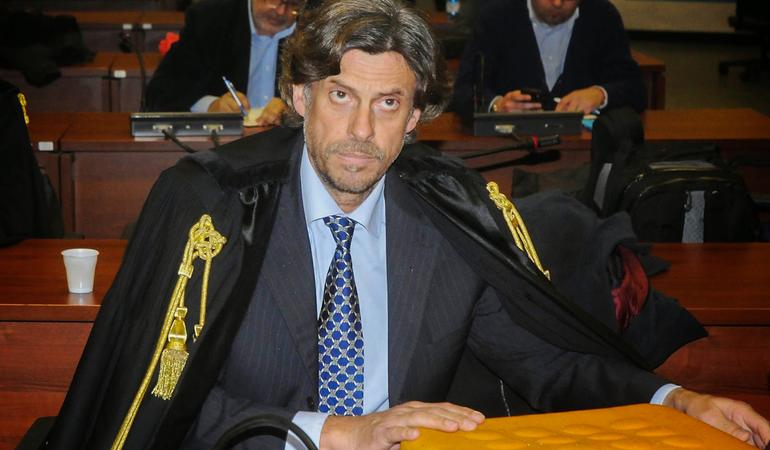
The prosecutor Patronaggio: "In Sardinia there is an alliance between local gangs and traditional mafias"
Cpr - Repatriation detention centers
Islands. Spaces of education and civil disobedience
Cpr - Repatriation detention centers
Islands. Spaces of education and civil disobedience
The prosecutor Patronaggio: "In Sardinia there is an alliance between local gangs and traditional mafias"
Interviewed by lavialibera, the attorney general of Cagliari, a former anti-mafia magistrate, warns of the risk of criminal infiltration in the renewables sector. On the clash between politics and the judiciary: "Democracy is based on checks and balances, it is possible to review parliamentary immunity"
Paolo Valenti Editor lavialibera
Alliances between local gangs, traditional mafias and politics, drug trafficking, risk of infiltration into renewable energy: "Whoever says that Sardinia is a happy island is too optimistic", warns Luigi Patronaggio, attorney general of Cagliari. A past as an anti-mafia magistrate in Palermo, then at the helm of the Agrigento prosecutor's office, he explains to lavialibera what the investigations of recent years have revealed on the presence of organized crime on the island. And on government policies he says: "It's not enough to repress, we need to understand the needs of those who complain."
From the courts of appeal the spotlight is on the mafia economy and crimes of minors
Prosecutor, for years it has been said that there is no mafia in Sardinia. Is that so?
In Sardinia there is no indigenous mafia, in the sense of organizations that replicate the typical methods of southern Italian mafias. But there are two big risks. The first is linked to the historic gangs specialized in kidnapping, which today have recycled themselves: they carry out robberies of valuables and vaults, but above all drug trafficking, both cultivation of marijuana and exchange between soft drugs and hard drugs. They are organized gangs that do not have the typical family structures of Southern mafias, but operate in ways that cause great social alarm. The other danger is that traditional mafias from Southern Italy will come to invest in Sardinia. Historically, the sectors of greatest interest are tourism, hotels and restaurants, but there is a risk that they will also intercept the enormous economic potential given by investments in alternative energies. Finally, we also observe cases of alliances between traditional mafias and Sardinian organized crime. A union facilitated by the co-presence of the respective representatives in the maximum security prisons of the island, but also by the fact that the family members of some inmates move here and therefore export their crime models. In short, when you say that Sardinia is a happy island you are too optimistic.
Speaking of renewable energy, do you see the risk that organized crime could corner public funds intended to encourage the transition, such as those provided for by the Pnrr?
Yes, and for this very reason we have signed a protocol with the Prefecture and the Financial Police to pay attention to this possible problem. The fact that a region historically poor in local entrepreneurship and resources becomes one of the main centers for alternative energies, not only at a national but European level, must arouse particular attention.
He recently raised the hypothesis that the definition of mafia association provided for by article 416 bis could also apply to Sardinian gangs. Can you explain better?
We have precedents that show how these historic gangs have ramifications in public administration and have also made unspeakable pacts with segments of deviant freemasonry. A recent case is the Monte Nuovo investigation (the investigation launched in 2023 by the Cagliari district anti-mafia directorate and conducted by the ROS carabinieri which sees 34 accused for mafia association, ed.). This is of concern, because this type of alliance between organized crime, segments of the administration, politics and deviant freemasonry follows the mechanisms that we have always found in traditional mafias.
You have asked the government that responsibility for investigations into robberies with heavy weapons be transferred to the anti-mafia district prosecutors' offices. Why?
We sent this proposal to the Ministries of Justice and the Interior because we realize that these criminal phenomena, which endanger public safety and security, have unique ramifications and directions. If we break up the investigations into the various prosecutor's offices, we lose the key to the problem. For example, when there is damage, a fire or a bomb in a business in Sicily or Calabria, the first thing to check is whether the origin is mafia and the district anti-mafia prosecutor's office immediately becomes responsible. This is because those phenomena are spy crimes, that is, in those regions it is historically, sociologically and criminologically ascertained that they are mechanisms of organized crime. In Sardinia these episodes, as well as the intimidation of public administrators, are not connected in a unitary perspective, but fragmented. And this fragmentation objectively represents a disadvantage in the conduct of investigations.
Let's talk about prison: data and recent news show that even in Sardinia the penitentiary system is under stress. Can we talk about an emergency?
The situation in Sardinia is critical, but not at the levels of other regions of Italy. Of course, there are prisons, like that of Uta, where we record with a certain frequency and concern both attacks against the prison police and acts of self-harm among inmates, but the numbers are decidedly lower than those in other regions.
Prison: all the articles of lavialibera
Broadening our gaze to the national level, do you think that the government's recent choices regarding criminal justice are going in the right direction?
At the moment in Italy there is great attention towards security policies, which regardless of whether the security problem is real or perceived. Now, the security response cannot be the only answer to the country's problems, because it is right that violence does not occur in the streets and in prisons. But you also need to have the ability to read social phenomena. It is not enough just to repress, it is also necessary to understand the needs of the square, of the prisoners, of the groups who are demanding.
Relations between politics and the judiciary are very tense. Can we talk about a clash?
That there is an ongoing conflict is beyond doubt and even the president of the Constitutional Court has recognized it. It is not just an Italian problem, but one for the entire democratic West, and arises from the refusal of legitimacy control by those who are not elected. Today the international vernacular is "the people elected me so I can do what I want". In reality, democracy does not work like this: there is not only popular legitimation, there are also other types of legality controls. And politics, in Europe as in Trumpian America, does not digest this control, so what it generally tries to do is to place the public prosecutor under the control of the executive and introduce discretion in criminal prosecution (i.e. the possibility for politics to indicate to the prosecutors which crimes to prosecute as a matter of priority, ed.). This would allow politics to act freely, without hindrance. But democracy is based on checks and balances, without which the balance would shift entirely to one side.
"No one can judge me": lavialibera's issue on attacks on the judiciary
Do you see room for lowering the level of conflict?
I believe, for example, that today there are the conditions to return to parliamentary immunity (before the reform approved in 1993 in the wake of Tangentopoli, the vote of the Chamber of origin was necessary to authorize the start of investigations against parliamentarians and not only, as happens today, for the arrest or use of wiretaps; now Forza Italia proposes to restore that mechanism, ed.). The founding fathers had seen in the authorization to proceed a mechanism to establish a boundary between politics and the judiciary, which however was skipped in the season of Clean Hands, perhaps too lightly. It is clear that it is not the same thing to initiate criminal proceedings against a supermarket thief or the Prime Minister. Therefore I do not believe that the reintroduction of parliamentary immunity is a weakness in equality, indeed it is one of the possible mechanisms for settling the conflict.