
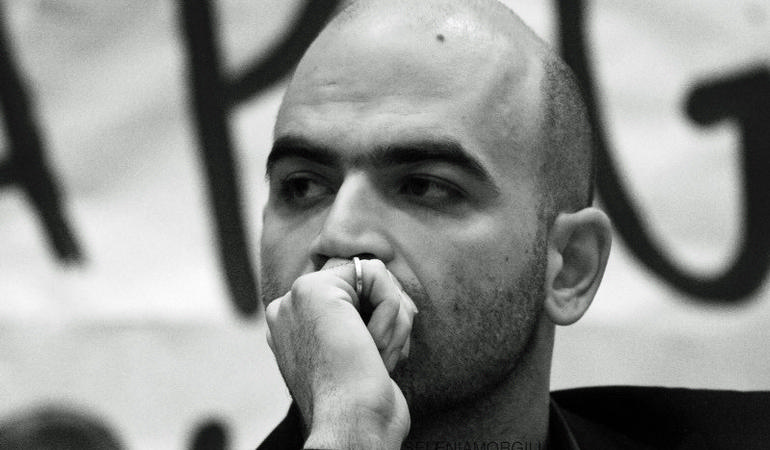
A "precise strategy" to silence Saviano and Capacchione from the Camorra lawyer
Cpr - Repatriation detention centers
Islands. Spaces of education and civil disobedience
Cpr - Repatriation detention centers
Islands. Spaces of education and civil disobedience
Threats to Saviano and Capacchione, sentences for the boss and his lawyer confirmed
The sentence against Casalesi boss Francesco Bidognetti and his lawyer Michele Santonastaso confirmed for the threats made in 2008 in the courtroom to Roberto Saviano and Rosaria Capacchione
Graziella Di Mambro Journalist
Updated on July 14, 2025
Update of 14 July 2025: The Court of Appeal of Rome confirmed the sentence for the boss of the Casalesi clan, Francesco Bidognetti, to one year and six months and for the lawyer Michele Santonastaso to one year and two months in relation to the threats made in the courtroom during the Spartacus appeal trial in Naples, in 2008, to the journalist Rosaria Capacchione and the writer Roberto Saviano. "They stole my life – commented Saviano after the sentence –. Now we have official proof in this second instance that the bosses with their lawyers signed an appeal where they targeted those who reported on the criminal power. And they did not attack politics, but journalism, insinuating that they would hold the journalists, and my name and that of Rosaria Capacchione were mentioned, responsible for their convictions. It had never happened in a courtroom, anywhere in the world".
Below are the reasons for the first degree sentence.
On March 13, 2008, one of the worst wounds to press freedom in Italy was inflicted. A reminder of this, in the days of the awarding of the Nobel Peace Prize to the two investigative journalists Maria Ressa and Dmitry Muratov, is the sentence of conviction for the threats pronounced before the Assize Court of Appeal of Naples by the lawyer Michele Santonastaso, defender of the Casalesi boss Francesco Bidognetti, against two journalists, Rosaria Capacchione and Roberto Saviano, threats so serious that in the following hours one was strengthened and the other was attributed escort. A few days ago the Court of Rome published the reasons for the sentence imposed on the Camorra member (one and a half years of imprisonment) and his lawyer (one year and two months) on 24 May. According to the judges, on 13 March 2008 a "precise strategy" was implemented to silence the author of Gomorra and the journalist of Il Mattino. And there was an effect, as explained by the two writers heard by the Roman judges as offended people: accused of only seeking fame, without any real interest in the fight against the mafia, both Saviano and Capacchione had to change their lives and modify their habits.
The threats in the courtroom before the judges
This story is a vivid insight into what investigative journalism is all about in challenging places on the planet. The Aversa countryside is one of those places. That day, the lawyer of Francesco Bidognetti (and of Antonio Iovine, another leader of that criminal group) read a request in the courtroom to ask to move the trial to another court where, he claimed, there would be a less compromised climate against his client. The text was thirty pages long, quite irregular, given that it was only supposed to make the request for referral known to the judges. Each sentence, however, was shared "expressly by defendants connected via videoconference (...). They personally promoted the application which was filed there", maintain the judges of the Supreme Court in rejecting Santonastaso's request. This means that the content, the threats, came from Bidognetti himself. This aspect, immediately, was considered an act of unprecedented gravity, scandalized and alarmed many other lawyers and many journalists. The Interior Ministry strengthened the protection of the two journalists. The Court of Rome now writes that that "irritual reading in the hearing by the lawyer" had "the ill-concealed purpose of giving public prominence to the act of dismissal and increasing the offensive and intimidating impact".
That act was triggered by the statements made by a justice collaborator, Augusto La Torre, who had previously made accusations against the lawyer Santonastaso then published by Il Mattino. Santonastaso said that those statements had "immediately made the rounds of the region through the complacent and interested support of the so-called printed paper, needless to say always the same, and in the person of the usual hired journalists, namely Rosaria Capacchione, punctual to satisfy with her pen the needs of some prosecutors", and the "well-known novelist" Saviano. In particular, the lawyer stopped to comment on an article dated 6 July 2007: "This article cannot help but disturb the minds of the judges (...), but it is not what we need to underline here but rather it is only an invitation to Mr. Saviano and others like him to do their job well and not to be the pen of those who are moved by very different goals than that of eliminating organized crime". Here is the threat, plunged into one of the most difficult trials ever against organized crime.
Discover our magazine!
Investigations, interviews, data, columns: because knowing is a right, remaining silent is a choice. On paper and digital
The Spartacus Trial
The Spartacus trial served to give the real dimension of the Casal di Principe clan and to account for the power acquired over the years, the ferocity consumed with dozens of victims. It was an image that the leaders above all did not want to be known outside the small controllable perimeter of the province of Caserta. This was the explosive context in which there was a threat to the two journalists and therefore to all Italian information, as the Court of Rome recognized in this sentence, establishing compensation to the National Federation of the Italian Press (Fnsi, the mayor of journalists) and to the Council of the Order of Journalists of Campania.
After seven years and 627 hearings before the Court of Santa Maria Capua Vetere, the trial called Spartacus ended in first instance with sentences in October 2004 and September 2005. The trial revolved around a series of committed and attempted murders by the Casalesi clan between 1988 and 1996. In the end a terrible picture emerged: the Casalesi were formed after the defeat of the Bardellino clan with the killing of the founder, Antonio, already a member of the Nuova Famiglia (the Camorra organization created to counter the New Organized Camorra of Raffaele Cutolo, ed.). The role of Antonio Bardellino passed to Bidognetti, Mario Iovine, Francesco Schiavone and Vincenzo De Falco who took control of everything with military management of the territory and the elimination of any possible dissent.
The dominion of the Casalesi clan
The Casalesi were everywhere: in public procurement, in arms and drug trafficking, in construction, in the control of votes, in the provision of public contributions. Talking about their performance would have very much bothered the bosses, the boss Bidognetti, known as Cicciotto è Midnight. Therefore it was necessary to stop the enemy, i.e. the journalists, and do it in a way and in a place that caused enough stir to get the message both to the rest of the association and to the entire community. When the threat came to fruition, Cicciotto was in prison at midnight, yet even from there he continued to exercise his dominion. And in fact the lawyer read the document on behalf of his clients Bidognetti and Iovine, also fearing the lack of serenity of some magistrates, among whom he included Raffaele Cantone.
Talking about the mafias. many papers, little road
Santonastaso's words against Saviano
Regarding the role of reporters, Santonastaso had spoken of a "climate of suspicion and insulting assumptions" which was also the result "of the collaboration of some hired journalists from the local press, for decades at the service of the strong powers" who "masked their servile and petty nature through a heroic victimhood in the fight against the Camorra". Then the definitive thrust: "Roberto Saviano who, on the ashes of the Camorra, with the help of some magistrates in search of publicity, tries to bring out his own professional success, which has nothing to do with the sacrosanct right of reporting. They would have no other explanation than that of creating a conditioning in the freedom of determination in the judges participating in the trial, causing a lack of impartiality and a lack of serenity of judgement, some news articles which appeared in local and national newspapers".
An "improper and violent content", the judges of Rome define it, who also outline the boss's desire to underline his criminal authority. It was a precise attack because a specific page of Saviano's book was cited: "We would like to know from Mr Saviano where he got the information reported on page 211 of his novel". The news was the attribution of the murder of Antonio Bardellino to Bidognetti, a fact that the boss needed to deny due to the internal dynamics and balance of the clan.
Silencing the information
From this affair there remains the hope that journalists in Italy can still be defended by democratic institutions against the excessive power and violence of organized crime. But also the awareness that an objective node exists in Italy, namely the mafia's interest in blocking information as it is considered a danger towards its associates and towards the image that they send outside the organization itself. The concept is summarized in the Capacchione-Saviano ruling: "The conclusion that must be drawn in the opinion of the court is that in addition to the dismissal Bidognetti was strongly interested (and still is) in making it clear to the outside world that the paternity of the Bardellino murder could not be publicly attributed to him and had an interest in Saviano being, equally publicly, 'put in order' so that his authority was not undermined and so that the journalist, or others like him, did not take future initiatives in towards him", we read in the reasons.
The judges further write that: "Ultimately his strategy, which his defender Santonastaso slavishly followed, was to demolish Saviano's credibility, denigrating him and pointing him out as a hired journalist and therefore to isolate him and order him to remain silent. This court concludes that Santonastaso's intervention, in the part in which, in a manner completely detached from the purpose of the dismissal act, contains threats addressed to the two journalists, was therefore dictated by the interest of Bidognetti to block their action against him".