
'Ndrangheta: 700 years in prison at the Aemilia maxi-trial
Cpr - Repatriation detention centers
Islands. Spaces of education and civil disobedience
Cpr - Repatriation detention centers
Islands. Spaces of education and civil disobedience
'Ndrangheta: 700 years in prison at the Aemilia maxi-trial
T he Supreme Court ruling comes seven years after the launch of the largest operation against organized crime in Emilia Romagna: at the center of the investigation is the Grande Aracri clan, which, starting from Cutro, in the province of Crotone, has taken root throughout Northern Italy
Sofia Nardacchione Freelance journalist
Approximately 700 years of imprisonment, 36 appeals rejected, 39 declared inadmissible, 31 convictions for mafia association. Thus, with the sentence of the Court of Cassation pronounced on 7 May, Aemilia, the maxi-trial of the Emilian 'Ndrangheta ended. The epilogue comes seven years after the launch of the largest operation against organized crime in the region and, in particular, against the Grande Aracri clan, which from Cutro - a Calabrian city in the province of Crotone - has taken root in Emilia-Romagna and throughout Northern Italy. Of a total of 87 defendants, 75 had their convictions confirmed. Cancellations were ordered for only 13 positions with slight recalculations of sentences or postponements relating to a few charges: among these is Michele Bolognino, sentenced to 20 years and 10 months - compared to 21 years and 3 months in the second degree - the only one of the main bosses of the mafia association not to have chosen the abbreviated procedure. For the Emilian 'ndrina he controlled the territories of Parma and Reggio Emilia, continuing to work for the organization even after his arrest in 2015.
The other condemned men include the Palmo brothers and Giuseppe Vertinelli, for whom sentences of 17 years and 4 months and 16 years and 4 months were confirmed. As entrepreneurs, according to the accusation, they placed themselves at the complete disposal of the gang, in particular facilitating the expansion of the association in the Emilian economy, including fictitious registrations of companies and properties, false invoicing and money laundering. And again, Gaetano Blasco, among the organizers of the clan, sentenced to 21 years and 11 months; Giuseppe Iaquinta, father of former footballer Vincenzo, sentenced to 13 years for mafia association; the Modenese entrepreneur Augusto Bianchini, who allowed the 'ndrangheta to take deep root in the territory, sentenced to 9 years for external complicity in a mafia association. His epilogue was tragic: after the conviction was confirmed, he attempted to take his own life by cutting his wrists and is now hospitalized in serious conditions in hospital.
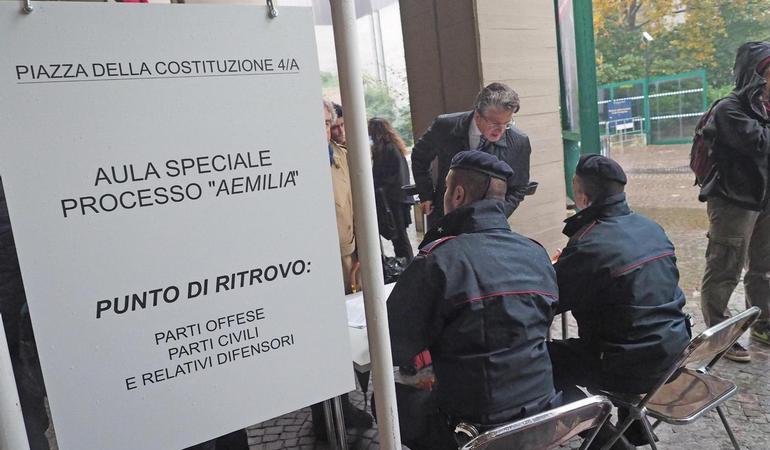
January 28, 2015 is the date that marks the beginning of Aemilia and what is destined to become the largest trial against the mafia in Northern Italy. At dawn, 117 people were arrested throughout Emilia-Romagna, especially in the provincial municipalities of Reggio Emilia and Modena, awakened by sirens, police cars and helicopters. Arrests were also carried out in Calabria and Lombardy, the other two regions involved with as many joint operations: Kyterion and Pesci. Operations against the 'ndrangheta and, in particular, against the Grande Aracri clan, rooted in Emilia-Romagna for decades and capable of expanding throughout Northern Italy. A story that dates back to the early 1980s and which today presents a modern mafia association, led since 2004 by Nicolino Grande Aracri. All around, a territory that in many cases opened its doors to the 'Ndrangheta, did business and made money. After the Infinito maxi trials in Lombardy and Minotauro in Piedmont, even Emilia-Romagna can no longer deny the rooting of the mafias. January 28, 2015 thus becomes a historic date for the region and for all those who until that moment, out of convenience or underestimation, had put the mafia problem aside. Enza Rando, vice-president and head of the legal office of Libera, who was a civil party in the trial, describes the climate: "There are those who didn't want to see and who woke up and those who instead did business and began to tremble. On the other hand, there are those who recognized that what we had been saying for some time was true, that is, that the mafias are rooted in Emilia too". The dimensions of the Aemilia operation became more evident with the start of the trial in the autumn of 2015: in the region there is no courtroom suitable for holding the preliminary hearings, which initially involved 239 defendants. The sessions - which will lead to 147 indictments with ordinary proceedings and 71 with abbreviated proceedings, 19 plea agreements and 2 acquittals - will take place in a pavilion of the Bologna Fair, where a temporary bunker courtroom has been created, large enough to accommodate hundreds of defendants and lawyers, with metal detectors at the entrance, cells for defendants with precautionary measures in prison, video surveillance and videoconferencing systems. The same will happen in Reggio Emilia, where, in the autumn of the same year, the ordinary rite of the maxi-trial will be celebrated, inside a courtroom built in the courtyard of the Court. With one difference: journalists and citizens also have access to the classroom: students (more than three thousand over the years), administrators and ordinary people.
Gray area, where mafias, business and politics meet
From the 1980s to today
To understand Aemilia and the roots of the Emilian 'Ndrangheta we need to go back in time a few decades, to the 1980s. In 1982 Antonio Dragone, head of the Cutro establishment, was sent to forced residence in Quattro Castella, a municipality of just over 10 thousand inhabitants on the outskirts of the Reggio Emilia Apennines. Not only the boss's family members arrive in the province of Reggio Emilia, but also the most loyal 'Ndrangheta supporters. At the center of the affairs in the area are drug trafficking, which also extends to the Modena area, extortion and the control of construction contracts. Reggio Emilia had already been a fertile territory for criminal and mafia figures for some time, as Vittorio Mete, associate professor at the University of Florence, explains: "In the 1960s and 1970s there was a great building expansion in that area: a sector in which immigrants from Cutria were employed first and then some criminal groups also made space. Then there is the drug sector, the trade of which is the reason why some people, before Dragone, moved from South to North. Dragone is sent to Reggio Emilia because there are already criminal presences, it is not the other way around. It was probably more convenient for the state apparatus to send him to this territory: since there are people who can host him, the state does not have to provide him with accommodation or other resources. Regarding the affair, the captain of the Crotone carabinieri at the time stated: "We took him away from Cutro and sent him to another Cutro". Raffaele. After having expanded the drug trafficking, Raffaele Dragone was also arrested, together with the director of a Modena bank with which he had set up heroin trafficking in the area. Already then we began to glimpse what would later be the fundamental characteristic for the rooting of the clan: the collaboration with compliant professionals, politicians and entrepreneurs, which would come to fruition with the regency of Nicolino Grande Aracri, who became boss of the Emilian 'Ndrangheta after a hard-fought internal feud. between Calabria and Emilia-Romagna and in which, in 1999 and 2004, Raffaele and Antonio Dragone were killed, among other murders such as those of Nicola Vasapollo and Giuseppe Ruggiero, killed in the autumn of 1992 in the province of Reggio Emilia and on which, only now, is light being shed in one of the many procedural strands born from Aemilia.
The business of crime
The charges themselves tell the story of the main affairs of the clan that ended up at the center of the Aemilia trial. There are the typical crimes - mafia-style criminal association, extortion, usury, theft, fires, drug dealing - and other more disturbing ones, which concern the roots in the Emilia-Romagna economy. The operation order states that the aim of the association was to "acquire directly and indirectly the management and/or control of economic activities, in particular in the construction, earthmoving, waste disposal, catering, quarry management sectors, in the works following the 2012 earthquake in Emilia; acquire public and private contracts". Crimes that are the sign of a 'Ndrangheta profoundly different from that of the territory of origin: an "autonomous and deep-rooted" mafia, as defined by the judges who in first and second instance recognized the association headed by Nicolino Grande Aracri as mafia. In a territory like that of Emilia-Romagna there are no longer traditional rites, affiliations and rituals, but new methods which, rather than control of the territory, aim at maximum profit. A silent mafia, which never ceases to intimidate, which exploits the territory and those who live in it, which takes advantage of crises - such as the one following the 2012 earthquake - to infiltrate and take root ever deeper, through methods which are not always foreign to the place of rooting, as Vittorio Mete explains: "In Emilia the Cutresi criminals have learned scams from the natives. We are faced with an area in which there are previously consolidated practices, in which even the mafia criminals find their space. There is, therefore, no healthy society that at a certain point is infected by criminal groups, just as there is no capacity for criminal groups to corrupt a society that is completely healthy. All societies coexist with illegal elements with practices of solidarity and cooperation." Even in Emilia-Romagna, at the basis of mafia affairs, there are increasingly refined mechanisms: the creation of a consortium of companies working in the construction sector and related sectors, which leads to enormous profits. Money that fuels what the judges have defined as a "swirling issue of false invoices", surrounded by a series of colluding professionals, entrepreneurs and politicians: "In this process - explains Enza Rando - there are the two sides of society, the journalists who oppose and are threatened and the journalists who are conniving and doing business with the 'Ndrangheta, politicians who have opposed it and others who, rather than conniving, have been absent, indifferent or complicit on a cultural level". In the trial, numerous people who are part of the so-called "grey zone" of the Emilian 'Ndrangheta were convicted. Among these, the Bolognese accountant Roberta Tattini, who made herself available to the mafia association by maintaining the important mechanism of fictitious registrations, necessary to protect themselves from possible police operations and confiscations. The Reggio Emilia journalist Marco Gibertini, who gave voice to the reasons of the Emilian 'Ndrangheta, putting it in contact with the Reggio Emilia business and political world. The Modenese entrepreneur Augusto Bianchini who "lent" his company to be able to work and earn while avoiding controls. And again, administrators who turned a blind eye allowing the criminal group to avoid disqualifications and exclusions from contracts, and politicians who put pressure to favor companies linked to the 'Ndrangheta.
The Grimilde trial reveals how mafias exploit EU funds
Aemilia and its strands
Since January 28, 2015, sentences have arrived, thousands of years of sentences for hundreds of defendants. But not only that. In April 2016, the municipality of Brescello was dissolved due to mafia infiltration, the first and currently only case in the region. As written in the dissolution report, in the municipality there was a "lack of attention" and "insensitivity" towards "the problem of organized crime which is widespread in the local context" and linked in particular to the presence of the family of Francesco Grande Aracri, brother of the boss Nicolino, subsequently involved in numerous trials. As regards Aemilia, in addition to the ordinary trial in 2018, the summary trial sentence was issued which recognized the same accusatory system, leading to the conviction of most of the main defendants. Year after year, thanks also to the declarations of some justice collaborators, new procedural lines have opened up. Aemilia bis, which began in 2016 with 23 defendants accused of, among other crimes, false invoicing; Aemilia 1992, which is shedding light on the two 'Ndrangheta murders that occurred in the province of Reggio Emilia thirty years ago and which, in October 2021, led to the life sentence of four 'Ndrangheta members, including Nicolino Grande Aracri. Traitors of the State or, rather, White list, which sees 12 people on trial accused, for various reasons, of threatening the State's administrative body and revealing official secrets for having attempted to eliminate the anti-mafia ban on the entrepreneur Augusto Bianchini. Among these is also the former senator Carlo Giovanardi, on whose immunity the Constitutional Court will decide. On 28 April, the former vice prefect of Modena Mario Ventura, the Customs Agency official Giuseppe Mario De Pensola, Augusto Bianchini and his son Alessandro were convicted at first instance only for revealing and using official secrets, but the statute of limitations is pending on the trial. The Grimilde trial, which is shedding light on crimes of an economic nature linked to mafia infiltration into the entrepreneurial fabric of the region, including investments, shell companies, carousel scams, but also exploitation, threats and scams on European financing. A trial in which the former president of the Piacenza city council, Giuseppe Caruso, was also convicted, under the orders of the gang when he was an employee of the Customs agency. Perseverance, which outlines the new structures of the clan after the arrests, including extortion, false invoices for a total of 13 million euros, money laundering, fictitious registrations to try to save the assets of the association, which increasingly kept a low profile and tried to increase its social consensus. And then, again, Reticolo, Octopus, Billions. "The subsequent trials - observes Enza Rando - tell the story of the post-Aemilia and the involvement of a part of politics. Perseverance and Grimilde have attested to a refinement of economic crimes, which affect our democracy, our services, the principles of the free market, violating the rights of workers and everyone. Not only that, those born after Aemilia are trials that have made us understand how the mafias are changing and how quickly they are moving forward". Trials that tell of an 'ndrangheta which, after the Aemilia operation, transformed itself, found new levers, new methods of infiltration. “We are only at the beginning,” said the then national anti-mafia prosecutor Franco Roberti. Antonio Valerio, 'Ndrangheta supporter and now collaborator of justice, had stated in the courtroom: "Don't delude yourself that it's over. The 'Ndrangheta is like weeds, until you uproot it down to the last deep root filament, it grows again". Prophecies that come true, visible in courtrooms where, seven years later, it is now common practice to hold mafia trials. Visible in the continuous arrests and new trials, in the too many names of proceedings that are often difficult to remember. In a new normality.