
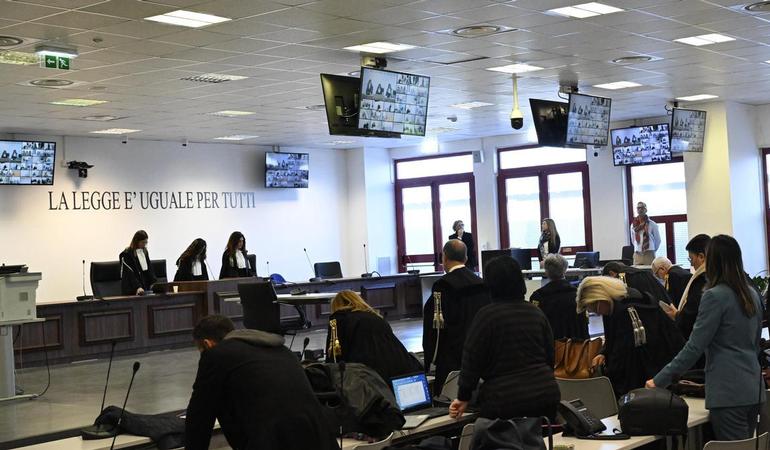
Rinascita-Scott trial, heavy sentences for 'Ndrangheta bosses, lighter ones for politicians
Cpr - Repatriation detention centers
Islands. Spaces of education and civil disobedience
Cpr - Repatriation detention centers
Islands. Spaces of education and civil disobedience
Rinascita-Scott trial, heavy sentences for 'Ndrangheta bosses, lighter ones for politicians
The first degree trial for 338 defendants has been sentenced. 207 sentences, up to 30 years in prison for bosses and followers of the historic 'ndrangheta families of the Vibonese area. Former parliamentarian Giancarlo Pittelli sentenced to 11 years, but for others allegedly belonging to the gray zone decisions contrary to the requests of the Catanzaro DDA
Francesco Donnici Journalist
Just as it had begun, in the bunker courtroom in Lamezia Terme built to host him, the first ordinary level of the Rinascita-Scott trial concluded, born from the largest investigation (at least in numbers) against the 'Ndrangheta, in particular the one operating in the Vibonese area, to date. More than a month after last October 16, the day on which the collegiate court of Vibo Valentia, presided over by judge Brigida Cavasino (alongside Claudia Caputo and Germana Radice), closed in chambers, a historic sentence was read out which did not spare any surprises. A verdict, not yet definitive, which will cause discussion given the scope of the judgment and the character of some of the defendants brought to trial by the magistrates of the Catanzaro district anti-mafia directorate of the prosecutor's office led, until a few weeks ago, by Nicola Gratteri. In addition to bosses and followers of some historic families of the region, in the rosary of 338 names covered by the device, there are also more or less well-known exponents of local business, prominent figures from the political environment, such as the former parliamentarian Giancarlo Pittelli, "infidel uniforms" and professionals closely linked to the Masonic world.
The reading of the device, which began around 10 in the morning, lasted just over two hours and saw 207 convictions and acquittals pronounced, with sentences of thirty years and under. The prosecution, represented by prosecutors Antonio De Bernardo, Andrea Mancuso and Annamaria Frustaci, had requested 332 sentences, for the application of a total of 4,774 years in prison, and 16 acquittal. The investigative hypothesis was confirmed in large sections, especially in the part concerning subjects believed to be part of the 'Ndrangheta families. The situation is different for the alleged exponents of the "grey zone" (professionals, politicians and representatives of institutions believed to be accomplices of the mafiosi, ed.), many of whom were not considered by the court to be external associates or competitors, unlike what was hypothesized by the prosecutor's office. In this sense, the acquittal of the former mayor of Pizzo Calabro and president of Anci Calabria, Gianluca Callipo, stands out, for whom 18 years of imprisonment had been requested despite the judges of the precautionary phase having already reduced the charges against him (which in the meantime also led to the dissolution of the municipality on the Tyrrhenian coast of Calabria).
The former prosecutor of Catanzaro, Gratteri, who has been head of the Naples prosecutor's office for about a month, also applied to the trial, which had its hearing held on 16 January 2021. For better or for worse, Rinascita-Scott, evoked by many for analogies and differences with the Palermo maxi-trial, is considered "his" trial, triggered by a prosecuting method, that of the merging of several investigations aimed at evoking the complex accusatory picture of the "unitarity of the 'ndrangheta", according to the magistrates, the legacy of the "lesson of Falcone and Borsellino", which has been the main object of discussion since the excited moments following the arrests on December 19, 2019.
Luigi Mancuso, from Limbadi to the "roof of the world". Route of a boss
The convictions: the Vibonese gangs
The maxi-investigation from which the procedure was born sees at its center the Mancuso gang of Limbadi, a center with just over three thousand inhabitants in the south-west of the province of Vibo Valentia. The prosecution describes the town as the "mother" (the mother house, ed.) of the Vibonese area, also making use of some wiretaps reported in documents. Limbadi is also the birthplace of the alleged "crime" (boss) from Vibo, Luigi Mancuso, whose procedural position has however been removed: U Supremu, as his nephew Emanuele Mancuso defined him, the first historical repentant of the family, will be judged in the Calabrian branch of Dedalo-Petrolmafie, another important trial currently underway, born from the investigation of several prosecutors on the interests of the mafias in the business of fuels.
However, there is no shortage of illustrious convictions, even among members of Limbadi's family. The alleged members of his "magic circle" were sentenced, who had also favored his inaction until his arrest at the end of 2019. Mentioned above all is his right-hand man Giovanni Giamborino, sentenced to 19 years and 6 months, who in a conversation defines Mancuso as "the roof of the world", more influential even than some historic bosses in the province of Reggio Calabria. His sentence, among others, is added to that of another loyalist, Pasquale Gallone, already sentenced to 19 years and 8 months in the second degree of the abbreviated trial.
Petrolmafie, a broker for all organizations
The common thread contained in the over 13 thousand pages of Rinascita-Scott's precautionary documents is represented by Luigi Mancuso's plan: released from prison in 2012, he wanted to reunite his family by positioning himself as a "man of peace", using the words of some repentants. The years of "Uncle Luigi's" imprisonment are in fact remembered as those of bloody feuds, many of which were blamed on his nephew, Pantaleone Mancuso known as Scarpuni, husband of Santa "Tita" Buccafusca, remembered among the innocent victims of the 'Ndrangheta, and son of "Don Turi", a historic exponent of the military wing of the family. Mancuso's plan starts from the meeting of the two power blocks created within the family to arrive at the project of uniting all the 'ndrine of the Vibonese area under the aegis of his criminal group, even those with whom historically they did not have good relations such as the Bonavota of Sant'Onofrio or the "piscopisani" (clan of Piscopio, a hamlet of Vibo Valentia).
The process affects all or almost all the groups active in the province. The presumed leaders of a series of 'ndrine and locals (territorial structures, ed.) were beheaded, including the Lo Bianco-Barba, the Pugliese and the Pardea-Camillò-Macrì of Vibo Valentia, the Accorinti of Zungri, the Bonavota of Sant'Onofrio, the Cracolici of Maierato and Filogaso, the Mazzotta of Pizzo Calabro, the Barbieri of Cessaniti, the Fiarè-Razionale-Gasparro of San Gregorio d'Ippona, the La Rosa of Tropea. Once he had obtained power within the province, Mancuso would then also turn outside to other territories, reweaving the web of interests that connect his gang to families from the province of Reggio Calabria such as the Piromalli of Gioia Tauro and the De Stefano, active in the Archi district of the city of the Strait. The convictions of the leaders of the 'Ndrangheta Vibonese
In doing so, Mancuso would have received support from some "charismatic" figures at the top of other historic groups in the province. Among these stands out Saverio Razionale sentenced to 30 (as many as he had asked for the accusation), head of the Fiarè-Razionale-Gasparro of San Gregorio d'Ippona. Having ended up at the center of a series of investigations into some bloody events that occurred in the province between the end of the 80s and the beginning of the 90s, after moving to Rome in 1995 he decided to "put on a suit and tie". The repentant Andrea Martella, former boss of Vibo Valentia sentenced to 8 years in Rinascita-Scott, defined him as "the Leonardo da Vinci of the 'ndrangheta", the architect of the birth of the "'ndrangheta 2.0". According to the prosecutor's office, Razionale was a person capable of building relationships with the Mancusos and their opponents as well as with some entrepreneurs. Mentioned above all is Antonino Delfino, originally from Reggio Calabria, sentenced to nine years in prison, who ended up in business with Razionale to overcome some financial problems. In his corporate group, the man from San Gregorio d'Ippona will invest 500 thousand euros in a hidden form to encourage a corporate network active in the clothing sector between Italy and the United Kingdom, and open new shops in Vibo Valentia to expand and also enter into business with some of the high fashion brands.
The brothers Domenico and Pasquale Bonavota were also sentenced, aged 30 and 28 respectively and considered to be at the top of the hegemonic group in the territory of Sant'Onofrio. The second, in particular, was the last fugitive left in circulation after the maxi-blitz at the end of 2019 and until 27 April 2023, the day on which the Carabinieri of the Special Operations Group arrested him while he was praying in the cathedral of San Lorenzo, in Genoa. Paolino Lo Bianco, considered to be the head of the 'Ndrangheta in the city of Vibo Valentia, historically linked to the Mancusos, especially after the deposition of the "Pardea-Ranisi", was also sentenced to thirty years in prison.
The 'ndrangheta in the Vibo area, an identity choice
The "zipper" subjects: accusations scaled down
However, the most awaited rulings were those against the so-called "link subjects", elements of connection between the mafia world and civil society in all its facets. In particular, the figure of Giancarlo Pittelli stands out, prince of the Catanzaro court in his role as criminal lawyer as well as defender for decades of Luigi Mancuso himself and of some prominent exponents of the Piromalli of Gioia Tauro; deputy and senator for several terms, for a long time with Forza Italia before moving, in 2017, to Fratelli d'Italia with much applause from the current prime minister Giorgia Meloni who defined him as "an added value for Calabria and all of Italy".
Pittelli, sentenced to 11 years in prison, was also accused by the prosecution, who had requested a 17-year sentence, of the crime of external complicity in a mafia association - the same crime hypothesis also advanced by the DDA of Reggio Calabria in the "Mala Pigna" proceeding - defining him as a "two-faced Janus", capable of putting the mafia world in communication with the legal, as well as Masonic, world, representing, in the words pronounced by prosecutor De Bernardo during the indictment, the possibility for Luigi Mancuso "to reach where he cannot reach with his own hand". A large part of the narrative beyond the trial also revolves around the figure of Pittelli, right from the preliminary phase. Already at the time of the arrest in his home, the investigators had found a pizzino containing some elements contained in the precautionary measure signed by the district investigating judge Barbara Saccà. An element that had partially confirmed the magistrates' fear of a possible leak of information that would have made the blitz futile if the "dramatic decision", as defined by Gratteri, had not been taken to bring forward the intervention, originally scheduled for Friday 20 December 2019, by 24 hours. A fate similar to that of Pittelli befell another professional, Francesco Stilo, sentenced to 14 years, among others former lawyer of Andrea Mantella.
Discover our magazine!
Investigations, interviews, data, columns: because knowing is a right, remaining silent is a choice. On paper and digital
Immediately after the reading of the ruling, Pittelli's lawyers, Salvatore Staiano, Guido Contestabile and Giandomenico Caiazza defined the conviction of their client as "indispensable to save Rinascita-Scott". "The lawyer Giancarlo Pittelli – we read in the note signed by the defenders – is convicted of the same crime for which only a few months ago the Court of Cassation first, and the Court of Review immediately afterwards, had excluded the existence of even serious indications of guilt. This is enough to make it clear to all those who have the intellectual honesty to want to do so, how this conviction was at all costs indispensable to save the credibility of the entire Rinascita Scott investigative operation."
Acquittals among the politicians involved
On the political front, the most significant reversals arrive. It is worth focusing on the positions of the former center-left regional councilor, Pietro Giamborino, sentenced to 1 year and 6 months in response to the prosecution's request for 20 years. According to justice collaborators, "baptized" in Piscopio and therefore "man of honour" devoted to politics. A circumstance denied by the court which did not recognize the existence of the crime of mafia association alleged against him. This verdict goes hand in hand with the acquittal pronounced against Gianluca Callipo for whom the prosecution had requested 18 years of imprisonment. A series of events were alleged against him which would see him involved in his role as an entrepreneur active in the hotel-tourism sector, which would have led him to come to terms with the exponents of the "Mazzotta" group headed by Salvatore Mazzotta, sentenced to 23 years, active in the well-known municipality on the Tyrrhenian coast which was dissolved and placed under police command a few months after the arrest of the mayor.
Among the "unfaithful uniforms" stand out the sentences pronounced against the lieutenant colonel of the Carabinieri Giorgio Naselli, in force in command of Catanzaro from 2006 to 2017 and provincial commander of Teramo at the time of the blitz, sentenced to two years and six months (the request was eight years), and the man from the secret services Michele Marinaro, marshal of the Financial Police, serving at the operations center of the Directorate anti-mafia investigation in Catanzaro before moving to the Presidency of the Council of Ministers (to which the intelligence agents report). For him the sentence is ten years and six months against a request of 17 years.
Scott's rebirth, for the media it's a missed opportunity
The numbers of the procedure
The Rinascita-Scott operation was launched between the night and dawn of Thursday 19 December 2019 and saw a total of 416 suspects, 334 recipients of precautionary measures. With the closure of the subsequent lines of investigation, the suspects will become 479 in total. The summary appeal sentence arrived at the end of last October and saw 67 convictions (for a total of over 600 years in prison) and seven acquittals, with an almost total confirmation of the ruling pronounced in the first instance.
The feeling that this operation was different from the others was already felt from that morning at the end of December, with the intervention of over three thousand Carabinieri from the ROS and the provincial command of Vibo Valentia, punctuated by the applause and encouragement of the citizens. An aspect also captured on the following 24 December 2019, with the march organized by the provincial coordination of the Libera association which had called together thousands of people from civil society, justice witnesses and family members of the innocent victims of the 'Ndrangheta.
The hearing and the first instance ruling were concluded relatively quickly given the size of the proceedings, demonstrating the importance recognized at least in the courtrooms. Outside, today's sentence at least seeks to draw the attention of that civil society encouraged from the first moment by prosecutor Gratteri to "occupy the spaces freed" after the arrests. And, while awaiting the next procedural phases, the certainty remains that, only when spaces are truly occupied by the good forces of Calabrian society, will a similar awareness that characterized post-massacre Palermo be achieved.