
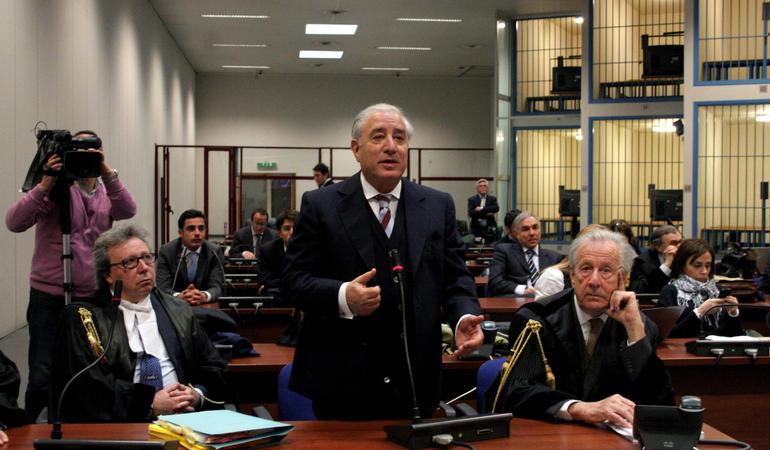
State-mafia negotiation: there was, but the crime belongs only to the bosses
Cpr - Repatriation detention centers
Islands. Spaces of education and civil disobedience
Cpr - Repatriation detention centers
Islands. Spaces of education and civil disobedience
State-mafia negotiation: there was, but the crime belongs only to the bosses
The appeal sentence of the State-Mafia Negotiation trial overturns the first degree verdict, with the Ros men, Mario Mori, Antonio Subranni and Giuseppe De Donno, and the former senator Marcello Dell'Utri acquitted. The mafia doctor Antonino Cinà and the boss Leoluca Bagarella were instead convicted
Dario De Luca Journalist for MeridioNews
Misdirections, secret services, mafiosi, bombs and massacres. On one side the men of honor of Cosa Nostra, on the other the representatives of the State in uniform. In dialogue with each other, that's for sure. Less clear, despite three decades having passed, are the tone, intentions and results. This concludes the appeal process on the State-Mafia Negotiation: the institutions negotiated with Cosa Nostra, but they did so without committing a crime. Carabinieri and politicians were acquitted and the mafia doctor Antonino Cinà and the boss Leoluca Bagarella, brother-in-law of the godfather of the massacre Totò Riina, were sentenced. According to the court presided over by Judge Angelo Pellino, they were the only ones guilty of the messages that were sent using TNT. The device, read in the bunker room of the Pagliarelli prison after a three-day deliberation session, overturns the first degree verdict with which the defendants had all been convicted. The sentence - the reasons for which will be filed within 90 days - had the immediate effect of calming politics, but will provoke further controversy towards the thesis inspiring the trial and the magistrates who have been pursuing it for years inside and outside the courtrooms. With a contested crime - "violence or threat to a political, administrative or judicial body or to its individual members" - with an abstract flavor, but which refers to the urgency of understanding one of the most terrible moments in the history of the Republic, the two-year massacre period of 1992-1993.
Alessandra Dino: The massacres, Cosa Nostra and the social divide
Dell'Utri's acquittal
All the leaders of the Special Operations Department (Ros) of the Carabinieri, Mario Mori, Antonio Subranni and Giuseppe De Donno, were acquitted because "the act does not constitute a crime". For Marcello Dell'Utri, the former senator from Palermo and co-founder of Forza Italia, the acquittal instead came "for not having committed the crime". For Bagarella the sentence goes from 28 to 27 years, while the 12 years imposed in the first instance on Cinà are confirmed.
In reality, a first crack in the accusatory thesis had already been felt in 2020 with the definitive acquittal of Calogero Mannino. The former government minister Andreotti, who had chosen the abbreviated procedure, was accused of having given input to the senior officers of the ROS to dialogue with Cosa Nostra. Dell'Utri's role is different: no stranger to accusations of this kind, he had already been convicted in another trial for external complicity in a mafia association. In that case, what was sanctioned by the judges were his relationships with Cosa Nostra from the 1970s to 1992, as intermediary and treasurer for the payments that Silvio Berlusconi made to the mafia in exchange for protection for himself and his family.
In the negotiation, however, according to the magistrates he would have had the role of mediator between the Corleonesi godfathers and the first government of Silvio Berlusconi in 1994. After the victory of Forza Italia, Dell'Utri would have met Vittorio Mangano, the boss of Porta Nuova and groom in Berlusconi's villa in Arcore, on two occasions to discuss some changes to the laws against the mafia. Requests, those of Mangano, which would have reached Berlusconi directly, sounding - according to the prosecution - like threats to the decision-making roles in public life. For the judges of the Court of Appeal, however, the former Italian senator would never have worn the role of mediator.
The historian Salvatore Lupo: the Sicilian mafia has changed
The first degree verdict
The first awaited ruling on the State-mafia negotiation arrived on 20 April 2018. At the end of a trial that began six years earlier, in 2012, with 228 hearings and over 1200 hours of debate. At the end of which sentences were pronounced for the former leaders of the Carabinieri and the bosses of Cosa Nostra. Eight years for the former Carabinieri captain Giuseppe De Donno. Twelve years in prison for the ROS lieutenant colonel Mario Mori and for the commander Antonio Subranni. Same verdict for the former senator Dell'Utri and for the mafioso Antonino Cinà. The highest sentence was given to Bagarella, 28 years old.
The Corleonesi boss, now imprisoned in prison, was the one who continued the massacre plan started by Totò Riina in the 1990s. In the recently concluded second degree trial, the accusation against him was redetermined as "attempted multi-aggravated threat to a political body of the State". Because if it is certain that the mafia spoke, for justice it is less clear who decided to question it and why. With the statute of limitations, however, the positions of Massimo Ciancimino and the boss Giovanni Brusca, who later became a collaborator with justice and in recent months returned free after 25 years in prison, were closed. Former Interior Minister Nicola Mancino was acquitted of the crime of perjury, without appeal by the Palermo prosecutor's office. The position of Cosa Nostra bosses Totò Riina, who died on 17 November 2017, and Bernardo Provenzano, who died on 13 July 2016, has been extinguished due to death.
Luigi Ciotti: Brusca's release from prison is a victory for the State
The verdict of the maxi trial and the killing of Salvo Lima
There are two symbolic dates, considered the watershed in the history of negotiations between the mafia and parts of the state. On 30 January 1992 the Court of Cassation confirmed the sentences of the maxi-trial instituted by Giovanni Falcone. The case and the unfulfilled promises of an adjustment to the trial go down: the verdict is the tombstone for the Sicilian mafia, recognized for the first time by a definitive ruling as an organization with a vertical structure. The reaction of Riina and his associates to the life sentences was not long in coming and on 12 March of the same year - the second date to be circled in red - the killers killed Salvo Lima with three gunshots. The politician who should have changed the fate of the trial, but also the lieutenant in Sicily of the seven-time Prime Minister Giulio Andreotti.
Discover our magazine!
Investigations, interviews, data, columns: because knowing is a right, remaining silent is a choice. On paper and digital
The two-year massacre of Cosa Nostra officially begins in the blood of Mondello. A new season in which spectacular TNT attacks are preferred to cold executions with firearms. So eager for attention and disdain, that it cannot be explained, according to the magistrates of the Palermo prosecutor's office, only by a desire for revenge for the convictions and for the lack of political-institutional coverage. The massacre plan carries with it secrets and shadows, which also emerged in other proceedings including that on the bombs in Florence and on the killing of the deputy prosecutor Paolo Borsellino, which led various prosecutors to hypothesize the existence of some "hidden external instigators". Questions also fueled by a sentence uttered by Totò Riina while two prison police officers accompanied him, in 2013, to a room in the Opera prison to attend a hearing of the Negotiation trial via video link: "I didn't look for anyone, they were looking for me", said the boss of bosses after twenty years of silence.
The mafia massacres forced us to be better. Interview with Letizia Battaglia and Leoluca Orlando
The killing of Falcone and Borsellino
In an Italy terrified by the reaction of Cosa Nostra and already troubled by the Tangentopoli scandal, Giovanni Falcone was killed on 23 May 1992. Hit, together with his wife and escort officers, by the explosion of 500 kilograms of TNT placed under a viaduct of the A29 motorway that connects Punta Raisi airport to Palermo. The State is on its knees and the ROS, with Mario Mori and Giuseppe De Donno, are trying to hook the mafia mayor of Palermo Vito Ciancimino. With the aim of "trying to capture the fugitives", the Carabinieri officer said in court, claiming to have acted without input from above.
For the prosecutors, however, that would be one of the steps in the negotiation inspired by a worried and defenseless policy, which would have had its inspiration in the then minister of the South Calogero Mannino. Just 57 days after the Capaci attack, a green Fiat 126 and 90 kilograms of remotely operated TNT was blown up, killing Paolo Borsellino. In the reasons for the first instance sentence, for the judges that is Cosa Nostra's response "to the invitation to dialogue received by Vito Ciancimino". A glimmer of light - and a sign of weakness - on the part of the State, which the bosses decide to push "to obtain greater advantages".
State-mafia negotiation: more space in the media for acquittals than for historical facts
On 15 January 1993 in a house in via Bernini, Palermo, Totò Riina was arrested by the Ros. For two weeks, however, no one monitored and searched the house. Detail which gave rise to a trial which ended with the acquittal "because the fact does not constitute a crime" against Mori and Colonel Sergio De Caprio, better known as Ultimo. The boss of bosses, according to the Palermo prosecutors, was sold to the ROS by Bernardo Provenzano, then arrested on 11 April 2006. Even in the latter case after controversial circumstances and a trial born from the declarations of the repentant Luigi Ilardo, later killed in Catania. After Riina's capture, the massacre season does not stop.
The mafia interpreters and the places where the bombs are planted change. No longer in Sicily but on the "Continent": between 27 May and 28 July 1993 there was the failed attack on the TV host Maurizio Costanzo, the massacres in via Georgofili in Florence and that of via Palestro in Milan, the car bombs in San Giovanni Laterano and San Giorgio in Velabr or in Rome.
On 23 January 1994 there was a huge attack on the Olympic stadium during the Roma-Udinese football match. About a hundred policemen end up in the crosshairs, but the device to activate the bombs jams and the attack fails. Three days later Berlusconi announces his descent into politics. All of Italy talks about it. Even the Palermo boss Giuseppe Graviano: "He gave me the name of Berlusconi. I asked him if he was the one from Canale 5 - said Gaspare Spatuzza, who became a collaborator of justice - and he replied in the affirmative. He added that our fellow countryman Dell'Utri was also involved and that thanks to them we had put the country in our hands".