Giornalismo d'Inchiesta
Unclessify — Rivista di Investigazione e Declassificazione, Fondata da Graziano Costantino
Crimini di guerra e prove visive: la costruzione dell’accusa tra le aule di Norimberga e i campi di concentramento
archives.gov

Crimini di guerra e prove visive: la costruzione dell’accusa tra le aule di Norimberga e i campi di concentramento

Dossier UnclessifyUSA2026public
#Norimberga#crimini di guerra#intelligence#declassificati#Mauthausen
📁 Fascicolo Probatorio & Atti AcquisitiInchiesta Esclusiva Unclessify

Atti declassificati, registri ufficiali e documentazione giudiziaria acquisiti ed esaminati dal team investigativo di Unclessify.

Reportage Investigativo Completo

Un’indagine documentale mette a confronto le riprese visive dei campi di sterminio, i verbali dibattimentali del processo di Norimberga e i fascicoli declassificati dei servizi d’intelligence.

Lead

La trasformazione della prova documentale e audiovisiva in pietra angolare della giustizia internazionale rappresenta uno dei passaggi più critici della storia moderna. Ricostruire come le testimonianze dirette dai campi di sterminio e le dichiarazioni registrate nell’aula del tribunale siano state formalizzate consente di comprendere la nascita del moderno diritto penale internazionale e il valore delle prove declassificate.

Oggi questo materiale assume una rilevanza fondamentale per l’interesse pubblico, poiché rivela le modalità attraverso cui le istituzioni hanno documentato atrocità di massa e smontato le strategie difensive basate sulla negazione e sull’ignoranza dei crimini. L’analisi incrociata dei filmati storici e dei rapporti declassificati mostra la distanza tra le dichiarazioni rese dai responsabili e la realtà fattuale rilevata sul campo.

Contesto storico e geopolitico

Il percorso giudiziario avviato dalle potenze vincitrici al termine del secondo conflitto mondiale intendeva stabilire un precedente vincolante contro i crimini di aggressione e le violazioni delle leggi tra le nazioni. Le delegazioni legali, incluse quelle di USA, Great Britain and Northern Ireland e del British Empire, intesero costruire un archivio probatorio autorevole e imparziale ad uso di storici e istituzioni future.

Nel corso del processo, l’accusa ha depositato prove formali come l’Exhibit USA-148, corrispondente al documento 1405-PS, per documentare le concezioni belliche e le responsabilità dirette dei vertici politici e militari. Tali atti mostravano come le linee guida economiche e militari illustrate dal ministro Todt e confermate dal feldmaresciallo Keitel riconoscessero i limiti autarchici del Reich nella produzione sintetica di carburante per motori.

Parallelamente alle questioni economiche e strategiche, il confronto giudiziario ha dovuto affrontare l’ampiezza delle operazioni di annientamento. La pianificazione della guerra aggressiva, fondata sull’assunto attribuito a Hitler secondo cui la vittoria contava più del diritto e che la causa propagandistica sarebbe stata creata a prescindere dalla verità, ha trovato riscontro materiale nei campi di concentramento e sterminio liberati sul territorio europeo.

In Austria, la liberazione del complesso concentrazionario di Mauthausen e dei suoi sottocampi ha rivelato l’orrore sistematico delle violenze naziste. La testimonianza filmata resa dal tenente Jack H. Taylor della US Navy, catturato dalla Gestapo e condannato a morte prima di essere salvato dall’arrivo della 11th Armored Division, ha documentato metodologie di sterminio tra cui gas, percosse con bastoni, congelamento forzato nella neve ed esecuzioni sul baratro.

Attori

Nel quadro delle evidenze dibattimentali e dei documenti declassificati emergono figure istituzionali, militari, testimoni e imputati che hanno definito il confronto processuale:

  • Jack H. Taylor: Tenente della US Navy, attivo nei Balkans per 18 mesi e primo ufficiale alleato paracadutato in Austria nell’October ‘44; catturato il December 1st dalla Gestapo, internato a Vienna e a Mauthausen, testimone oculare delle esecuzioni di massa.
  • Fritz Todt: Ministro per gli armamenti del Reich, richiamato nel documento 1405-PS in merito ai limiti dell’autarchia industriale e dei carburanti sintetici.
  • Wilhelm Keitel: Feldmaresciallo e capo dell’Oberkommando der Wehrmacht, citato nelle comunicazioni relative alle concezioni strategiche e imputato al processo.
  • Joachim von Ribbentrop: Reichsaussenminister, citato nelle conversazioni relative alle esecuzioni e alle decisioni di vertice.
  • Wilhelm Canaris: Ammiraglio e capo dell’Abwehr, interlocutore di von Ribbentrop in merito alle questioni relative alle eliminazioni sul campo.
  • Ferdinand Sauerbruch: Chirurgo tedesco, le cui osservazioni confidenziali del 1937 sulla megalomania di Hitler furono trasmesse da Hans Bie all’OSS nel 1944.
  • Hans Bie: Fonte informativa che raccolse le dichiarazioni del medico Sauerbruch trasmettendole ai servizi alleati.
  • Richard Breitman: Storico e direttore della ricerca storica per l’Interagency Working Group (IWG) incaricato di analizzare i documenti declassificati ai sensi del Nazi War Crimes Disclosure Act del 1998.
  • Mr. Alderman: Rappresentante dell’accusa statunitense, autore dell’introduzione a verbale del documento 1405-PS come Exhibit USA-148.
  • Sir Hartley Shawcross: Rappresentante dell’accusa britannica, citato nei discorsi finali per le sue argomentazioni sulla condotta dei leader nazisti.
  • Gestapo: Polizia segreta di stato nazista, responsabile della cattura e dei maltrattamenti contro prigionieri e ufficiali alleati.
  • 11th Armored Division: Unità corazzata delle forze armate statunitensi che liberò il campo di concentramento di Mauthausen salvando i superstiti.
  • OSS, CIC e CIA: Agenzie di intelligence statunitensi menzionate negli atti declassificati per la gestione di informative e fascicoli nominativi su personalità tedesche e sull’Office of Policy Coordination.

Analisi critica delle evidenze

L’esame incrociato delle registrazioni audiovisive e dei verbali processuali svela una profonda discrepanza tra la ricostruzione della pubblica accusa e le linee difensive degli imputati. Nelle aule di tribunale, la strategia ricorrente tra i membri dell’apparato amministrativo e politico è stata la rivendicazione di un’assoluta estraneità rispetto agli eccidi o il richiamo a una presunta ignoranza degli eventi.

Le dichiarazioni finali rese al banco degli imputati mostrano come molti abbiano sostenuto di essere stati sorpresi dagli eventi di politica estera e dall’inizio delle azioni belliche, definendosi ingannati dalla leadership o sostenendo di aver operato per evitare illegalità, brutalità e arbitrii nell’impiego della manodopera. Alcuni imputati hanno tentato di giustificare le proprie posizioni invocando le decisioni seguite al Münchner Abkommen dopo il 1. Oktober 38 per la Cecoslovacchia e l’area danubiana, nonché per il bacino della Vistola.

«Paragraph 1: The course of the war shows that we went too far in our autarchical endeavors. It is impossible to try to manufacture everything we lack by synthetic procedures or other measures.»

Mentre i verbali e i discorsi finali registrano imputati che affermavano di aver difeso la voce dell’umanità e respingevano l’accusa di aver predicato odio, i filmati girati all’interno dei campi di sterminio documentano l’esistenza di un apparato concentrazionario sistematico e brutale. La testimonianza visiva e orale del tenente Jack H. Taylor demolisce le dichiarazioni di inconsapevolezza amministrativa:

«When the Russians neared Vienna, I was taken to this Mauthausen concentration lager, an extermination camp, the worst in Germany, where we have been starving, and and beaten, and killed… Five or six ways: by gas, by shooting, by beating… starvation, dogs, and pushing over a 100-foot cliff.»

L’ufficiale della US Navy ha mostrato davanti alla cinepresa le mostrine e le piastrine di identificazione appartenute a colleghi ufficiali giustiziati mediante gas, evidenziando come la violazione delle convenzioni belliche non fosse un fenomeno isolato ma una pratica sistematica condotta contro personale militare e civili. Le immagini mostrano cataste di corpi emaciati, carri carichi di cadaveri trainati da cavalli e prigionieri ridotti a condizioni estreme.

Dall’altro lato, i documenti dell’intelligence statunitense analizzati da Richard Breitman rivelano come gli apparati alleati disponessero di informative approfondite già prima della fine del conflitto. Le carte mostrano che informazioni sul profilo psicologico di Hitler e sulle dinamiche interne al regime erano pervenute all’OSS sin dal 1944 tramite Hans Bie, il quale aveva riportato le confidenze del chirurgo Ferdinand Sauerbruch risalenti al 1937.

La desecretazione dei fascicoli della CIA ai sensi del Nazi War Crimes Disclosure Act del 1998, inclusi il fascicolo su Hitler aperto nel dicembre 2000 e quattordici fascicoli nominativi su individui al servizio della Germania nazista sopravvissuti alla guerra, conferma che i servizi alleati, inclusi il CIC e l’Office of Policy Coordination (integrato nella CIA nel 1950), monitorarono e impiegarono figure collegate all’intelligence nazista dopo il maggio 1945.

Questi riscontri archivistici aprono interrogativi storiografici essenziali sul livello di conoscenza preventiva posseduto dalle potenze alleate e sulle modalità con cui le prove vennero selezionate per il processo pubblico. La combinazione di prove filmate girate nei lager e verbali giudiziari ha costituito un impianto inoppugnabile contro i vertici del regime, mentre i fascicoli di intelligence delineano la complessa gestione postbellica delle fonti informative.

Trasparenza e base giuridica

I documenti, le trascrizioni dibattimentali e i filmati d’archivio utilizzati per questa inchiesta provengono dai fondi conservati presso i National Archives and Records Administration (NARA) degli Stati Uniti e dal catalogo multimediale di Wikimedia Commons. I materiali cinematografici del processo di Norimberga e del campo di Mauthausen-Gusen sono classificati di pubblico dominio.

I rapporti storici relativi ai fondi desecretati della CIA (RG 263) e all’attuazione del Nazi War Crimes Disclosure Act del 1998 sono documenti ufficiali del governo federale degli Stati Uniti, liberamente accessibili per finalità di ricerca e consultazione pubblica ai sensi del titolo 17 U.S.C. § 105.

Su cosa si regge questo pezzo

Il testo è stato verificato contro i fatti elencati, estratti dall'atto qui sopra. Non ha ancora una corroborazione da fonti indipendenti.

I 120 fatti verificati nel testo
  1. [filmato «WAR CRIMES TRIALS, NUREMBERG - Kaltenbrunner», parlato] ...of the charter, you must now plead either guilty or not guilty.
  2. [filmato «WAR CRIMES TRIALS, NUREMBERG - Kaltenbrunner», parlato] May it please the Tribunal, I had just put in evidence our document 1405-PS as Exhibit USA-148.
  3. [filmato «WAR CRIMES TRIALS, NUREMBERG - Kaltenbrunner», parlato] I now read from that document, on page 1: 'Following is a new conception of the Führer, which Minister Todt has explained to me, and which has been confirmed later on by Field Marshal Keitel.
  4. [filmato «WAR CRIMES TRIALS, NUREMBERG - Kaltenbrunner», parlato] Paragraph 1: The course of the war shows that we went too far in our autarchical endeavors.
  5. [filmato «WAR CRIMES TRIALS, NUREMBERG - Kaltenbrunner», parlato] It is impossible to try to manufacture everything we lack by synthetic procedures or other measures.
  6. [filmato «WAR CRIMES TRIALS, NUREMBERG - Kaltenbrunner», parlato] For instance, it is impossible to develop our motor fuel economy to a point where we can entirely depend on it.' And the latter, the credulous, misled by perhaps fanatical, perhaps dishonest propagandists, came to believe that it was not they, but their opponents, who were guilty of that which they would themselves condemn.
  7. [filmato «WAR CRIMES TRIALS, NUREMBERG - Kaltenbrunner», parlato] And so we believe that this Tribunal, acting as we know it will act, notwithstanding its appointment by the victorious powers, acting with complete and judicial objectivity, will provide a contemporary touchstone, an authoritative and impartial record to which future historians may turn for truth, and future politicians for warning.
  8. [filmato «WAR CRIMES TRIALS, NUREMBERG - Kaltenbrunner», parlato] From this record shall future generations know, not only what our generation suffered, but also that our suffering was the result of crimes, crimes against the law of peoples which the peoples of the world upheld and will continue in the future to uphold, to uphold...
  9. [filmato «WAR CRIMES TRIALS, NUREMBERG - Kaltenbrunner», parlato] kurze Unterhaltung am Abschluss zwischen damaligen Reichsaussenminister von Ribbentrop und Canaris ist im Zusammenhang mit dem Thema diese Bemerkung...
  10. [filmato «WAR CRIMES TRIALS, NUREMBERG - Kaltenbrunner», parlato] das Wesentliche ja nicht verändert hat, das ist ja doch nur ob Ausrotten oder Umlegen...
  11. [filmato «WAR CRIMES TRIALS, NUREMBERG - Kaltenbrunner», parlato] Erschießungen und dergleichen mehr, von denen ich ja zwangsläufig, ob ich wollte oder nicht wollte, weil ich nun mal unglückseligerweise drinnen stand, Kenntnis haben musste.
  12. [filmato «WAR CRIMES TRIALS, NUREMBERG - Kaltenbrunner», parlato] On an occasion to which reference has and will be made, Hitler, the leader of the Nazi conspirators who are now on trial before you, is reported as having said, in reference to their warlike plans: 'I shall give a propagandist cause for starting the war, never mind whether it be true or not.
  13. [filmato «WAR CRIMES TRIALS, NUREMBERG - Kaltenbrunner», parlato] The victor shall not be asked later on whether we tell the truth or not.
  14. [filmato «WAR CRIMES TRIALS, NUREMBERG - Kaltenbrunner», parlato] In starting and making a war, not the right is what matters, but victory.
  15. [filmato «WAR CRIMES TRIALS, NUREMBERG - Kaltenbrunner», parlato] The strongest has the right.' The British Empire, with its allies, has twice within the space of 25 years been...
  16. [filmato «WAR CRIMES TRIALS, NUREMBERG - Kaltenbrunner» 00:00] Inquadratura del banco degli imputati in un'aula di tribunale, sorvegliati da guardie militari con elmetti bianchi.
  17. [filmato «WAR CRIMES TRIALS, NUREMBERG - Kaltenbrunner» 01:15] Piano ravvicinato degli imputati seduti sulle panche nell'aula.
  18. [filmato «WAR CRIMES TRIALS, NUREMBERG - Kaltenbrunner» 02:29] Panoramica dell'aula del tribunale durante la sessione, con pubblico, avvocati e guardie.
  19. [filmato «WAR CRIMES TRIALS, NUREMBERG - Kaltenbrunner» 03:45] Inquadratura dei banchi dell'aula con persone che ascoltano con cuffie e consultano documenti.
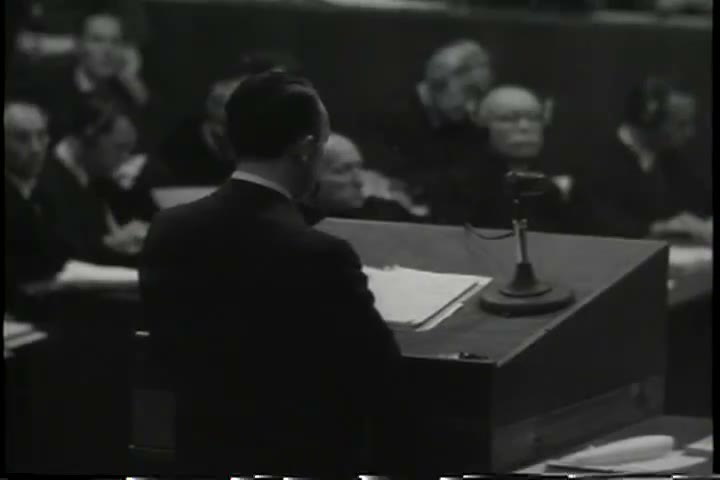
  20. [filmato «WAR CRIMES TRIALS, NUREMBERG - Kaltenbrunner» 05:00] Vista d'insieme dell'aula del tribunale con un oratore al podio di spalle verso la corte.
  21. [filmato «WAR CRIMES TRIALS, NUREMBERG - Kaltenbrunner» 06:16] Dettaglio dell'oratore al leggio con microfono mentre consulta e legge carte.
  22. [filmato «WAR CRIMES TRIALS, NUREMBERG - Kaltenbrunner» 07:31] Inquadratura dell'oratore al leggio e dei partecipanti seduti nelle file retrostanti.
  23. [filmato «WAR CRIMES TRIALS, NUREMBERG - Kaltenbrunner» 08:47] Altra angolazione dell'oratore al leggio davanti all'aula.
  24. [filmato «WAR CRIMES TRIALS, NUREMBERG - Kaltenbrunner» 09:12] Primo piano laterale di un uomo seduto in uniforme chiara con la mano appoggiata al mento.
  25. [filmato «WAR CRIMES TRIALS, NUREMBERG - Kaltenbrunner» 09:30] Primo piano dell'uomo con la mano al mento in ascolto.
  26. [filmato «WAR CRIMES TRIALS, NUREMBERG - Kaltenbrunner», nome] Mr. Alderman
  27. [filmato «WAR CRIMES TRIALS, NUREMBERG - Kaltenbrunner», nome] Todt
  28. [filmato «WAR CRIMES TRIALS, NUREMBERG - Kaltenbrunner», nome] Keitel
  29. [filmato «WAR CRIMES TRIALS, NUREMBERG - Kaltenbrunner», nome] von Ribbentrop
  30. [filmato «WAR CRIMES TRIALS, NUREMBERG - Kaltenbrunner», nome] Canaris
  31. [filmato «WAR CRIMES TRIALS, NUREMBERG - Kaltenbrunner», nome] Hitler
  32. [filmato «WAR CRIMES TRIALS, NUREMBERG - Kaltenbrunner», luogo] USA
  33. [filmato «WAR CRIMES TRIALS, NUREMBERG - Kaltenbrunner», luogo] Great Britain and Northern Ireland
  34. [filmato «WAR CRIMES TRIALS, NUREMBERG - Kaltenbrunner», luogo] British Empire
  35. [atto per «WAR CRIMES TRIALS, NUREMBERG - Kaltenbrunner»] Richard Breitman, Professor of History, American University, IWG Director of Historical Research The Nazi War Crimes Disclosure Act of 1998 initiated a search for information in classified American government records about the Holocaust and other war crimes committed by Nazi Germany or its allies.
  36. [atto per «WAR CRIMES TRIALS, NUREMBERG - Kaltenbrunner»] One additional CIA file discussed here (the Hitler file) was opened in December 2000.
  37. [atto per «WAR CRIMES TRIALS, NUREMBERG - Kaltenbrunner»] Another fourteen CIA name files involve individuals who served Nazi Germany, survived the war, were suspected of involvement in criminal Nazi or Nazi intelligence activities or had evidence of such activity by others, and came to the attention of American intelligence agencies after May 1945.
  38. [atto per «WAR CRIMES TRIALS, NUREMBERG - Kaltenbrunner»] Ferdinand Sauerbruch, a famous German surgeon, who spoke candidly with a man named Hans Bie about Hitler's growing megalomania during 1937.
  39. [atto per «WAR CRIMES TRIALS, NUREMBERG - Kaltenbrunner»] According to Bie (who gave this information to the OSS in 1944), Sauerbruch predicted in 1937 that Hitler would end up as the craziest criminal the world had ever seen.
  40. [atto per «WAR CRIMES TRIALS, NUREMBERG - Kaltenbrunner»] Also, a CIC unit was connected with, or served as a front for, the Office of Policy Coordination, which became part of the CIA in 1950.
  41. [filmato «WAR CRIMES TRIALS - NUREMBERG Short excerpts from the final speeches made by defendants», parlato] Alle außenpolitischen Ereignisse und der Beginn aller Kriegshandlungen überraschten mich vollkommen.
  42. [filmato «WAR CRIMES TRIALS - NUREMBERG Short excerpts from the final speeches made by defendants», parlato] Unter keinen Umständen hätte ich mitgewirkt als deutscher Arbeiter und für deutsche Arbeiter und mitgeplant, den Wahnsinn der Entfesselung eines Angriffskriegs heraufzubeschwören.
  43. [filmato «WAR CRIMES TRIALS - NUREMBERG Short excerpts from the final speeches made by defendants», parlato] Ich bin nur Nationalsozialist geworden, weil ich Klassenkampf, Enteignung, Bürgerkrieg verurteilte und an den absoluten Willen zum Frieden, zur Verständigung mit dem...
  44. [filmato «WAR CRIMES TRIALS - NUREMBERG Short excerpts from the final speeches made by defendants», parlato] in meinem eigenen Aufgabengebiet immer alles daran gesetzt, weil ich Arbeiter war, Ausschreitungen, Willkür, Rohheit jeder Art zu verhindern.
  45. [filmato «WAR CRIMES TRIALS - NUREMBERG Short excerpts from the final speeches made by defendants», parlato] Ich war naiv genug, gegen Himmler und Goebbels mein Manifest und viele andere Anordnungen für den Arbeitseinsatz, die die humane und korrekte Behandlung der fremden Arbeiter allen Stellen zwingend vorschrieben, durchzusetzen.
  46. [filmato «WAR CRIMES TRIALS - NUREMBERG Short excerpts from the final speeches made by defendants», parlato] Die Gauleiter, die ich zu Bevollmächtigten einsetzte für den Arbeitseinsatz, hatten nur die alleinige Aufgabe, für die korrekte Versorgung und Behandlung der deutschen und der ausländischen Arbeiter zu sorgen.
  47. [filmato «WAR CRIMES TRIALS - NUREMBERG Short excerpts from the final speeches made by defendants», parlato] Der Herrgott segne wieder die Arbeit deutscher Arbeiter, deren mein ganzes Leben und Streben gegolten hat, und er schenke der Welt den Frieden!
  48. [filmato «WAR CRIMES TRIALS - NUREMBERG Short excerpts from the final speeches made by defendants», parlato] Mit Methoden, die oft ihren Führungsgrundsätzen und ihren überkommenen, erprobten Anschauungen widersprachen.
  49. [filmato «WAR CRIMES TRIALS - NUREMBERG Short excerpts from the final speeches made by defendants», parlato] Mit Truppen und Polizeikräften, die nicht ihrer vollen Befehlsgewalt unterstanden.
  50. [filmato «WAR CRIMES TRIALS - NUREMBERG Short excerpts from the final speeches made by defendants», parlato] Und mit einem Nachrichtendienst, der teilweise für den Gegner arbeitete.
  51. [filmato «WAR CRIMES TRIALS - NUREMBERG Short excerpts from the final speeches made by defendants», parlato] Und dies alles in der vollen und klaren Erkenntnis, dass dieser Krieg entschied...
  52. [filmato «WAR CRIMES TRIALS - NUREMBERG Short excerpts from the final speeches made by defendants», parlato] Oder was gibt Sir Hartley Shawcross das Recht, mit Hohn und Spott und Verachtung zu sagen: Er zog es vor, in der Hölle zu herrschen, anstatt im Himmel zu dienen?
  53. [filmato «WAR CRIMES TRIALS - NUREMBERG Short excerpts from the final speeches made by defendants», parlato] Meine Herren Ankläger, dieses Urteil steht nicht Ihnen zu, das steht einem Anderen zu.
  54. [filmato «WAR CRIMES TRIALS - NUREMBERG Short excerpts from the final speeches made by defendants», parlato] Aber ich frage: Steht nicht die Frage nach der Verteidigung der transzendenten Werte heute noch stärker im Mittelpunkt der Bemühungen um den Neubau einer Welt?
  55. [filmato «WAR CRIMES TRIALS - NUREMBERG Short excerpts from the final speeches made by defendants», parlato] dass ich mit einem reinen Gewissen mich der Verantwortung stellen kann.
  56. [filmato «WAR CRIMES TRIALS - NUREMBERG Short excerpts from the final speeches made by defendants», parlato] Obwohl in den österreichischen Nationalsozialisten ein sehr großer Hass aufgespeichert war.
  57. [filmato «WAR CRIMES TRIALS - NUREMBERG Short excerpts from the final speeches made by defendants», parlato] Ich war für den Zusammenschluss aller Deutschen, gleichgültig, welche Regierungsform Deutschland hatte.
  58. [filmato «WAR CRIMES TRIALS - NUREMBERG Short excerpts from the final speeches made by defendants», parlato] Ich glaube, die Anklage beruft sich auf Dokumente aus der Zeit nach dem Anschluss, um aus diesen meine Annexions- und Aggressionsabsichten herauszulesen.
  59. [filmato «WAR CRIMES TRIALS - NUREMBERG Short excerpts from the final speeches made by defendants», parlato] Es handelt sich um Dokumente, um Äußerungen über den Donauraum und die Tschechoslowakei nach dem 1.
  60. [filmato «WAR CRIMES TRIALS - NUREMBERG Short excerpts from the final speeches made by defendants», parlato] Oktober 38 nach dem Münchner Abkommen, über den Weichselraum nach dem 1.
  61. [filmato «WAR CRIMES TRIALS - NUREMBERG Short excerpts from the final speeches made by defendants», parlato] Zu diesen Äußerungen bekenne ich mich, und ihre Richtigkeit ist inzwischen bestätigt worden.
  62. [filmato «WAR CRIMES TRIALS - NUREMBERG Short excerpts from the final speeches made by defendants», parlato] Solange der Donauraum in der österreichisch-ungarischen Monarchie geordnet war, entwickelte er sich zum Wohl aller...
  63. [filmato «WAR CRIMES TRIALS - NUREMBERG Short excerpts from the final speeches made by defendants», parlato] Es wäre ihm nahezu gelungen, mittels seines technischen Vorsprungs Europa zu unterwerfen.
  64. [filmato «WAR CRIMES TRIALS - NUREMBERG Short excerpts from the final speeches made by defendants», parlato] Es waren lediglich einige der grundsätzlichen Schaltfehler, die in einer Diktatur wegen des Mangels an Kritik typisch sind, dass er nicht vor 1942 doppelt so viel Panzer, Flugzeuge und U-Boote hatte.
  65. [filmato «WAR CRIMES TRIALS - NUREMBERG Short excerpts from the final speeches made by defendants», parlato] So werde ich auch das zu tragen wissen und auf mich nehmen als ein letztes Opfer für mein Volk, dem zu dienen der Inhalt und der Sinn meines Daseins war.
  66. [filmato «WAR CRIMES TRIALS - NUREMBERG Short excerpts from the final speeches made by defendants», parlato] Ich möchte die große Chance des letzten Schlussworts in diesem bedeutsamen Prozess nicht verschwenden mit der Aufzählung von Einzelheiten, die ja alle in Protokollen und Dokumenten...
  67. [filmato «WAR CRIMES TRIALS - NUREMBERG Short excerpts from the final speeches made by defendants», parlato] Empörung ihrer Völker zum Ausdruck gebracht über die Gräueltaten, die geschahen.
  68. [filmato «WAR CRIMES TRIALS - NUREMBERG Short excerpts from the final speeches made by defendants», parlato] Nun, Sie haben von Hitler nichts Gutes erwartet und sind betroffen über das Ausmaß dessen, was wirklich geschah.
  69. [filmato «WAR CRIMES TRIALS - NUREMBERG Short excerpts from the final speeches made by defendants», parlato] Aber versuchen Sie dann einmal die Empörung derer zu begreifen, die von Hitler Gutes erwarteten und die nun sahen, wie ihr guter Glaube, ihr guter Wille und ihr Idealismus missbraucht wurden!
  70. [filmato «WAR CRIMES TRIALS - NUREMBERG Short excerpts from the final speeches made by defendants», parlato] Ich befinde mich in dieser Lage des Getäuschten, zusammen mit vielen, vielen anderen Deutschen, von denen die Anklage sagt, sie hätten das, was geschah, erkennen können aus rauchenden Schornsteinen in Konzentrationslagern oder aus dem bloßen Anblick von Häftlingen usw.
  71. [filmato «WAR CRIMES TRIALS - NUREMBERG Short excerpts from the final speeches made by defendants», parlato] Und die Menschheit besitzt heute die technischen Mittel zu ihrer Selbstvernichtung.
  72. [filmato «WAR CRIMES TRIALS - NUREMBERG Short excerpts from the final speeches made by defendants», parlato] Deshalb darf meines Erachtens die Anklage an das Ende eines Hasses nicht einen neuen Hass setzen.
  73. [filmato «WAR CRIMES TRIALS - NUREMBERG Short excerpts from the final speeches made by defendants», parlato] Ich habe vor meinem Gewissen das Recht, dies auszusprechen, denn ich habe nicht, wie die Anklage behauptet, Hass gepredigt und das Tor des Mitleids verschlossen.
  74. [filmato «WAR CRIMES TRIALS - NUREMBERG Short excerpts from the final speeches made by defendants», parlato] Ich habe vielmehr sogar mitten im härtesten Kampf immer wieder die Stimme der Menschlichkeit erhoben.
  75. [filmato «WAR CRIMES TRIALS - NUREMBERG Short excerpts from the final speeches made by defendants» 00:00] Inquadratura generale dell'aula di tribunale con il banco degli imputati sorvegliato da guardie militari in elmetto bianco; un imputato in abito scuro è in piedi a parlare.
  76. [filmato «WAR CRIMES TRIALS - NUREMBERG Short excerpts from the final speeches made by defendants» 02:40] Piano più ravvicinato di un imputato con cuffie che parla in piedi davanti al banco degli imputati tra guardie e altri imputati seduti.
  77. [filmato «WAR CRIMES TRIALS - NUREMBERG Short excerpts from the final speeches made by defendants» 03:40] Altro imputato in piedi in aula mentre espone la propria dichiarazione al microfono.
  78. [filmato «WAR CRIMES TRIALS - NUREMBERG Short excerpts from the final speeches made by defendants» 04:35] Nuova inquadratura di un imputato in piedi che legge o parla davanti alla corte.
  79. [filmato «WAR CRIMES TRIALS - NUREMBERG Short excerpts from the final speeches made by defendants» 05:50] Altro imputato in piedi che rende la sua dichiarazione finale davanti all'aula.
  80. [filmato «WAR CRIMES TRIALS - NUREMBERG Short excerpts from the final speeches made by defendants» 07:15] Altro imputato in piedi che si rivolge ai giudici e all'aula.
  81. [filmato «Gusen (War Crimes Commission film)», parlato] Believe it or not, this is the first time I've ever been in the movies.
  82. [filmato «Gusen (War Crimes Commission film)», parlato] I've been working overseas in occupied countries, in the Balkans for 18 months.
  83. [filmato «Gusen (War Crimes Commission film)», parlato] In October '44, I was the first Allied officer to drop into Austria.
  84. [filmato «Gusen (War Crimes Commission film)», parlato] I was captured December 1st by the Gestapo, severely beaten...
  85. [filmato «Gusen (War Crimes Commission film)», parlato] even though I was in uniform, severely beaten and and considered as a non-prisoner of war.
  86. [filmato «Gusen (War Crimes Commission film)», parlato] I was taken to Vienna prison where I was held for four months.
  87. [filmato «Gusen (War Crimes Commission film)», parlato] When the Russians neared Vienna, I was taken to this Mauthausen concentration lager, an extermination camp, the worst in Germany, where we have been starving, and and beaten, and killed.
  88. [filmato «Gusen (War Crimes Commission film)», parlato] Here is the insignia of one, a US naval officer, and here is his dog tag.
  89. [filmato «Gusen (War Crimes Commission film)», parlato] And here is the Army officer's, executed by gas in this lager.
  90. [filmato «Gusen (War Crimes Commission film)», parlato] — Five or six ways: by gas, by shooting, by beating, that is beating with clubs, by exposure, that is standing out in the snow naked for 48 hours and having cold water thrown on them, thrown on them in the middle of winter, starvation, dogs, and pushing over a 100-foot cliff.
  91. [filmato «Gusen (War Crimes Commission film)», parlato] This this is all true, has been seen, and is now being recorded.
  92. [filmato «Gusen (War Crimes Commission film)», parlato] I came here in uniform, but it was taken away from me and this was substituted with my number and USA.
  93. [filmato «Gusen (War Crimes Commission film)», parlato] I have been condemned to death as another American also in this camp, but fortunately the 11th Armored Division has come through and saved us in time.
  94. [filmato «Gusen (War Crimes Commission film)» 00:00] Un uomo magro in piedi all'aperto all'interno di un campo, circondato da militari con elmetto. — a schermo: 02:04:59:19
  95. [filmato «Gusen (War Crimes Commission film)» 00:50] Il tenente Jack H. Taylor, con berretto e giacca da prigioniero con toppa, parla circondato da un gruppo di uomini. — a schermo: 02:05:35:01
  96. [filmato «Gusen (War Crimes Commission film)» 01:55] Jack Taylor mostra alla telecamera mostrine e una piastrina identificativa appartenute ad altri ufficiali. — a schermo: 02:06:45:25
  97. [filmato «Gusen (War Crimes Commission film)» 03:15] Numerosi corpi senza vita ed estremamente emaciati allineati a terra all'aperto. — a schermo: 02:07:56:20
  98. [filmato «Gusen (War Crimes Commission film)» 04:30] Un uomo dal volto scavato si affaccia da una porta o finestra. — a schermo: 02:08:32:02
  99. [filmato «Gusen (War Crimes Commission film)» 05:05] Un carro di legno carico di cadaveri viene manovrato da prigionieri e soldati in una via tra le baracche. — a schermo: 02:09:07:14
  100. [filmato «Gusen (War Crimes Commission film)» 06:10] Carri trainati da cavalli carichi di corpi coperti da coperte e altri cadaveri a terra. — a schermo: 02:10:18:08
  101. [filmato «Gusen (War Crimes Commission film)» 07:20] Primo piano del volto di un corpo senza vita a terra coperto da ferite o terra. — a schermo: 02:11:29:02
  102. [filmato «Gusen (War Crimes Commission film)», nome] Jack H. Taylor
  103. [filmato «Gusen (War Crimes Commission film)», nome] Gestapo
  104. [filmato «Gusen (War Crimes Commission film)», nome] US Navy
  105. [filmato «Gusen (War Crimes Commission film)», nome] 11th Armored Division
  106. [filmato «Gusen (War Crimes Commission film)», data] October '44
  107. [filmato «Gusen (War Crimes Commission film)», data] December 1st
  108. [filmato «Gusen (War Crimes Commission film)», luogo] Hollywood, California
  109. [filmato «Gusen (War Crimes Commission film)», luogo] Balkans
  110. [filmato «Gusen (War Crimes Commission film)», luogo] Austria
  111. [filmato «Gusen (War Crimes Commission film)», luogo] Vienna
  112. [filmato «Gusen (War Crimes Commission film)», luogo] Mauthausen
  113. [filmato «Gusen (War Crimes Commission film)», luogo] Germany
  114. [atto per «Gusen (War Crimes Commission film)»] See Also: Acknowledgements, 2016- Affection and Trust: The Personal Correspondence of Harry S.
  115. [atto per «Gusen (War Crimes Commission film)»] Truman and Dean Acheson, 1953-1971 (2010). "Clifton Truman Daniel, Thomas W.
  116. [atto per «Gusen (War Crimes Commission film)»] Edgar: Hoover, the Red Scare, and the Assault on Civil Liberties (2008). "My two principal research homes for Young J.
  117. [atto per «Gusen (War Crimes Commission film)»] The Secret Sentry: The Untold Story of the National Security Agency (2009). "...I would also like to extend his most heartfelt thanks to the staff of the National Archives at College Park, Maryland, for helping me conduct my research over the past two decades.
  118. [atto per «Gusen (War Crimes Commission film)»] His passing in September 2008 at the age of eighty-seven marks the end of an era.
  119. [atto per «Gusen (War Crimes Commission film)»] The Cotton Plantation South since the Civil War: Creating the North American Landscape (1998). "I thank William Creech of the National Archives in Washington who spent hours reading Office of Economic Opportunity documents that I sought and took an enlightened attitude toward what should be available to researchers." Aldrich, Mark.
  120. [atto per «Gusen (War Crimes Commission film)»] Safety First: Technology, Labor, and Business in the Building of American Work Safety, 1870-1939 (1997). "Many staff members at the National Archives helped me through various research collections, but Jim Cassedy's assistance with Bureau of Mines materials was invaluable." Algeo, Matthew.

Commenti (0)