
Public Interest and the Mechanics of Atomic Normalization
During the first full decade of the Cold War, the United States government produced an extensive media apparatus to shape domestic and international perceptions of nuclear energy. The simultaneous deployment of tactical civil defense instruction, intercontinental strike documentation, and scientific diplomacy created a synchronized narrative regarding the manageability of nuclear force.
Examining these primary audiovisual records reveals how public anxiety over catastrophic weapons was actively managed across different demographic segments. While schoolchildren were instructed that physical shelter and basic shielding could mitigate a detonation, military documentation detailed strategic delivery systems designed to project total destruction across continents.
Analyzing this structural divergence is vital for evaluating how institutional communications manage the public perception of extreme technological risks. The juxtaposition of these records illustrates how complex defense policies were translated into behavioral compliance and geopolitical consensus.
Historical and Geopolitical Context
The dawn of the thermonuclear era in the early 1950s confronted federal planners with an unprecedented strategic dilemma. As the Soviet Union broke the American atomic monopoly and developed long-range aviation, the United States mainland faced potential direct attack for the first time in modern history.
Federal institutions responded by creating three parallel communication channels. First, civil defense authorities sought to prevent mass panic through domestic drills and educational programs designed to instill routine responses to nuclear threats, framing catastrophic blast waves as manageable disruptions akin to fires or traffic hazards.
Second, the armed forces documented the expansion of heavy bombardment capabilities to demonstrate credible deterrence, testing specialized in-flight arming procedures and long-range refueling to establish round-the-clock global reach across medium and heavy strategic bombers.
Third, diplomatic channels initiated comprehensive public relations campaigns abroad to reframe atomic physics around industrial and medical progress, culminating in international expositions that opened directly in territories scarred by previous wartime detonations.
Institutional Actors and Scientific Authorities
The institutional architecture behind this informational triad involved federal civil agencies, military commands, scientific commissions, and foreign delegations. Primary oversight was distributed across specialized administrative bodies:
- Federal Civil Defense Administration (FCDA): Established to organize state and local readiness programs, the agency collaborated directly with the Safety Commission of the National Education Association to design school curricula and public instructional media.
- Strategic Air Command (SAC) and Tactical Air Command: Operational branches of the United States Air Force responsible for executing atomic delivery missions, developing long-range logistical routes, and conducting standardized weapon loading procedures.
- United States Atomic Energy Commission (AEC): The regulatory and developmental body that supervised weapon testing alongside the military and supplied technical displays, full-scale reactor models, and medical isotope exhibits for domestic and foreign exhibitions.
- Diplomatic and Overseas Authorities: Including Ambassador Allison, Japanese Prime Minister Ichirō Hatoyama, Chief Cabinet Secretary Nemoto, and Matsutarō Shōriki, who served as chairman of Japan's Atomic Energy Commission during the opening of the 1955 Tokyo exposition.
- Foundational Physicists Cited in Official Pedagogy: Media productions explicitly invoked the scientific lineage of Henri Becquerel, Marie Curie, Ernest Rutherford, Niels Bohr, Albert Einstein, Otto Hahn, Enrico Fermi, Hideki Yukawa, and Ernest Lawrence to anchor the technology in fundamental natural law rather than wartime devastation.
Critical Analysis of the Archival Evidence
The primary film records expose fundamental structural contradictions in how the effects of nuclear weapons were communicated across civilian, military, and diplomatic domains. The official civil defense production designed for schools presented the physical phenomena of an atomic detonation through simplified analogies to everyday hazards.
“Since it may be used against us, we must get ready for it, just as we are ready for many other dangers that are around us all the time. We have a fine fire department to put out the fire, and you have fire drills in your school so you'll know what to do.”
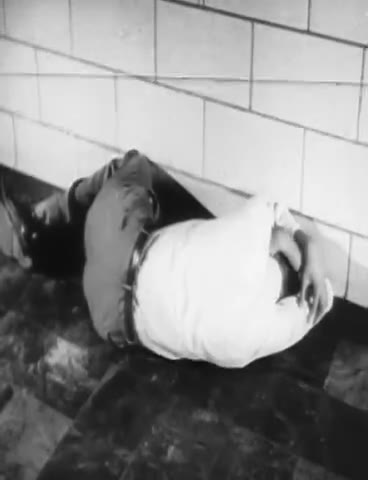
By equating an atomic flash with an intense sunburn and blast damage with shattered storefronts, the curriculum reduced an existential existential crisis to mechanical drill routines. Students were told that covering the face and neck under a wooden desk or tight against a hallway wall would prevent major trauma from falling debris and flying glass.
“First, you duck, and then you cover, and very tightly you cover the back of your neck and your face… Then, if the glass breaks and flies through the air, it won't cut you.”
In stark contrast, military footage documenting Air Force delivery aircraft detailed destruction on an entirely different scale. Official narrators outlined weapons capable of releasing the power of ten thousand lightning bolts to obliterate urban centers of two hundred thousand inhabitants in a single strike.
“The energy of 10,000 lightning bolts, enough to wipe out a city of 200,000, is packed within this harmless-appearing case. So, with healthy respect and cool efficiency, the weapon is hoisted into the bomb bay of a B-36.”
The operational doctrine demonstrated in the flight records relied on sweeping strategic platforms designed for massive payloads. The 180-ton Convair B-36, powered by six 3,500-horsepower conventional engines and four jet engines producing 42,000 combined horsepower, was capable of continuous 51-hour endurance missions over 8,500 nautical miles on 22,000 gallons of fuel.
Military records highlighted that a single modified B-36 could deliver two standard 60-inch atomic bombs, packing a destructive force four thousand times greater than an 84,000-pound conventional carpet-bombing run. The logistic pipeline utilized Boeing B-29s, B-50s (such as the Lucky Lady, which achieved a non-stop four-day global circumnavigation via in-flight refueling), jet-powered Boeing B-47 Stratojets flying at 550 knots, and massive Douglas C-124 Globemaster transports capable of airlifting four fully packaged 60-inch bombs directly from domestic stockpiles to forward operational bases.
“Dog 1 to Destiny Control, leveling out at 8500 feet for IFI… So, black curtains are on the windows as protection against heat and bright light from the burst.”
The cockpit procedures for In-Flight Insertion (IFI) at 8,500 feet, complete with black anti-radiation thermal curtains, starkly contradicted the civilian instruction that covering one's head with a jacket or cardboard folder would provide adequate personal protection against the instantaneous flash and thermal output.
The third branch of this communication apparatus, exemplified by the official documentation of the United States Atoms for Peace Exhibition opening on November 1, 1955, in Hibiya Park, Tokyo, deliberately pivoted public attention away from delivery systems toward scientific utility. By drawing more than 330,000 visitors over six weeks, the exhibition showcased medical therapies, such as cobalt-60 machines equivalent to two-million-volt X-ray units, radioactive iodine for thyroid diagnosis, and phosphorus treatments.
“Allison conveyed a message from President Eisenhower, that the exhibit stands as a symbol of our country's mutual determination that the great power of the atom shall be dedicated to the arts of peace.”
This diplomatic exhibition utilized working models of the Brookhaven National Laboratory graphite reactor to demonstrate controlled chain reactions using uranium bars and neutron-absorbing control rods, measured safely by Geiger counters behind transparent lead-glass shields and operated with mechanical “magic hands” manipulators. The narrative firmly rooted nuclear fission within classical atomic theory dating back to Democritus, presenting nuclear technology as an inevitable scientific evolution rather than an instrument of strategic warfare.
What these records collectively reveal is an administrative consensus aimed at domestic normalization and international rehabilitation. The technical data presented in military documentation demonstrated complete institutional awareness that civil shielding techniques were insufficient against urban thermonuclear strikes, yet public readiness media continued to emphasize personal compliance to maintain civil order.
Transparency and Archival Provenance
The visual records and operational narrations examined in this dossier originate from primary federal archival holdings maintained across United States government record groups. These motion pictures were produced directly by the Federal Civil Defense Administration, the United States Air Force, and the United States Information Agency in cooperation with the Atomic Energy Commission.
Under Title 17, Section 105 of the United States Code, works created by officers or employees of the United States federal government as part of their official duties are excluded from copyright protection and exist entirely within the public domain. These historical documents are permanently preserved and accessible for public research through the National Archives and Records Administration (NARA) and digital repositories at Wikimedia Commons.
Preserving and cross-referencing these audiovisual records provides direct insight into Cold War information management, ensuring that institutional records remain open to independent journalistic and historical investigation.