
Public Interest and Systemic Vulnerability in Criminal Inquiries
When high-stakes corporate disasters and fatal transport incidents enter the criminal justice pipeline, the integrity of preliminary technical assessments dictates whether indictments survive scrutiny or collapse before trial. In complex forensic probes, prosecutors rely entirely on external technical specialists appointed under procedural mandates to reconstruct black box telemetry, structural metal fatigue, and corporate safety protocols.
A critical constitutional dispute arising from an aviation disaster investigation laid bare a severe statutory asymmetry: attempting to bribe a prosecutor’s technical aide carried harsher criminal exposure under public administration corruption provisions than suborning an impartial expert appointed directly by a sitting trial judge. This contradiction threatened not only proportional sentencing but also the foundational boundary between crimes against judicial administration and general public corruption offenses.
Judgment 163 of 2014 from the Italian Constitutional Court highlighted how decades of piecemeal procedural reforms left the prosecutorial technical consultant stranded in an ambiguous legal territory, caught between public service duties and witness-like evidentiary roles. The implications of this judicial stalemate remain central to modern complex litigation, where corporate defendants possess the financial leverage to target specialized investigators before formal charges are ever filed.
Historical Trajectory and the Post-1988 Codification Dilemma
The structural friction examined in Judgment 163/2014 traces directly back to the transition from the inquisitorial 1930 Rocco Code to the adversarial 1988 Code of Criminal Procedure. Under the historic framework, judicial inquiries were unified under investigating magistrates, and technical expertise was uniformly treated as an auxiliary arm of the court, protected uniformly under specific administration of justice provisions.
With the 1988 reform, the criminal trial bifurcated into distinct investigation and trial phases, transforming the Public Prosecutor into an investigating party rather than a neutral adjudicator. Under Article 359 of the Italian Code of Criminal Procedure, prosecutors gained the autonomy to appoint their own technical consultants (consulenti tecnici del pubblico ministero) to execute urgent, non-repeatable forensic verifications during preliminary investigations.
However, the Substantive Criminal Code (Codice Penale) was never holistically aligned with this new procedural architecture, creating systemic gaps in how perjury, false statements, and illicit inducements were categorized. Emergency anti-mafia legislation in 1992, enacted via Decree-Law No. 306, attempted to patch these vulnerabilities by introducing Article 371-bis for false statements to prosecutors, yet the precise status of technical consultants remained unsettled across specialized titles of the penal code.
“All’opera di riallineamento dei delitti contro l’amministrazione della giustizia al mutato panorama processuale è rimasta, peraltro, estranea la figura del consulente tecnico nominato dal pubblico ministero ai sensi dell’art. 359 del codice di procedura penale.”
The underlying factual incident that forced this issue to the Constitutional Court arose from an aviation disaster investigation involving a crashed commercial airliner. During preliminary forensic inquiries, an intermediary approached the prosecutor’s appointed aviation specialist, promising substantial financial compensation in exchange for an engineering report tailored to exonerate the airline.
When judicial authorities moved against the perpetrators, the prosecution faced a doctrinal deadlock regarding the legal qualification of the illicit offer. If treated as instigation to unfaithful technical assistance under Article 380, the rejected bribe remained non-punishable under Article 115; if classified as corruption under Article 322, paragraph 2, it triggered severe penalties designed for corrupt public officials rather than procedural witness tampering under Article 377.
Institutional and Legal Entities Involved
The constitutional conflict brought multiple institutional authorities, statutory bodies, and jurisdictional figures into direct debate regarding penal proportionality and procedural integrity.
The Constitutional Court of the Italian Republic
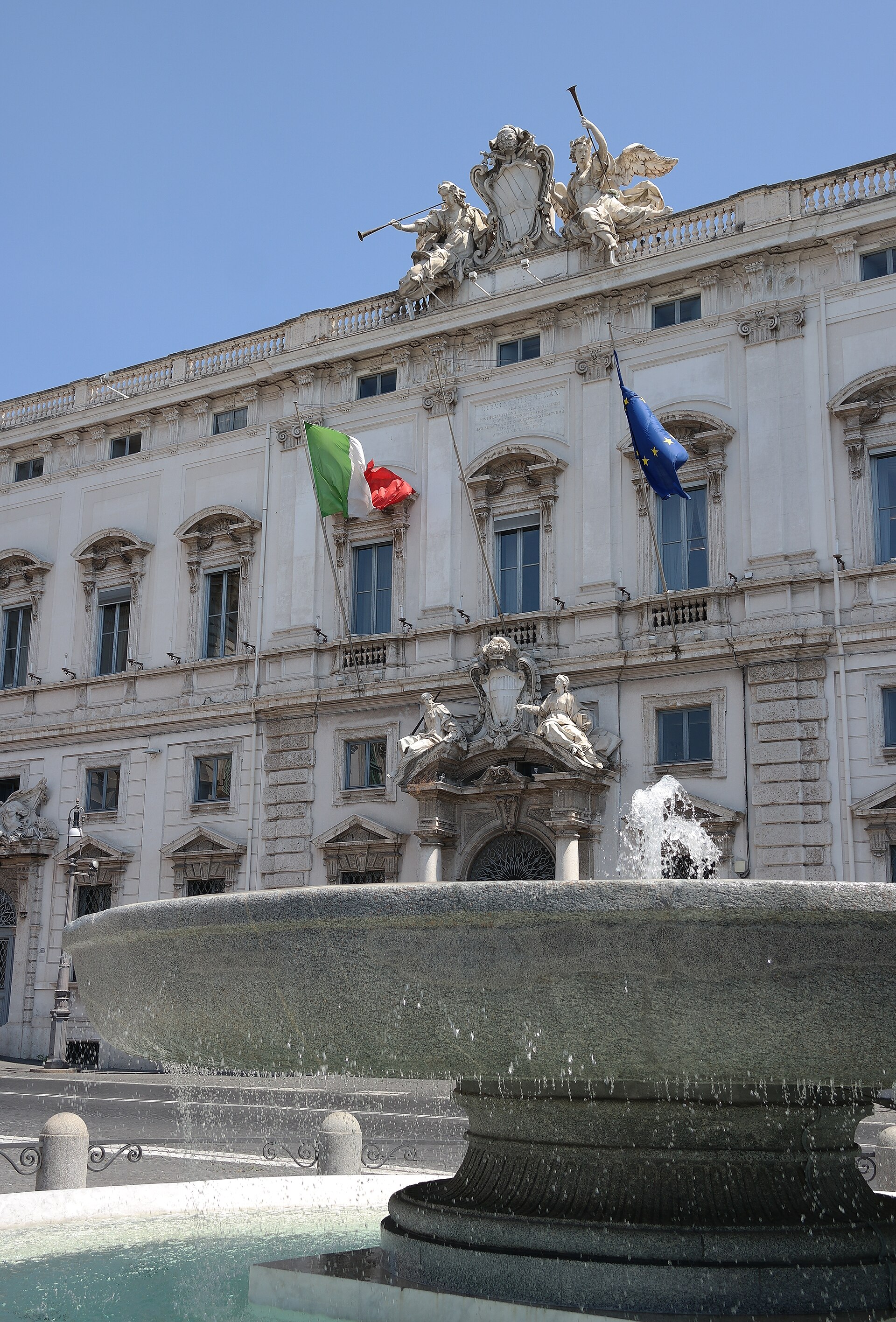
The apex constitutional body, operating under President Gaetano Silvestri and Judge Rapporteur Franco Frigo, was called to resolve whether the disparity between Article 322, paragraph 2, and Article 377 of the Criminal Code breached the equal protection principle under Article 3 of the Italian Constitution.
The Public Prosecutor’s Office and Technical Auxiliaries
The investigating prosecutorial magistrates who initiated the preliminary disaster probe under Article 359 of the Code of Criminal Procedure, alongside the appointed forensic flight expert whose independence was illicitly solicited by aviation industry intermediaries.
The Supreme Court of Cassation (Joint Civil and Criminal Chambers)
The Sixth Criminal Section and the United Sections (Sezioni Unite) of the Supreme Court of Cassation, which deliberated on the jurisdictional qualification of subornation offenses and referred the matter to the Constitutional Court over concerns of irrational punitive discrepancies.
Commercial Aviation Defense Interests
The corporate defense apparatus and intermediaries representing the airline operating the crashed aircraft, whose efforts to divert forensic conclusions regarding mechanical or operational responsibility catalyzed the criminal indictment.
Critical Analysis of the Evidentiary Record and Statutory Gaps
The core legal dilemma articulated in Judgment 163/2014 resides in an undeniable statutory paradox: an individual who attempts to suborn an official court expert (perito)—a neutral figure sworn directly before the trial judge—faces the lighter sentencing framework of Article 377, paragraph 1 (obstruction of justice). Conversely, an individual attempting to suborn a technical consultant hired by the prosecution during preliminary inquiries faces the heavier sanction of Article 322, paragraph 2 (bribery of a public official).
From a systemic perspective, this disparity violates intuitive principles of procedural justice. The court-appointed expert holds a sovereign duty of strict neutrality toward the court, whereas a prosecutorial consultant acts as an auxiliary to an accusatory party. Punishing an illicit approach to the party’s aide more severely than an assault on the judge’s own expert reflects an inverted hierarchy of legal goods.
“È inammissibile la questione di legittimità costituzionale dell’art. 322, secondo comma, cod. pen., impugnato, in riferimento all’art. 3 Cost., nella parte in cui assoggetta la subornazione del consulente tecnico del pubblico ministero ad una pena superiore a quella prevista dall’art. 377, primo comma, cod. pen. per la subornazione del perito.”
Legal commentators and procedural scholars, including analyses by Kostoris and Piotto, noted that the Constitutional Court chose an institutional posture of restraint by declaring the matter inadmissible rather than issuing an additive judgment. The Court acknowledged the presence of systemic friction but held that restructuring the relationship between general corruption crimes and specific offenses against the administration of justice required explicit legislative intervention rather than judicial rewriting.
The evidentiary record leaves several structural vulnerabilities unaddressed in contemporary practice. Because preliminary technical evaluations often dictate whether an indictment is filed or an inquiry dismissed (archiviazione), the pressure exerted on prosecutorial experts remains acute. By declining to equalize the statutory definitions, the jurisprudence left criminal courts to navigate conflicting precedents on whether an investigative expert acts purely as a public officer (pubblico ufficiale) or as a prospective witness subject to Article 501 cross-examination rules.
Transparency and Public Domain Verification
This dossier is constructed from the official records and evidentiary findings of Judgment No. 163 of 2014 (ECLI:IT:COST:2014:163), issued by the Constitutional Court of the Italian Republic following the council chamber hearing of April 9, 2014, and published in the Official Gazette on June 18, 2014.
In accordance with Article 5 of Italian Law No. 633 of April 22, 1941 (and subsequent amendments), texts of official acts of the State, judicial sentences, and public administrative decisions are completely exempt from copyright restrictions and belong fully to the public domain. The complete case file, preliminary referral orders, and comparative legal analyses are publicly verifiable through the institutional archives of the Corte Costituzionale.