
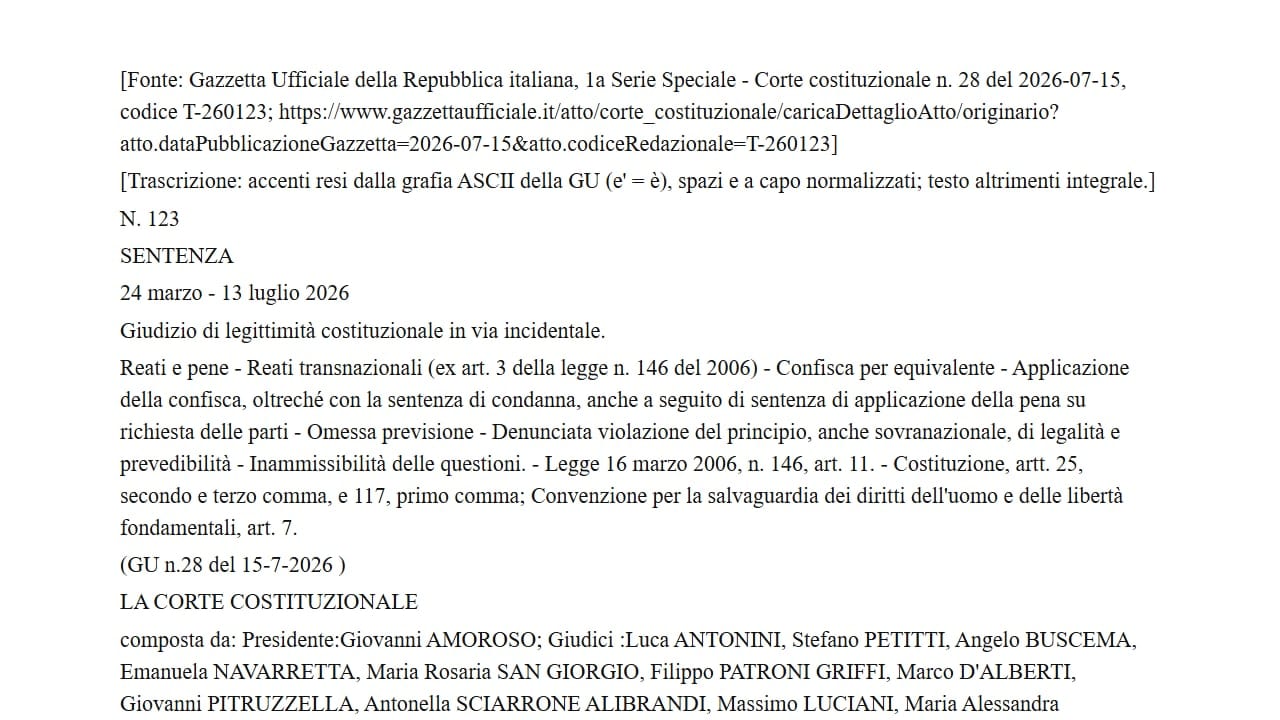
In 2017 the Preliminary Hearing Judge of the Court of Arezzo applies, at the parties’ request, an agreed sentence to two defendants whom the Constitutional Court would later identify by the initials F. B. and M. F. It is a plea bargain, judgment no. 340 of 2017, but it carries a heavy confiscation: sums of money, a car and real estate, taken not because they derive directly from the offences charged but for a value corresponding to their proceeds, profit or price. The legal basis is Article 11 of Law no. 146 of March 16, 2006, the law ratifying the United Nations Convention against Transnational Organized Crime: for transnational offences it provides for confiscation by equivalent “with the judgment of conviction”. The two appeal to the Court of Cassation precisely against the confiscation. The Second Criminal Section, in judgment no. 16100 of 2019, dismisses the appeals, and on February 27, 2019 the decision becomes final.
Six years later the issue returns to the same court, this time at the enforcement stage. The convicted persons ask for the confiscation to be revoked, and the judge, by two almost identical orders of April 28 and 29, 2025, entered as nos. 143 and 144 in the 2025 register of orders and published in Official Gazette no. 35, first special series, of the same year, turns to the Constitutional Court. The doubt is whether it was foreseeable, for those who plea-bargained, that a rule written for the “judgment of conviction” would also apply to a plea bargain; and whether a measure that may be a penalty can rest on a finding that the judge himself calls weak. The Court, presided over by Giovanni Amoroso, heard the parties at the public hearing of March 24, 2026, with Judge Massimo Luciani as rapporteur, and decided the same day. Judgment no. 123 of 2026, filed on July 13 and published in Official Gazette no. 28 of July 15, 2026, declares the questions inadmissible. The Court does not rule on the merits: the request was framed obscurely, and in any case the enforcement judge could not call into question a rule already applied by a final judgment.
The other story begins on October 3, 2012, in the arrivals hall of Milan-Linate airport. A taxpayer arriving from Switzerland is found carrying a work of art of considerable value that he has not declared and on which he has not paid the value added tax due on import. The criminal trial for smuggling ends in acquittal: in the meantime Legislative Decree no. 8 of January 15, 2016 has decriminalised simple smuggling, and the act is no longer an offence. The file passes to the administrative authority, which orders the seizure and confiscation of the work under Article 301 of the Consolidated Customs Act, Presidential Decree no. 43 of January 23, 1973. Before the confiscation is ordered, the taxpayer has already paid the evaded tax and the administrative penalties in full.
No customs duties were at stake on the work. Goods coming from Switzerland are governed by the Agreement between the European Economic Community and the Swiss Confederation of July 22, 1972, and in the case, as the Joint Sections write, “the evasion of duties, which were neither due nor charged, does not even arise”. The only tax evaded is import VAT. Confiscation therefore does not stem from a VAT rule but from a cross-reference: Article 70 of the VAT decree provides that the customs laws on border duties apply to disputes and penalties, and among them is Article 301, which always orders confiscation of the things smuggled. It is this cross-reference, written in 1972, that leads to an entire work of art being taken for a tax already paid.
The taxpayer challenges the confiscation before the Provincial Tax Commission, which dismisses the appeal; the appeal judge instead rules in his favour, holding that after decriminalisation customs confiscation no longer applies. The Customs Agency appeals to the Court of Cassation; the Tax Section, by interlocutory order no. 21917 of July 21, 2023, refers the question to the Joint Civil Sections, and these, by order of July 4, 2024, entered as no. 167 in the 2024 register of orders and published in Official Gazette no. 39 of the same year, raise the constitutional question. The Court, with Judge Luca Antonini as rapporteur, heard it at the public hearing of May 6, 2025 and decided it on June 11. Judgment no. 93 of 2025, filed on July 3 and published in Official Gazette no. 28 of July 9, 2025, declares Article 70(1) of the VAT decree, Presidential Decree no. 633 of October 26, 1972, partly unconstitutional: the object of the violation cannot be confiscated if the person liable has paid in full the evaded tax, the related charges including interest, and the penalty.
The two cases share a question that has run through Italian criminal and tax law for years: when does a confiscation stop being the mere recovery of what the offence yielded and become a punishment, and what safeguards must it respect when it does. In the background is judgment no. 13783 of 2025 of the Joint Criminal Sections of the Court of Cassation, which both cases cross: according to that decision, if confiscation, direct or by equivalent, does not take more than the offence produced, it is a burdensome and restorative measure, but not a punitive one. In the Arezzo case that change in case law is the hook with which the enforcement judge tries to reopen a final judgment; in the Linate case the Court reaches the opposite conclusion about the measure before it, because taking an entire work of art for a tax worth a fraction of its price is a punitive sanction.
The outcomes differ and must be kept apart. The previous version of this page presented both cases as still open and attributed to the Court conclusions that belonged to the referring judges or the parties: for example, that confiscation applied with a plea bargain breached the principle of foreseeability, a thesis on which judgment no. 123 of 2026 says nothing at all. It also cited, as part of the plea-bargain case, a passage that belongs to judgment no. 93 of 2025, and listed among the documents examined two judgments that do not appear in the sources. The full texts, published in the Official Gazette, make it possible to reconstruct what the judges asked, what the State and the private parties answered, and what the Court decided, with its reasons.
A third text helps to understand the first. In the Arezzo case the referring judge cites constitutional judgment no. 83 of 2024, in which the Court, rejecting a doubt raised by the Court of Marsala on the sentence reduction in plea bargains, had described the judgment applying an agreed sentence as “only ‘equated’” to a conviction. That phrase is the pivot of the Arezzo judge’s argument: if a plea bargain is not a real conviction, a confiscation that the law ties to the “judgment of conviction” should not follow it. What the Court meant in 2024 can be read in the judgment itself, and is reconstructed below.
The Arezzo plea bargain and the final judgment to be reopened
The Arezzo orders ask for Article 11 of Law no. 146 of 2006 to be declared unconstitutional insofar as it provides for confiscation with the judgment of conviction “and not also following a judgment applying the penalty at the parties’ request under Article 444 et seq. of the Code of Criminal Procedure”. On relevance, the judge explains that the confiscation hit assets not deriving directly from the offences, so it was by equivalent, and that if the questions were upheld he would have to order their return. The final judgment, he argues, is no obstacle. While ruling out retroactive effect for a favourable change in case law, he cites Joint Sections judgment no. 18288 of 2010, which calls for a “systematic interpretation of Article 666(2) of the Code of Criminal Procedure in the light of the provisions of the European Convention on Human Rights”, and judgment no. 8052 of 2024, which brings case-law-made rules within criminal legality. It would not be a matter, he writes, of “deciding whether a later change in case law can overturn a final judgment”, but of establishing whether the confiscation under Article 11 is a penalty and whether the rule respects foreseeability and legality.
The judge then traces the history of confiscation by equivalent. The Court of Cassation had always recognised it as a sanction, excluding it for instance against a legal person for tax offences by its legal representative, in Joint Sections judgment no. 10561 of 2014, and in case of limitation, in no. 31617 of 2015. Then came the turn of judgment no. 13783 of 2025: “if confiscation – direct or by equivalent – does not take more than what was obtained from the offence, it is burdensome and restorative but not punitive”. The referring judge infers that confiscation under Article 11 is now restorative, but adds that “this distinction is not relevant in the present case since the central issue concerns the foreseeability of the measure”. At the time of the trial, he notes, the measure was considered punitive; today “that certainty no longer exists”.
The crux, for the Arezzo judge, lies elsewhere: it is necessary “to verify whether confiscation by equivalent was a foreseeable measure for those who settled their case under Article 444 of the Code of Criminal Procedure”. The criminal procedure reform, Legislative Decree no. 150 of October 10, 2022, allowed the parties to agree also on ancillary penalties and discretionary confiscation. And although the Constitutional Court, in judgment no. 336 of 2009, affirmed full equivalence between conviction and plea bargain, “Article 445(1) of the Code of Criminal Procedure expressly refers only to confiscation under Article 240 of the Criminal Code – that is, direct confiscation, whether discretionary or mandatory – and not to confiscation by equivalent”. Where the legislature wanted value confiscation to follow plea bargains too, it wrote so; where it did not, as in Article 11, it would be hard to argue that equivalence expands on its own.
In support the referring judge cites the European Court of Human Rights judgment of October 29, 2013, Varvara v. Italy, and Joint Sections judgment no. 31617 of 2015, which would require a formal finding of liability for confiscation understood as a penalty. He cites constitutional judgment no. 83 of 2024, which speaks of “a judgment that is only ‘equated’ to a conviction and that has no effect in non-criminal proceedings”. And he cites the Strasbourg judgment of December 19, 2024, Episcopo and Bassani v. Italy, which for confiscation under Article 322-ter of the Criminal Code held insufficient a non-final finding of liability ended by limitation. If even that is not enough, the judge writes, “one wonders how a measure of a burdensome or punitive nature can apply in the presence of a plea-bargain judgment – whose finding is inherently weak – where the rule does not expressly provide for it”. His conclusion is that Article 11 “does not fully meet the standards of accessibility and foreseeability set out in Article 7 of the Convention”.
The State and the private party: two opposite readings
The President of the Council of Ministers intervened in both cases, through the State Attorney General’s Office, asking for the questions to be declared inadmissible or unfounded. The first argument is that the request is unclear: the operative part of the orders complains that confiscation does not apply to plea bargains, while the reasoning argues the opposite, that it should not apply. The second is that the questions are irrelevant. The money was confiscated directly, not by equivalent, under the case law prior to judgment no. 13783 of 2025; and a change in case law does not allow a final judgment to be revoked, which is possible only if the offence is abolished or a rule is declared unconstitutional. As for the car and the real estate, the new case law would not even be favourable: by making confiscation by equivalent no longer always punitive, but with “a merely restorative function with respect to the financial position prior to the offence”, it would worsen the position of those who plea-bargained.
On the merits, the State Attorney argues that foreseeability must be measured against the rules in force when the confiscation was applied. Law no. 134 of June 12, 2003 had extended to plea bargains all the confiscations under Article 240 of the Criminal Code, including confiscation by equivalent under paragraph 2, point 1-bis; and the third paragraph of that article states that confiscation by equivalent “also applies where the penalty is applied at the parties’ request under Article 444 of the Code of Criminal Procedure”. Article 322-ter, which expressly refers to plea bargains in its first paragraphs and speaks of a “judgment of conviction” in its third, would show that the two expressions are equivalent. And the 2022 reform, while widening the cases in which plea bargains have no effect in other proceedings, did not touch confiscation: “the legislature did not see fit to exclude the equivalence of that judgment to a conviction for the purposes of confiscation”. For the State, moreover, the Episcopo and Bassani judgment itself rules out that a restorative confiscation falls under Article 7 of the Convention: the safeguards would lie in Article 42 of the Constitution and Article 1 of Protocol No. 1.
M. F., a party in the second case, appeared with a twofold position: the questions are unfounded if they seek to extend confiscation to plea bargains, well founded if the rule is read as already allowing it. For the defence, a plea-bargain judgment rests on a “weak” finding, incompatible with the safeguards of Article 7 of the Convention, and applying to it the confiscation provided for convictions would be analogy to the detriment of the accused. In a brief of March 3, 2026, accompanied by two expert opinions, the party adds that confiscation under Article 11 is criminal because it exceeds the advantage obtained, that the Court of Cassation is divided on the point, as its Case Law Office has noted, and that whenever the legislature wanted confiscation to follow plea bargains it said so: in Articles 322-ter, 640-quater, 600-septies and 648-quater of the Criminal Code, in Article 2641 of the Civil Code, in the 2008 budget law and in the consolidated immigration act. Therefore, it concludes, “the equivalence clause in Article 445(1-bis) of the Code of Criminal Procedure is not considered sufficient by the legislature to establish equivalence between a conviction and a plea bargain for the specific purpose of confiscation”.
A request that asked for the opposite of what it argued
The Court joins the two cases and starts with the State’s objections. The first is well founded. The reasoning of the orders is built on the doubt that confiscation by equivalent can be ordered with a plea bargain; the operative request, instead, challenges the rule insofar as it provides for it with a conviction and not also with a plea bargain. In other words, the Court observes, the request appears aimed at an additive ruling extending transnational confiscation precisely to plea bargains, the opposite of what the judge argues. The request also comes at the end of a line of reasoning that the judgment calls “not linear”: the orders devote much space to the legal nature of confiscation and then, on page 11, declare it irrelevant.
The ambiguity, the Court adds, is confirmed by the private party’s submissions, which ask for the questions to be found unfounded in one sense and well founded in the other: the party presents them as main and alternative requests, but the orders contain no trace of questions raised in the main and in the alternative. The “obscurity and uncertainty of the request, which are very marked indeed” are enough on their own to make the questions inadmissible, as the Court held in similar cases in judgments no. 143 of 2018, nos. 102 and 32 of 2016, no. 247 of 2015 and in orders no. 261 of 2020, no. 250 of 2019 and no. 65 of 2018.
A final judgment is not reopened at the enforcement stage
For completeness the Court examines a second ground of inadmissibility, and here the judgment says something that reaches beyond the case. As a rule, the enforcement judge cannot raise questions on a rule already applied at trial: they should have been raised there. The only exception, set by judgment no. 210 of 2013 and recalled in no. 100 of 2015, concerns the need to comply with a substantive judgment of the European Court of Human Rights where a remedy is possible at the enforcement stage. The principle, the Court writes, citing judgment no. 57 of 2016, “precludes, in criminal enforcement proceedings, questioning the constitutionality of the rule under which the offender was convicted and of the penalty consequently imposed”.
Constitutional case law has accepted that the finality of a judgment may give way only to supervening events concerning punishability and sentencing. The first case was the Strasbourg Grand Chamber judgment of September 17, 2009, Scoppola v. Italy, which allowed life sentences to be recalculated as thirty years’ imprisonment even for those who had not applied to Strasbourg. According to judgment no. 147 of 2021, the enforcement judge may raise questions only as a result of a “constitutionally relevant supervening event” that has altered the sequence between trial and enforcement. That happened in judgment no. 68 of 2021 on the revocation of a driving licence ordered by a final judgment. The exception, the Court recalls, concerns the penalty, not the finding of liability.
In the Arezzo case, by contrast, the confiscation was ordered with the plea bargain and became final with Court of Cassation judgment no. 16100 of 2019, which had expressly dealt with the alleged unlawfulness of the confiscation. The referring judge challenges a rule already applied with final effect, and there is no unlawful penalty capable of producing a “relaxation of the finality of the judgment”. These grounds absorb the State’s other objections. The operative part, having joined the cases, declares inadmissible the questions on Article 11 of Law no. 146 of 2006 raised under Articles 25(2) and 117(1) of the Constitution and Article 7 of the Convention. The practical consequence is that the confiscation stands. On the point of law the orders raised, whether transnational confiscation by equivalent can follow a plea bargain, the Court says nothing: the answer is left to the ordinary courts.
What the Court had said about plea bargains
Judgment no. 83 of 2024, cited by the Arezzo judge, arose from an entirely different problem. The Court of Marsala, in a trial for breach of special police supervision obligations, had seen the prosecutor refuse consent to a plea bargain with a reduction by half, because for minor offences Article 444 of the Code of Criminal Procedure allows a reduction of up to one third, while the summary trial, after Law no. 103 of June 23, 2017, halves the sentence. The disparity, for the Marsala court, was “liable to produce discriminatory results in practice”, unreasonable “if not paradoxical”, because a plea bargain is the procedure that saves the most time. The Court, presided over by Augusto Antonio Barbera with Franco Modugno as rapporteur, in chambers on March 19, 2024 declared inadmissible the questions under Articles 24 and 111 of the Constitution and unfounded the one under Article 3; the judgment was filed on May 10, 2024.
The reason lies in the different nature of the two procedures. In a summary trial the judge fully establishes liability and applies the fixed one-third reduction to the sentence he chooses; in a plea bargain the defendant obtains a certain, agreed sentence that the judge cannot change, through a judgment “equated” to a conviction and without effect in non-criminal proceedings. Added to this are advantages with no equivalent: the request may be made conditional on a suspended sentence, and for sentences up to two years there are no costs, ancillary penalties or security measures, except confiscation in the cases of Article 240 of the Criminal Code. Legislative Decree no. 150 of 2022 then extended the lack of effect of plea bargains to disciplinary, tax and audit proceedings and allowed, in plea bargains with sentences above two years, agreement on discretionary confiscation. The phrase about the “equated” judgment thus served, in 2024, to explain why the two procedures cannot be compared; in the Arezzo case it was used to argue that a plea bargain cannot ground a confiscation, but the Court, in 2026, did not examine that argument.
A work of art at Linate and VAT treated like a customs duty
In the Linate case the Joint Civil Sections first settle the issue that brought the case before them: they hold that “the continued validity of Article 301 of Presidential Decree no. 43 of 1973 must be affirmed” even after decriminalisation, because the 2016 decree did not repeal it. Then they raise the constitutional doubt. They note that the case “concerns the import of goods from Switzerland into Italy”, governed by the Agreement between the European Economic Community and the Swiss Confederation, and that according to settled case law, in Cassation judgments no. 16109 of 2015, no. 8473 of 2018 and no. 5962 of 2019, “import VAT is not a border duty (under Article 34 of the Customs Act) like customs duties but, as to its features, is the same tax as intra-EU VAT”.
Yet Article 70 of the VAT decree applies to import tax the penalties of the customs laws, including the confiscation under Article 301, which does not exist for domestic VAT. The Joint Sections cite the Court of Justice judgment of February 25, 1988, Case C-299/86, Rainer Drexl, on the “manifestly disproportionate gap in the severity of penalties” between imports and domestic trade. For domestic VAT, non-criminal violations are punished only administratively, under Legislative Decrees nos. 471 and 472 of 1997, without confiscation; for criminal ones, confiscation under Article 12-bis of Legislative Decree no. 74 of March 10, 2000 provided that “confiscation does not apply to the part that the taxpayer undertakes to pay to the Treasury, even where there has been a seizure”. Even for customs duties, they add, the regime is milder: Article 124 of the Union Customs Code, Regulation (EU) 952/2013, extinguishes the customs debt when the goods are confiscated. For import VAT, instead, confiscation is added to the penalties and does not extinguish the debt.
Confiscation, moreover, is fixed and automatic and takes no account of conduct. The Joint Sections say so with the facts of the case: “in the case at hand the taxpayer did unlawfully import a work of art, but also, before the confiscation order was even adopted, paid in full both the evaded tax and the administrative penalties imposed”. Their conclusion is that the combination of confiscation and pecuniary penalties, for transactions with Switzerland, is particularly severe and in any case harsher than for domestic VAT and for VAT in trade between EU States, even looking at criminal cases, which are objectively more serious. A conforming interpretation, they add, is ruled out by the wording of Article 70, and the Article 12-bis rule cannot be extended by interpretation.
The State’s objections and the taxpayer’s replies
The State Attorney General’s Office asks for the question to be declared inadmissible or unfounded, or for the file to be returned to the referring court. It argues that the reference to Article 49 of the EU Charter of Fundamental Rights is generic and concerns only criminal penalties; that the court should have considered that, given the large amount evaded, the conduct would have remained criminal; and that the reasoning is contradictory, because on the one hand it justifies harsher treatment by the greater difficulty of detecting import evasion and on the other it denies significant differences in detection. On the merits, for the State, import VAT is a border duty under Article 34 of the Consolidated Customs Act, which includes “any other consumption tax or surtax in favour of the State”, and “bringing goods into the country in evasion of border duties [would be] far more serious than any tax evasion or avoidance within the country of the same amount”.
In its brief of April 9, 2025 the State insists: import evasion requires “more laborious detection”, and whoever commits it breaches national sovereignty by lying to the customs authorities, who also control the entry of prohibited items, from drugs to weapons. Confiscation would serve “to prevent smuggling by depriving the offender of the goods”, and not to recover taxes: its aim is “to discourage smuggling altogether”. Finally, the State asks for the file to be returned to the Court of Cassation in light of Legislative Decree no. 141 of September 26, 2024, which rewrote the national customs rules and, in Article 27(2) of its Annex 1, expressly classifies import VAT as a border duty.
The taxpayer, who joined the proceedings, replies that the 2024 decree does not apply to his case, because it provides that the “administrative penalties in Annex 1 and Article 3 apply to violations committed from the date of entry into force of this decree”, that is, from October 4, 2024. He adds, in a brief of April 15, 2025, that import evasion is already punished with very heavy pecuniary penalties, in his case up to ten times the unpaid duties, and that it is “the combination of those penalties with a mandatory confiscation measure of extreme severity, such as customs confiscation, that breaches the limit of proportionality”. Finally, he points out that the question concerns cases in which the tax debt was fully extinguished before the confiscation, so the State’s references to a criminal offence are beside the point.
The Court: a relative, not absolute, disproportion
The Court rejects all the objections. The reference to Article 49 of the Charter is correct: the Joint Sections use it to argue that mandatory confiscation does not respect proportionality between sanction and offence, a principle that also follows from paragraph 3, under which “the severity of penalties must not be disproportionate to the criminal offence”, and VAT, a harmonised tax, falls within EU law. When a question has a “constitutional tone”, a court may always ask the Constitutional Court to remove the incompatible law, as recalled in judgment no. 7 of 2025. On the criminal nature of the conduct, the Court notes that the referring court had to take note of the outcome of the trial: acquittal because of decriminalisation. And the reasoning is not contradictory. Contradiction, the judgment recalls, citing its own case law, makes reasoning unable “to show and explain how the alleged violation arises”, as when a complaint “contradicts the very premise from which the claimant starts”; here the Joint Sections simply said that differences in detection, which exist, are not enough to justify confiscation.
Nor does the 2024 reform justify returning the file. Legislative Decree no. 141 of 2024 repealed the 1973 consolidated act and introduced a genuine national customs code, but it expressly excludes retroactive effect for the new administrative penalties; the violation dates back to 2012, the pecuniary penalty has been paid, and confiscation is confirmed by the rules now in force. As for classifying import VAT as a border duty, which the explanatory report links to criminal Cassation judgment no. 4978 of 2022 and which judgment no. 43140 of 2024 extended to the past, for the Court it does not change the substance: VAT remains a tax founded on fiscal neutrality and the right to deduct, as recalled by the Court of Justice judgments Equoland of 2014, U.I. srl of 2022 and Gaston Schul of 1982, whereas duties serve to protect the market and fund the Union’s own resources. Since the Joint Sections framed the question on Article 70 read together with Article 282, which punishes smuggling “with a fine of not less than two and not more than ten times the border duties”, and with Article 301, the Court decides the general question: whether confiscation, in cases of import VAT evasion, is a disproportionate punitive sanction.
On the merits the question is well founded, in the terms the Court itself defines. Proportionality applies to all administrative sanctions and to tax sanctions, as held in judgment no. 46 of 2023 and by the Court of Justice in Case C-712/17, En.Sa srl. The Italian legislature moved in the same direction: Law no. 23 of March 11, 2014, then Law no. 111 of August 9, 2023, which called for “improving the proportionality of tax penalties, reducing their burden and bringing it into line with levels in other European States”, implemented by Legislative Decree no. 87 of June 14, 2024 and merged into the consolidated text of Legislative Decree no. 173 of November 5, 2024. Against this development, the challenged rule is out of line. Article 301 provides that in cases of smuggling “confiscation shall always be ordered of the things that served or were intended to commit the offence and of the things that are its object or its product or profit”. Confiscation does not extinguish the tax debt and is added to the pecuniary penalty, from two to ten times the amount evaded, for conduct that is a crime or an administrative offence depending on whether the amount exceeds 10,000 euros. It is a combination, the Court writes, with no equal for either domestic VAT or customs duties.
But the Court does not grant the Joint Sections’ request to remove confiscation. The consolidated act classifies it as a “security measure”, and the Court recognises that it is punitive, because it does not merely make the State whole for the unpaid tax but takes far more from the taxpayer. However, unlike the confiscation of instrumental assets struck down in judgments no. 7 of 2025 and no. 112 of 2019, confiscation of the smuggled object is proportional: VAT is always a percentage of the value of the goods, 10 per cent in the Linate case, and confiscation hits a multiple of the profit, adjusting to the factor that best expresses the seriousness of the offence. Moreover, when mandatory confiscation of instrumental assets was removed, discretionary confiscation took its place; if this one were removed, no confiscation at all would remain for import VAT. And since the tax arises with the physical entry of the goods into the territory, and a protective seizure of indivisible goods is not always possible, once confiscation is lost “the State could find itself essentially disarmed in the face of import VAT evasion”.
The defect, therefore, is not an absolute disproportion: it is what the Court calls a relative, or “ordinal”, disproportion, which emerges from the comparison with Article 124 of the Union Customs Code, which extinguishes the duty upon confiscation, and with the rules on domestic VAT, where seizure for the purpose of confiscation is not ordered if the debt is being paid off. The new text of Article 12-bis, amended by Legislative Decree no. 87 of 2024, in fact excludes seizure if the tax debt is being paid off in instalments and the taxpayer is up to date with payments. The remedy turns on the conduct of the person who went wrong: if the offender pays the evaded tax, the charges with interest and the penalty, the State has recovered the entire debt and the guarantee function that justifies confiscation falls away. The operative part declares Article 70(1) unconstitutional insofar as it does not provide that, where Article 301 applies, “the things that are the object of the violation shall not be confiscated if the person liable pays in full the amount evaded, the related charges including interest, and the pecuniary penalty”.
Two confiscations, two outcomes
Placed side by side, the judgments show two ways in which a question on confiscation can reach the Constitutional Court, and two opposite outcomes. In the Linate case the question came from the Joint Sections of the Court of Cassation, in proceedings still open, and was clearly framed: the Court upheld it, but rewrote the remedy, and left confiscation in place for those who do not pay. In the Arezzo case the question came from the enforcement stage, after a final judgment on which the Court of Cassation had already ruled, and was framed so as to ask for the opposite of what it argued: the Court did not examine it.
Two things remain open, because the records do not resolve them. The first is the point raised in Arezzo: whether confiscation by equivalent for transnational offences can be ordered with a plea bargain when the rule speaks only of conviction. The positions on the table are those of the referring judge and the private party on one side, and of the State Attorney on the other; the Court did not choose between them. The second concerns customs confiscations for VAT ordered before judgment no. 93 of 2025: the judgment decides the case at hand and sets the rule for the future, but it does not say how many confiscations there have been nor how courts will treat closed cases. It is an observation of this investigation that in both cases the crux is the same, the gap between what the offence yielded and what the State takes, and that the Court’s answer came only where the question was raised at the right time and in the right way.
The evidence file
- Decision 1: Constitutional Court, judgment no. 123 of 2026, decided March 24, 2026, filed July 13, 2026; president Giovanni Amoroso, rapporteur Massimo Luciani; Official Gazette, 1st Special Series, no. 28 of July 15, 2026 (full text, in Italian).
- Outcome 1: questions on Article 11 of Law no. 146 of March 16, 2006 inadmissible (Articles 25(2) and 117(1) of the Constitution, in relation to Article 7 ECHR), because the request was obscure and because they were irrelevant at the enforcement stage. Referring court: Preliminary Hearing Judge of the Court of Arezzo acting as enforcement judge, orders of April 28 and 29, 2025 (nos. 143 and 144 of 2025).
- Decision 2: Constitutional Court, judgment no. 93 of 2025, decided June 11, 2025, filed July 3, 2025; president Giovanni Amoroso, rapporteur Luca Antonini; Official Gazette, 1st Special Series, no. 28 of July 9, 2025 (full text, in Italian).
- Outcome 2: Article 70(1) of Presidential Decree no. 633 of 1972, in relation to Articles 282 and 301 of Presidential Decree no. 43 of 1973, unconstitutional insofar as it does not exclude confiscation of the object of the violation where the person liable pays tax, charges and penalty in full. Referring court: Court of Cassation, Joint Civil Sections, order of July 4, 2024 (no. 167 of 2024).
- Decision 3: Constitutional Court, judgment no. 83 of 2024, decided March 19, 2024, filed May 10, 2024; president Augusto Antonio Barbera, rapporteur Franco Modugno; Official Gazette, 1st Special Series, no. 20 of May 15, 2024 (full text, in Italian); questions on Article 444 of the Code of Criminal Procedure partly inadmissible and partly unfounded.
- Rules and records cited: Articles 240 and 322-ter of the Criminal Code; Articles 444, 445 and 666 of the Code of Criminal Procedure; Legislative Decree no. 150 of 2022; Legislative Decree no. 8 of 2016; Article 12-bis of Legislative Decree no. 74 of 2000; Legislative Decrees nos. 87 and 141 of 2024; Article 124 of Regulation (EU) 952/2013; Court of Cassation, Joint Criminal Sections, judgment no. 13783 of 2025; ECtHR, Varvara v. Italy, Scoppola v. Italy, Episcopo and Bassani v. Italy; CJEU, Case C-299/86, Rainer Drexl.
- Corrections to the previous version: the outcomes of the cases; the conclusions of the referring judges and of the parties are not the Court’s; the earlier block quotation was not verbatim and belonged to another judgment; two judgments listed as examined that do not appear in the records have been removed.
- Personal data: the persons in the Arezzo proceedings are identified only by the initials used by the Court, without the offences charged, which the judgment does not describe; the taxpayer in the Linate case, acquitted in criminal proceedings, is not identified.
- Basis for reproduction: Article 5 of Italian Law no. 633 of April 22, 1941, which excludes official acts from copyright.