
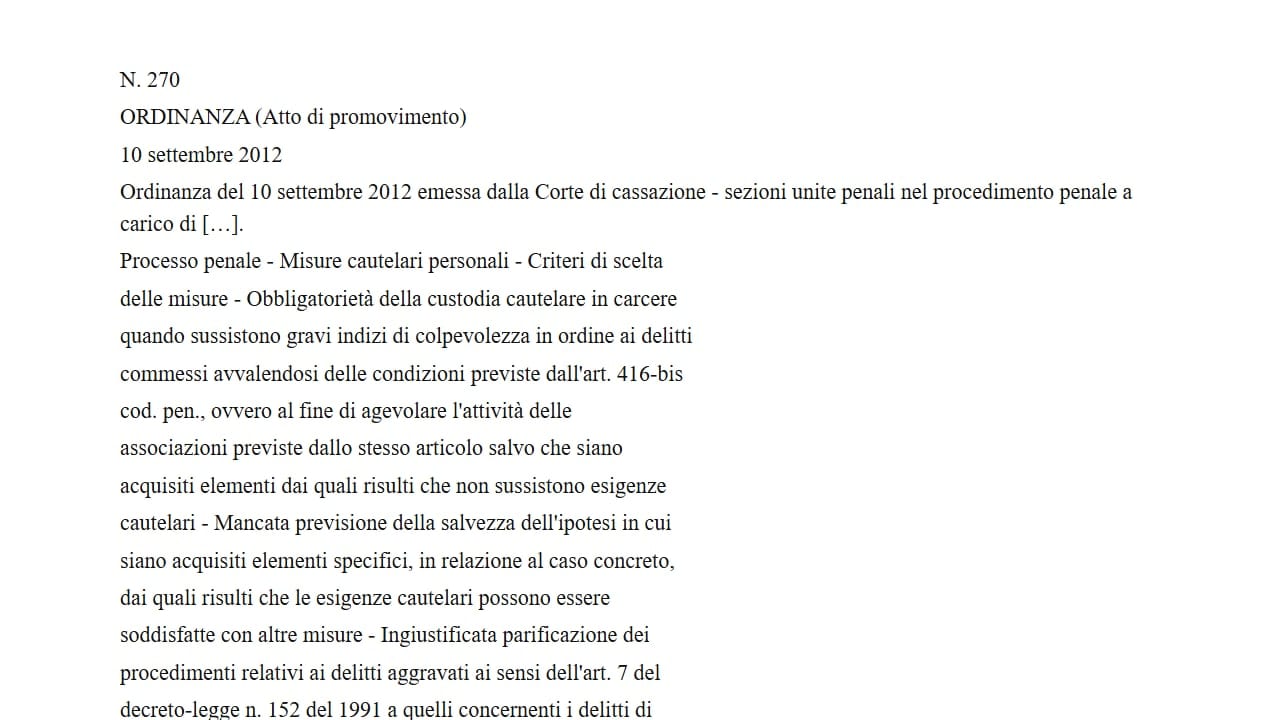
On July 19, 2012, in Rome, the Joint Criminal Divisions of Italy’s Court of Cassation (the Sezioni Unite) met in chambers to decide the appeal of a man held in prison in criminal proceedings that began in Naples. The charges listed in the order are unlawful possession and carrying in a public place of an unregistered common firearm, receiving stolen goods and extortion, all brought with the aggravating circumstance of using mafia methods and of acting to help a mafia organization. The appellant was not asking to be released: he was asking to go back to house arrest, which one judge had granted him and another had taken away. The answer is an order dated September 10, 2012, published in the Official Gazette, 1st Special Series devoted to the Constitutional Court, no. 48 of December 5, 2012, as order register no. 270 of 2012. The Joint Divisions did not close the case: they declared a question of constitutionality relevant and not manifestly unfounded, stayed the proceedings and sent the file to the Constitutional Court.
The story behind that hearing begins two years earlier. On May 6, 2010 a judge of the Naples Court, at the end of a fast-track (abbreviated) trial, replaced pre-trial custody in prison with house arrest. The Cassation order does not report the outcome of that trial, and no final conviction appears in the act: the appellant remains presumed innocent, and the measure concerning him is a precautionary measure, not a sentence. The prosecutor challenged the substitution. On February 16, 2012 the Naples Court, sitting as appeal judge for precautionary measures, upheld the challenge in an order filed on February 23: custody in prison could not be replaced with a lighter measure, because Articles 275(3) and 299(2) of the Code of Criminal Procedure, read together, prevent it, and because the suspect is charged with the aggravating circumstance of Article 7 of Decree-Law no. 152 of 1991, converted by Law no. 203 of 1991.
The whole knot lies in those two provisions. Article 275 sets the criteria by which the judge chooses the measure that fits the nature and degree of the precautionary needs in the specific case, but paragraph 3 creates an exception: for a list of offences, including those committed by exploiting the conditions described in Article 416-bis of the Criminal Code or in order to help mafia-type associations, custody in prison is mandatory “unless evidence is obtained showing that there are no precautionary needs.” This is the absolute presumption of adequacy: if precautionary needs exist, however strong or weak, there is only one measure. Article 299(2), which governs the replacement of measures when the needs diminish, opens precisely with the words “except as provided by Article 275(3).” For the Naples Court the consequence was straightforward: anyone in prison for one of those offences gets out only if the precautionary needs disappear entirely, and in that case the measure is revoked, not replaced.
Defence counsel appealed to the Court of Cassation alleging breach of procedural law and inadequate reasoning, and argued the opposite: the presumption of Article 275 would be only relative, capable of being overcome by the judge’s discretionary assessment, in light of the decisions in which the Constitutional Court had recently declared that provision partly unconstitutional, one category of offences after another. The appeal was assigned to the Sixth Criminal Division, which by an order of May 10, 2012, filed on June 4, referred it to the Joint Divisions because the Court’s case law on the point was split. By decree of June 6, 2012 the First President assigned it to the Joint Divisions and set a hearing in chambers with the parties.
At the hearing of July 19 the report was presented by Judge Vincenzo Romis, who would also draft the order; the bench was chaired by President Lupo. For the prosecution, Advocate General Massimo Fedeli asked for the appeal to be dismissed; defence counsel asked for it to be upheld. The question the bench set itself is written in quotation marks in the act: to establish “whether the presumption of adequacy of custody in prison under Article 275(3) of the Code of Criminal Procedure operates only when the measure is first ordered, or also covers subsequent events concerning whether the precautionary needs persist.”
What makes the act unusual is its double move. In the first part the Joint Divisions answer the question in the strictest sense, the same one the Naples Court had applied: the presumption applies for the whole life of the precautionary measure, not only at the moment it is ordered. In the second part the same bench asks whether the provision, read in this way, is compatible with the Constitution when the offence is not membership of a mafia association itself but a crime aggravated under Article 7: an aggravating circumstance that, the judges write, can accompany the commission of any offence and can also concern people who do not belong to the association. The interpretive answer, therefore, does not decide the appeal. What halts it is the doubt about constitutionality.
This is why the order is neither a judgment that closes a case nor a ruling that settles the rule for good. It is a referral: a judge who must apply a law and doubts its constitutionality cannot simply set it aside, but must turn to the Constitutional Court. That is what the Court of Cassation does, citing Article 23 of Law no. 87 of March 11, 1953: it stays the proceedings, orders the immediate transmission of the file and, in the meantime, leaves things as they are, “without prejudice to the precautionary measure in force.” While the Constitutional Court examines the question, the appellant remains in the condition decided by the Naples Court. How the Constitutional Court later answered is not written in this act, and this page does not add it: the document read stops at the question.
The constitutional standards invoked are three articles of the Constitution. Article 3, because of the unjustified equal treatment of proceedings for crimes aggravated under Article 7 and proceedings for mafia crimes, and because of the irrational subjection of different concrete situations to the same precautionary regime. Article 13(1), which declares personal liberty inviolable and is the reference point for the ordinary regime of precautionary measures. Article 27(2), on the presumption of innocence, because such an automatic rule risks giving precautionary coercion the functional features typical of punishment. To get there, the order retraces twenty years of case law of the Court of Cassation and of the Constitutional Court, and lines up the decisions with which the Constitutional Court, from 2010 onwards, had already removed mandatory prison custody for sexual violence, murder, aiding illegal immigration, association for drug trafficking and criminal association set up to commit the offences of Articles 473 and 474 of the Criminal Code.
The text published in the Gazette gives the appellant’s personal details, as was the practice for referral orders. This page does not reproduce them: the person concerned is not needed to understand the question, which is about a rule of law and the way it applies to thousands of proceedings. What matters is the procedural position, which the act describes precisely: a suspect, later a defendant, held in pre-trial custody for offences aggravated under Article 7, with no final conviction.
Two readings of the same line of the Code
Before answering, the Joint Divisions reconstruct the split. The view that the presumption governs only the initial moment of the measure had been put forward most recently by the Sixth Division in judgment no. 25167 of February 18, 2010 (Gargiulo, Rv. 247595): the obligation of prison custody cannot cover later events, because at that stage the passage of time and the actual persistence of social dangerousness must be assessed, and so the judge must check whether the original measure can be replaced with a lighter one. That decision relied on two older precedents, judgment no. 54 of January 13, 1995 (Corea) and no. 3592 of May 24, 1996 (Corsanto), according to which, if an appeal court finds an offence for which Article 275 requires prison against someone under house arrest, the decision on liberty must be taken under Article 299(4), which governs tightening a measure when precautionary needs have increased, and not under Article 275, because it is not a first application. The same line had been repeated by the Sixth Division in judgment no. 4424 of October 20, 2010, filed on February 4, 2011 (D’Angelo, Rv. 249188), without new arguments.
The prevailing case law, however, had long gone the other way. As early as 1992 the First Division (Bigoni) had ruled out that, once serious evidence of guilt was established, custody in prison could be replaced with house arrest. In 1993 the Granato judgment said it explicitly: for the offences of paragraph 3, “the persistence of precautionary needs, even if attenuated, as long as serious evidence of guilt continues to exist, entails keeping the original, more severe coercive measure”; to leave prison, the needs must disappear completely, and then the measure is revoked under Article 299(1). Then came the Giugliano judgment, specifically on the offence of Article 416-bis, and in 1999 the Valenza judgment, according to which the presumption “operates in all phases of the criminal proceedings, and not only when the precautionary measure is applied.” Then Santaniello in 2004, Miceti Corchettino and Marino in 2005, Vitagliano in 2008, Femia, Galdi and Di Simone in 2010, Armens and Ciminello in 2011.
In the Marino judgment, no. 20447 of January 26, 2005, the Sixth Division had also declared manifestly unfounded the question of the constitutionality of Article 299(2) insofar as it prohibits replacing prison custody when the needs diminish: for that decision the rule was neither an unreasonable use of legislative discretion nor a breach of equality, given the high danger to social coexistence and collective security of the offences concerned. Since the rule was laid down by statute, there was no breach of Article 13(1) of the Constitution; and Article 27(2) was not considered applicable to coercive measures adopted for precautionary purposes. The Armens judgment of February 16, 2011 summed up the argument in a sentence the Joint Divisions would adopt: “it would make no sense to require custody in prison if it could then be replaced with a less burdensome measure.”
The Joint Divisions had never ruled directly on the question. But in judgment no. 27919 of March 31, 2011 (Ambrogio), discussing the amendments to Article 275, they had already written that “the presumptions already mentioned when considering the initial order of the precautionary measure also come into play when the measure is replaced,” adding however: “Nevertheless, presumptions that did not previously exist cannot operate at that stage.” It was, in practice, an endorsement of the majority view.
“Ordered” and “applied”: the principle of the Joint Divisions
The bench confirms the prevailing view, and does so for three sets of reasons. The first is textual. The legislature meant the presumption of Article 275(3) to be exceptional, as shown by the specific list of offences and by the clause that saves only the case in which precautionary needs do not exist. It is a departure from the general rule of paragraph 1, under which the judge takes into account the suitability of each measure to the nature and degree of the needs, and a departure from the principle of prison as a last resort. For this reason, the Court reasons, the provision must be read in the strictest way the text allows, consistently with its purpose: balancing the liberty of the suspect against the protection of the community, as the Constitutional Court had indicated in order no. 450 of 1995.
The second reason is logical, and it is the Armens argument: it would be inconsistent to require prison for offences the legislature considers particularly serious and then allow it to be replaced with a lighter measure. The third is systematic, and it rests on two words. In the first sentence of Article 275(3), where prison is the residual measure, the Code says custody “may be ordered”; in the sentence on the absolute presumption it says custody “is applied.” For the Joint Divisions the difference is not accidental: “ordered” points to the initial moment, while “applied” is the same word used in Article 299, which deals with revoking and replacing measures. And Article 299(2) expressly refers to Article 275(3) as an exception to the possibility of replacing the measure when the needs diminish. The provision reads: “except as provided by Article 275(3), when the precautionary needs appear attenuated or the measure applied no longer appears proportionate to the seriousness of the offence or to the penalty that may be imposed, the judge replaces the measure with a less severe one or orders it to be applied in a less burdensome manner.”
The minority view relied on paragraph 4 of the same article, which allows the judge, at the prosecutor’s request, to replace the measure with a more severe one when precautionary needs have increased. The Joint Divisions reply that paragraphs 2 and 4 are symmetrical: one governs easing, the other tightening, and nothing in paragraph 4 supports the minority reading. Replacing a measure with a lighter one expresses the general rule under which the judge constantly checks whether the conditions for restricting liberty still exist; but the legislature chose to create an exception, limiting the judge’s discretion through statutory criteria for offences considered particularly dangerous to society. The principle stated, in the text published in the Gazette, is this: “The presumption of adequacy of custody in prison under Article 275(3) of the Code of Criminal Procedure operates not only when the measure is first ordered, but also in the subsequent events concerning the persistence of the precautionary needs.”
Put like that, it looks like a win for the Naples Court’s line and a defeat for the appellant. But it is precisely the sharpness of this reading that shifts the problem: if the presumption operates throughout custody, and Article 299 expressly refers to it, then the constitutionality of the presumption decides, in practice, whether the appellant can go back to house arrest. Having settled the interpretive question, the judges write, it becomes necessary to assess whether the question of the constitutionality of Article 275(3) for crimes aggravated under Article 7 is not manifestly unfounded.
Mandatory prison dismantled offence by offence
The starting point is order no. 450 of 1995, in which the Constitutional Court had found the presumption that prison is the adequate measure for mafia-type organized crime compatible with the Constitution. The choice of measure, the Court had said, does not necessarily require the judge to assess each case: it can be made in general terms by the legislature, “respecting the reasonableness of the choice and the correct balancing of the constitutional values involved.” For the mafia that reasonableness was evident, given the danger to the basic conditions of social coexistence and collective security inherent in those crimes.
Fifteen years later the picture changes. In judgment no. 139 of 2010, which concerned legal aid and Article 76(4-bis) of the consolidated law on court costs, the Constitutional Court recalled that “absolute presumptions, especially when they limit a fundamental right of the person, violate the principle of equality if they are arbitrary and irrational, that is, if they do not reflect generalized experience, summed up in the formula id quod plerumque accidit.” From there it began to redraw the boundaries of precautionary presumptions, which Decree-Law no. 11 of February 23, 2009, converted by Law no. 38 of April 23, 2009, had extended well beyond mafia crime.
Judgment no. 265 of 2010 declared Article 275(3) unconstitutional for the sexual offences of Articles 600-bis(1), 609-bis and 609-quater of the Criminal Code. The Court recalled that the adequacy criterion expresses the principle of the “least necessary sacrifice,” the cornerstone of the precautionary system, and that prison must remain residual. The exception for mafia crimes in the strict sense had passed scrutiny by the Constitutional Court and by the European Court of Human Rights, because the associative and continuing nature of those crimes makes it reasonable to presume that only prison neutralizes the danger “linked to the likely continuation of contacts between the defendant and the association.” The Strasbourg court, in its judgment of November 6, 2003, Pantano v. Italy, had justified the special rules in light of “the specific nature of the phenomenon of organized crime and above all of the mafia type,” because the provisional detention of the accused “tends to cut the links between the persons concerned and their original criminal environment.” That rationale, however, does not extend to crimes which, however odious, are often merely individual.
With similar arguments, judgment no. 164 of 2011 struck down the rule for murder: however serious, murder does not presuppose permanent membership of a criminal group, because it “can be, and often is, a merely individual act.” Judgment no. 331 of 2010 removed the presumption for aiding illegal immigration under Article 12(3) of Legislative Decree no. 286 of 1998. Judgment no. 231 of 2011 touched an associative offence for the first time, association for drug trafficking under Article 74 of Presidential Decree no. 309 of 1990: even though it presupposes a stable bond, “any organization, even a rudimentary one, of personal activities and economic means, however simple and basic,” is enough to constitute it, so the offence covers situations too varied to ground a general rule of experience.
Finally judgment no. 110 of 2012, on criminal association set up to commit the offences of Articles 473 and 474 of the Criminal Code. Here the Constitutional Court made clear that its partial rulings do not extend by themselves to the other offences listed in Article 275(3), because “the wording of the provision […] does not allow, by interpretation, the effect that only a declaration of unconstitutionality can produce.” This is the sentence that explains why the Court of Cassation cannot resolve the case on its own and must ask for a new ruling. In the same judgment the Court described decision no. 231 of 2011 as “particularly significant” and returned to the feature that distinguishes the mafia association: a bond that expresses intimidating force and conditions of subjection and silence, with a network of connections and territorial roots that give the presumption an adequate “statistical basis.” It added that listing an offence among those of Article 51(3-bis), assigned to the district anti-mafia prosecutors, is not enough to justify mandatory prison, because that provision follows “a logic distinct from and eccentric to the one underlying the provision under review,” linked to the organization of prosecutors’ offices.
Helping a clan is not the same as belonging to it
On this basis the Joint Divisions build their doubt. If, for association for drug trafficking, a stable associative bond was not enough to justify mandatory prison, then all the more an aggravating circumstance that does not require any bond at all may not be enough. Crimes aggravated under Article 7, the bench writes, may not require precautionary needs that can be met only by prison, “having, or being able to have, an individual structure.” The aggravating circumstance can accompany any offence; if it were included in the expression “mafia crimes” used by the Constitutional Court, “one would end up treating as equal, in terms of social and legal disvalue, entirely different criminal conduct.”
The equal treatment concerns people even before offences. Applying the presumption to crimes committed with mafia methods or to help an association would mean treating in the same way those who joined the association and those who, without belonging to it, wished to help its activities or to exploit the condition of subjection it creates in order to carry out their own criminal aims. The intimidating force of the bond and the condition of silence that, for the Constitutional Court, justify the presumption are not necessarily present in conduct aggravated under Article 7: serious behaviour and a sign of dangerousness, the judges observe, but not necessarily more dangerous than that of a member of an association devoted to drug trafficking. And in the specific case, for the aggravating circumstance charged against the appellant under both forms, “any bond or link with the association is excluded.”
The order also recalls judgment no. 10 of March 28, 2001 of the Joint Divisions (Cinalli), which had clarified the dual nature of the aggravating circumstance. One form is objective, the use of mafia methods in the single crime; the other is subjective, the specific intent to help the group’s activity. The mafia method of Article 416-bis characterizes the associative phenomenon and persists regardless of individual crimes; the method of the aggravating circumstance is a possible feature of a specific episode, so much so that a member can commit a crime without using the group’s intimidating power. In the same way, the associative offence requires an actual contribution to the common cause, while the aggravating circumstance concerns the mere intent to help the group’s activity, regardless of the result. This is the distinction that, in the bench’s view, makes an identical precautionary regime unreasonable.
There is a point of analysis that the act lets the reader see without stating it: the presumption the Joint Divisions have just reinforced in the first part is the same one they submit to the Constitutional Court in the second. This is not a contradiction. The court of legitimacy interprets the law as it is, and precisely because its reading leaves no room for the judge of the individual case, the only way to reopen that room runs through the Constitutional Court.
Relevance, stay, transmission
For a question to reach the Constitutional Court it must also be relevant, that is, decisive for the pending case. Here it is directly so: the review court upheld the prosecutor’s appeal precisely on the assumption that the presumption, for crimes charged with the Article 7 aggravating circumstance, also operates after the measure has been adopted. If the presumption fell for those crimes, the judge would again be able to assess in the specific case whether the precautionary needs could be met by a measure other than prison.
In the operative part, the Court declares relevant and not manifestly unfounded the question of the constitutionality of the second sentence of Article 275(3) of the Code of Criminal Procedure, as amended by Article 2 of Decree-Law no. 11 of February 23, 2009, insofar as, for crimes aggravated under Article 7, it does not save the case in which specific evidence is obtained, in relation to the individual case, showing that the precautionary needs can be met by other measures. Then: “It stays the pending proceedings and orders the immediate transmission of the file to the Constitutional Court.” The registry serves the order on the parties and on the President of the Council of Ministers, and communicates it to the Presidents of the two Houses of Parliament. The act is signed by President Lupo and by the drafting judge Romis.
The result, for anyone reading the order today, is a precise snapshot of a moment: the Court of Cassation confirming the strictest rule and, in the same act, asking the Constitutional Court whether that rule is lawful. What happened next, before the Constitutional Court and in the stayed proceedings, must be looked for in other acts.
The evidence file
- Act: Court of Cassation, Joint Criminal Divisions, order of September 10, 2012 (decided on July 19, 2012), referral published in the Official Gazette, 1st Special Series - Constitutional Court, no. 48 of December 5, 2012, order register no. 270 of 2012, editorial code 012C0465 (full text, in Italian).
- Bench: President Lupo; reporting and drafting judge Vincenzo Romis. For the prosecution, Advocate General Massimo Fedeli, who asked for the appeal to be dismissed.
- Decision challenged: order of the Naples Court of February 16, 2012, filed on February 23, sitting as appeal judge for precautionary measures, which had upheld the prosecutor’s appeal against the replacement of prison custody with house arrest ordered on May 6, 2010.
- Outcome: principle stated that the presumption of Article 275(3) also operates in later stages of the measure; question of the constitutionality of the second sentence of Article 275(3), in relation to Article 7 of Decree-Law no. 152/1991, declared relevant and not manifestly unfounded under Articles 3, 13(1) and 27(2) of the Constitution; proceedings stayed, file sent to the Constitutional Court, precautionary measure maintained. No decision on the merits of the charges.
- Records cited: Constitutional Court, order no. 450 of 1995 and judgments no. 139, 265 and 331 of 2010, no. 164 and 231 of 2011, no. 110 of 2012; European Court of Human Rights, Pantano v. Italy, November 6, 2003; Joint Divisions, Cinalli (no. 10 of 2001) and Ambrogio (no. 27919 of 2011); the judgments of the single divisions on the two lines of case law; the Sixth Division’s referral order of May 10, 2012 and the First President’s decree of June 6, 2012.
- People and personal data: the appellant was in pre-trial custody for offences charged with the Article 7 aggravating circumstance; no final conviction appears in the act and the presumption of innocence applies. This page omits his name, initials, date and place of birth, which are not needed to understand the question.
- Basis for reproduction: Article 5 of Italian Law no. 633 of April 22, 1941, which excludes official acts of the State from copyright.