Investigative Journalism
Unclessify — Journal of Investigation and Declassification, Founded by Graziano Costantino
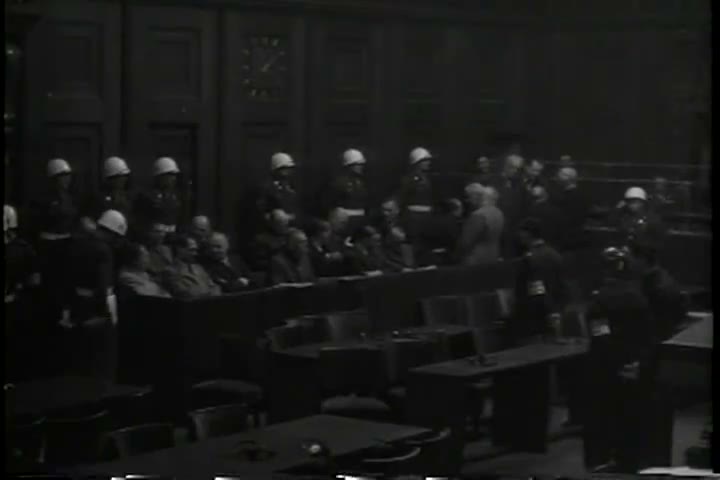
Film footage of the Nuremberg war crimes trial inside the courtroom
archives.gov
STREAMING HD

Film footage of the Nuremberg war crimes trial inside the courtroom

archives.govUnited States2026public
#crimini di guerra#intelligence#declassificazione#olocausto#storia contemporanea

The footage shows the courtroom session with defendants seated under guard, speakers addressing the tribunal from the lectern, and attendees listening through headphones while reviewing documents.

The footage records proceedings inside the courtroom, focusing on the defendants seated on their benches under the surveillance of military guards wearing white helmets. Camera angles capture wide views of the chamber filled with observers and personnel listening through headphones and examining papers, as well as speakers addressing the court from the lectern using microphones. The recorded sound includes a plea of not guilty entered in German and arguments by Mr. Alderman presenting document 1405-PS as Exhibit USA-148, citing wartime autarchic directives, Hitler, Minister Todt, Field Marshal Keitel, von Ribbentrop, and Canaris, alongside references to the United States and Great Britain and Northern Ireland, concluding with close-up shots of an individual in a light uniform listening with his hand on his chin.

Running for a duration of 10 minutes, this official film was produced by the Department of the Army through the Office of the Chief Signal Officer and is maintained in the public domain. The preserved material documents the judicial and evidentiary framework organized by Allied authorities in the period following May 1945 to adjudicate war crimes and examine the responsibilities of Third Reich officials.

The corresponding official report, released on archives.gov under the 1998 Nazi War Crimes Disclosure Act and coordinated by Richard Breitman of American University for the interagency IWG group, provides historical context on declassified records from the CIA, the Counter Intelligence Corps, and the Office of Policy Coordination. These official files review intelligence gathering on figures including Adolf Hitler, Klaus Barbie, Schwend, and Josef Mengele, illuminating postwar investigative efforts.

Examining this archival footage alongside declassified governmental records provides primary evidence of courtroom procedures, allowing researchers to evaluate oral submissions and trial exhibits against official contemporaneous intelligence documentation.

Share:

Content Details

Source

archives.gov

Nation

USA

Year

2026

Classification

public

Categories

declassified, History

Format

Direct Stream HD

Link Status

Validated source

📁 Case File & Evidentiary RecordsUnclessify Video Dossier

Investigative recordings, authenticated telemetry, and official exhibits verified by Unclessify Intelligence.

Editorial Transparency & Fair Use Notice

Original investigative video reportage compiled exclusively by Unclessify Intelligence based on declassified archives, authenticated telemetry, and historical public records. Synthesis, narrative context, and editorial analysis represent independent journalism under international freedom of information and public interest principles.

Read Full Editorial Policy & Source Transparency →

What this piece rests on

The text was checked against the facts listed below, extracted from the act above. It does not yet carry corroboration from independent sources.

The 20 facts verified in the text
  1. Richard Breitman, Professor of History, American University, IWG Director of Historical Research The Nazi War Crimes Disclosure Act of 1998 initiated a search for information in classified American government records about the Holocaust and other war crimes committed by Nazi Germany or its allies.
  2. One additional CIA file discussed here (the Hitler file) was opened in December 2000.
  3. Another fourteen CIA name files involve individuals who served Nazi Germany, survived the war, were suspected of involvement in criminal Nazi or Nazi intelligence activities or had evidence of such activity by others, and came to the attention of American intelligence agencies after May 1945.
  4. Ferdinand Sauerbruch, a famous German surgeon, who spoke candidly with a man named Hans Bie about Hitler's growing megalomania during 1937.
  5. According to Bie (who gave this information to the OSS in 1944), Sauerbruch predicted in 1937 that Hitler would end up as the craziest criminal the world had ever seen.
  6. Also, a CIC unit was connected with, or served as a front for, the Office of Policy Coordination, which became part of the CIA in 1950.
  7. Someone looking back at events before 1950 might mistakenly think that Barbie had a connection with a CIA unit.
  8. But Schwend also claimed that he had worked for the Office of Strategic Services in 1945. (Barbie and Schwend, according to one CIA source, were involved in a plot to assassinate Victor Paz Estenssoro, leftist president of Bolivia who was ousted and forced into exile in Peru.) Despite such issues, the CIA continued to express confidence publicly and privately that the agency had no direct connection with Barbie.
  9. The CIA did not seriously enter the chase for Eichmann until late 1959, but Israeli agents located him in Argentina first and spirited him out to Israel for trial.
  10. Josef Mengele: The CIA's file on Auschwitz doctor Josef Mengele consists of published articles about Mengele and his various hideouts in South America, mistaken sightings of him, information of unknown reliability about his associates in Paraguay, Argentina, and Brazil, and much information about events in 1984-85, when his tracks finally emerged.
  11. Mengele had escaped from Europe to Paraguay, lived there and elsewhere in South America from 1951 on, obtaining Paraguayan citizenship in 1959 under his own name.
  12. When it was discovered in 1985 that a Brazilian German couple named Bossert had befriended Mengele, the Bosserts revealed how Mengele had died in 1979 and where he was buried-at a town named Embu outside Sao Paolo.
  13. All the teams of government experts concluded that Mengele had died in Sao Paolo in 1979.
  14. The most significant document in the Mengele file is a CIA response, dated 18 July 1965, to a Justice Department request for a trace on Dr.
  15. Schwend (see discussion of him in the Barbie listing) was sighted with Mengele in Uruguay in 1962.
  16. The CIA did start a search in 1972, concluding that Mengele had been in Paraguay, where he had enjoyed the protection of the Paraguayan government, and had vanished in 1960-he was rumored to have gone to Brazil.
  17. S. investigation of Mengele's whereabouts began only in 1985-six years after his death.
  18. Heinrich Mueller: The CIA name file on Heinrich Mueller, head of the Gestapo, mostly contains results of an internal investigation in 1970-71 to determine whether Mueller had died in Berlin at the end of World War II or had survived, with key German police files, in Soviet hands.
  19. Initially, the CIA assumed that Mueller had died in 1945, but the Israeli capture of Adolf Eichmann in hiding in 1960 fanned speculation that Mueller might also be alive.
  20. A defector from Polish intelligence who had specialized in the whereabouts of Nazi war criminals mentioned in 1960 hearsay evidence that the Soviets had recruited Mueller in 1945.

Comments (0)