
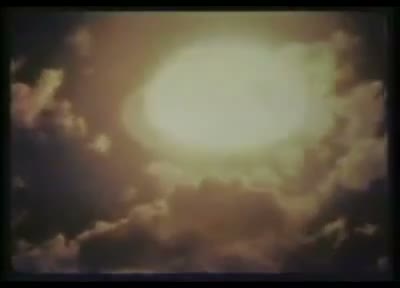
The footage opens on a black screen accompanied by a narrator introducing the atomic detonations identified as X-ray, Yoke, and Zebra, described as milestones in the age of atomic energy. At nine seconds, the record presents a close-up view of a nuclear explosion, capturing the rapid formation and expansion of a luminous fireball rising over the water and through cloud layers. Subsequent camera angles show intense flashes illuminating the overcast sky, the vertical rise of the mushroom cloud, and a twilight or night detonation lighting up the horizon with smoke and fire clouds.
Lasting two minutes, this audiovisual record was produced by the United States Department of Energy and is held in the public domain. The file is accessible through Wikimedia Commons as part of the visual documentation preserved from the nuclear testing programs conducted across the Pacific Proving Grounds.
Declassified records place these images within the operational history of Enewetak Atoll, which was secured by the United States Marine Corps between February 17 and February 23, 1944, and incorporated into the Trust Territory of the Pacific Islands in July 1947. Between 1948 and 1958, the atoll hosted six nuclear and thermonuclear test series, beginning with Operation Sandstone in April and May 1948, followed by events such as the Ivy Mike detonation on October 31, 1952, which obliterated Elugelab Island, and concluding with the Hardtack series in 1958.
Testing ceased following the signing of the Partial Test Ban Treaty in August 1963, leading to cleanup commitments announced in April 1972 and radiological surveys conducted in mid-1975 by the Energy Research and Development Administration and the Defense Nuclear Agency. These visual and institutional records remain central to examining state management of radiological hazards, administrative responsibilities toward trust territories, and long-term environmental remediation.