
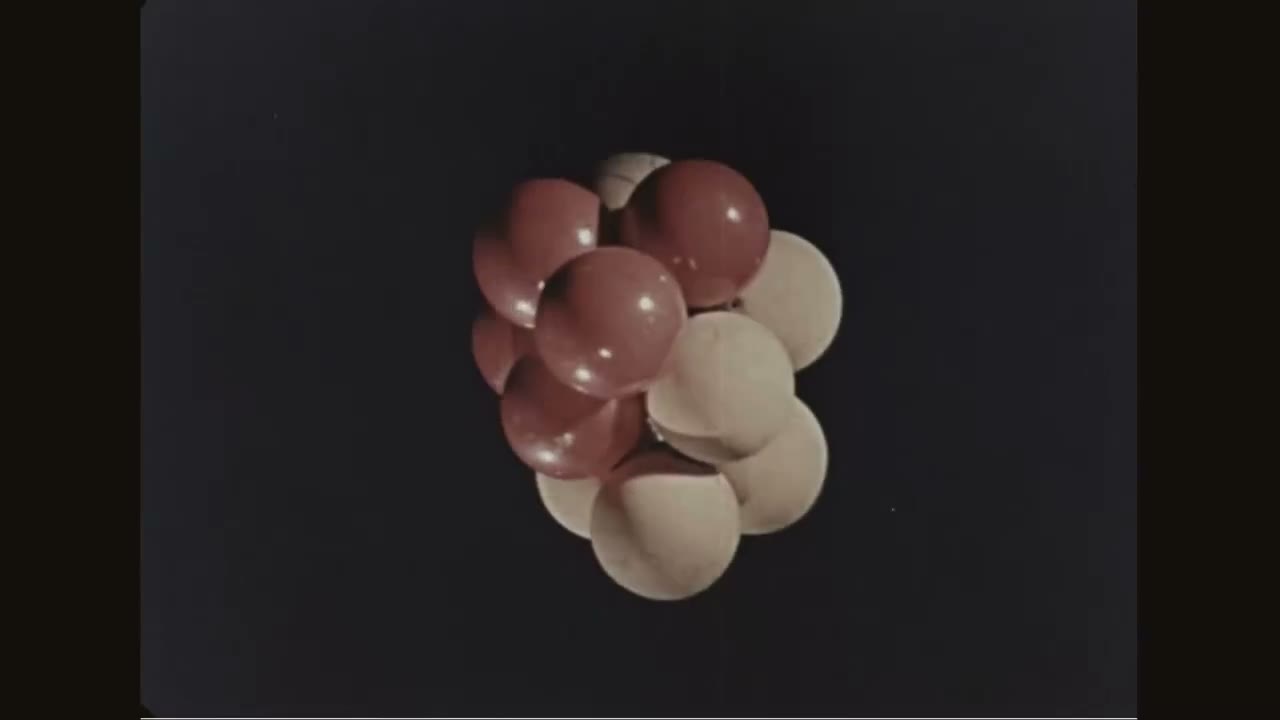
The 17-minute documentary film Power for Peace records the official opening of the United States Atoms for Peace Exhibition in Hibiya Park, Tokyo, on November 1, 1955. The proceedings show United States Ambassador to Japan John M. Allison delivering a message from President Eisenhower, followed by statements from Matsutaro Shoriki, chairman of Japan’s Atomic Energy Commission, and a declaration from Prime Minister Hatoyama presented by Chief Cabinet Secretary Nemoto. Over the initial six-week period, the venue recorded approximately one third of a million visitors. The visual sequence outlines the evolution of atomic theory from the early concepts of Democritus to the discoveries of Henri Becquerel, Madame Curie, Ernest Rutherford, Niels Bohr, Hideki Yukawa, Ernest O. Lawrence, Albert Einstein, Otto Hahn, and Enrico Fermi.
Preserved by the US National Archives, the film is held in the public domain and made available via Wikimedia Commons. The footage contains historical photographs of Henri Becquerel and of Ernest O. Lawrence with his 1930 cyclotron model, demonstrations recorded by JVC cameras, technicians handling apparatus behind lead bricks and protective glass screens, cutaway models of the CP-5 heavy water reactor and graphite reactors, animated sequences of nuclear fission, thyroid diagnostic scans using radioactive iodine, and research operations linked to the Brookhaven National Research Laboratory.
The custody of this visual record corresponds with the broader mandate of the US National Archives to maintain and release federal historical documentation under designated National Archives Identifiers. This preservation repository includes declassified administrative studies and official records, such as the Office of the Secretary of Defense Vietnam Task Force report commissioned in 1967 by Robert McNamara and delivered by Leslie Gelb to Clark Clifford in January 1969, reflecting the systematic archiving of postwar governmental files.
The motion picture provides primary documentation of the international educational campaign launched in the mid-1950s to promote civilian atomic technology in Japan. It captures how scientific milestones dating from the 1896 discovery of unstable elements and the 1938 realization of uranium fission were translated into working applications for electric power generation, medical diagnostics, and industrial measurement.