
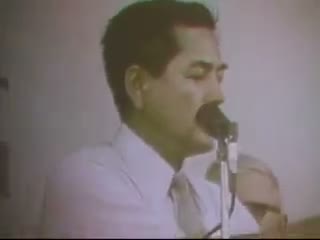
The footage shows the movement of American munitions based in Okinawa to Johnston Island in 1971, recording technical operations and official statements. The sequences feature transport vehicles with markings, ships sailing at sunset or sunrise, officers speaking in front of seated groups inside hangars, and personnel in protective suits and helmets near storage buildings. The shots also capture hands handling cables with pliers, military trucks with panels bearing the word POISON, forklifts maneuvering, personnel with helmets descending from maritime structures, and officers wearing sunglasses and red caps with the inscription RED HAT BOSS.
The document comes from the National Archives and Records Administration and is released under a public domain license. The film is part of the operations conducted by United States military forces, involving over 1,500 people and units such as the 267th Chemical Company, documenting a complex logistical and security activity in the field.
The official reference act establishes the historical framework of the operation, recalling that in 1962 Edgewood Arsenal initiated a classified operation to ship munitions to Okinawa under the code name Red Hat. In 1969 it was discovered that toxic munitions were in Okinawa, and President Richard Nixon promised Japan’s Prime Minister Eisaku Sato that he would remove the weapons from Okinawan soil. On February 13, 1971, the first convoy was sent to Johnston Island, located 750 miles southwest of Hawaii. Each vehicle leaving the holding center was inspected to ensure the civilian population had not been contaminated, and Japanese officials inspected the empty igloos after the removal was completed on September 10, 1971.
This material remains relevant because it provides visual evidence of a sensitive Cold War military and diplomatic operation, highlighting the logistical coordination between the United States and Japan for the remediation of a strategic territory through the secure relocation of hazardous materials.