
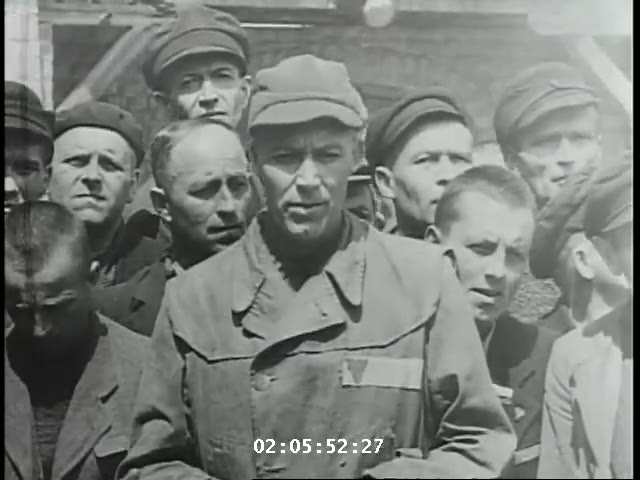
In this eight-minute recording, Lieutenant Senior Grade Jack H. Taylor of the US Navy, from Hollywood, California, describes his captivity wearing a prisoner jacket marked with his number and USA. Taylor explains that after operating for 18 months in the Balkans, he was the first Allied officer to drop into Austria in October ‘44, before being captured on December 1st by the Gestapo, beaten, held in Vienna prison for four months, and transferred to the Mauthausen extermination lager. Taylor presents the insignia and dog tag of executed American officers and details execution methods used in the camp, including gas, club beatings, starvation, dogs, drops over a 100-foot cliff, and 48-hour naked exposure in the snow with cold water poured over victims. The camera documents emaciated corpses laid out on the ground, a hollow-faced prisoner looking out, and both wooden carts and horse-drawn wagons loaded with bodies moved along the camp paths.
The footage was produced by the United States Army Signal Corps under the direction of E. R. Kellogg, George C. Stevens, and James B. Donovan, and is released under a public domain license. Preserved through the military chain of custody, the audiovisual document was incorporated into United States federal preservation repositories, including facilities in College Park, Maryland, and presidential libraries such as the Harry S. Truman facility in Independence, Missouri.
Official records held at the National Archives (archives.gov) contextualize this film within the investigative work of the War Crimes Commission, documenting atrocities and breaches of international conventions at Gusen and associated camps during World War II. Processing standards documented by archivists including Greg Bradsher, Richard Boylan, Timothy Mulligan, Larry McDonald, Elizabeth Safly, William Creech, and Rene Jussaud anchor these visual materials within broader federal holdings.
The film serves as primary evidentiary footage of conditions inside the camp prior to the arrival of the 11th Armored Division, offering direct factual evidence for the critical and independent historical analysis of wartime atrocities.