
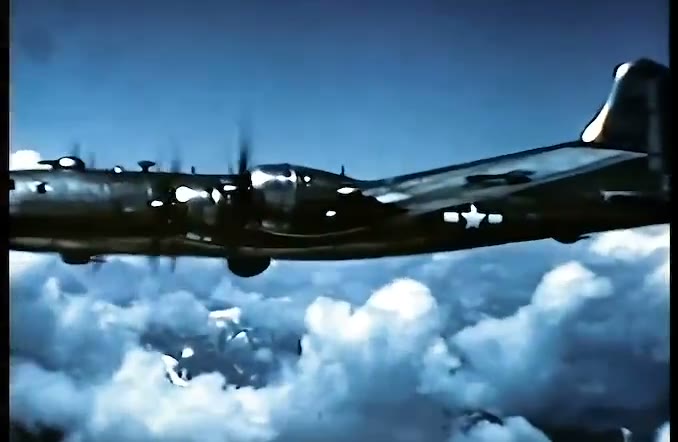
This 13-minute historical film illustrates the operational procedures for atomic weapon handling and aerial delivery conducted by United States military aircraft. The footage begins with an atomic bomb inside a protective security case being hoisted into the bomb bay of a B-36 bomber before climbing to cruising altitude over the Pacific. The documentary details the operational capacity of the B-29 medium bomber, capable of flying 3400 nautical miles non-stop from Omaha to England and carrying a 60-inch atomic weapon at 300 knots from 30,000 feet, as well as the upgraded B-50 equipped with 3500-horsepower engines, taller tail surfaces, and a delivery range of 4000 nautical miles at 35,000 feet, citing the non-stop four-day global flight of the B-50 Lucky Lady. Scenes include the B-47 jet bomber, parachute-assisted landings, the rapid takeoff of a B-57 near hangars, mid-air refueling probe connections, a fighter executing a LABS delivery maneuver, and cockpit instrumentation including the Sperry Gyroscope Co. Time-To-Go indicator.
The motion picture is an official production created by the USDoD, AEC, and USAF, held under the Commons title USAF Atomic Bomb Delivery Aircraft 1950s Film and distributed within the public domain. It records joint operational testing carried out by the Air Force alongside the Atomic Energy Commission to establish handling methods and flight profiles for Strategic Air Command and Tactical Air Command units, referencing operational backgrounds in Europe, Japan, and Korea.
Contextual administrative records concerning military functions and technical oversight are preserved in the National Archives within Record Group 77 for the Office of the Chief of Engineers, authorized originally under acts of May 9, 1794, and March 3, 1795. These holdings are detailed in preliminary inventories NM 19, NM 45, NM 78, and NM 79 compiled and revised by Johnson, covering textual correspondence files and engineering records extending through 1955.
The footage remains a primary visual record of early Cold War doctrine, demonstrating in-flight refueling mechanisms, high-altitude bombing instrumentation, and transatlantic strategic transit routes between North America, Newfoundland, and forward operational areas.