
Public Interest and Contemporary Relevance
The transition from battlefield documentation to judicial evidence during the Nuremberg trials established modern legal frameworks for prosecuting state-sponsored atrocities. Archival motion pictures and declassified intelligence reports provide an empirical record against historical negationism and systemic propaganda.
Contemporary international tribunals continue to rely on the evidentiary precedents set in 1945, where motion pictures, primary administrative records, and survivor testimonies converged to defeat institutional denial. Analyzing these primary materials demonstrates how forensic intelligence transforms raw footage into permanent legal accountability.
Historical and Geopolitical Context
In the aftermath of World War II, the International Military Tribunal convened in Nuremberg to adjudicate the aggressive warfare and crimes against humanity perpetrated by the leadership of Nazi Germany. Prosecutors from the United States and Great Britain and Northern Ireland faced the unprecedented challenge of establishing systemic guilt across complex military and bureaucratic chains of command.
As Allied forces advanced across Europe in late 1944 and early 1945, specialized camera units recorded the liberation of concentration camps and secured administrative archives. These visual records were directly integrated into court proceedings to corroborate seized documentary evidence, creating an irrefutable evidentiary chain.
The courtroom proceedings exposed deep fissures between high-level policy documents and the testimonies of surviving victims. Seized records such as Document 1405-PS, submitted as Exhibit USA-148, detailed economic and strategic military decisions made by the highest echelons of the regime, directly contradicting the defensive narratives constructed by the accused during cross-examinations and final speeches.
Simultaneously, tactical intelligence collected during field operations revealed the direct consequences of administrative directives. Field testimonies recorded at liberated concentration camps provided real-time documentation of systematic extermination practices, bridging the gap between strategic planning and execution.
Key Actors and Entities
The evidentiary landscape of the Nuremberg proceedings and post-war investigations involved senior military commanders, intelligence operatives, legal prosecutors, and medical observers:
- Hitler: Leader of the National Socialist regime whose strategic directives and propaganda mandates formed the basis of the aggressive war conspiracy charges presented by Allied prosecutors.
- Wilhelm Keitel: Field Marshal who confirmed strategic economic directives and wartime resource planning, cited directly in prosecution documents during the tribunal proceedings.
- Fritz Todt: Reich Minister for Armaments and Ammunition whose early assessments of synthetic production limits and autarchical policy failures were introduced into the judicial record.
- Joachim von Ribbentrop: Reich Minister for Foreign Affairs whose official diplomatic communications and conversations were examined to prove foreknowledge of aggressive war plans and extermination directives.
- Wilhelm Canaris: Head of the Abwehr whose recorded discussions with senior diplomatic officials documented knowledge of mass executions and intelligence operations.
- Hartley Shawcross: British Chief Prosecutor who delivered closing arguments dismantling the moral and legal defenses raised by the accused leadership.
- Mr. Alderman: American prosecution counsel who presented captured documentary evidence and structural exhibits establishing economic and military conspiracy.
- Jack H. Taylor: Lieutenant in the US Navy and Allied operational officer captured in Austria on December 1st, 1944, who provided first-hand filmed testimony detailing systemic executions at the Mauthausen concentration camp.
- Ferdinand Sauerbruch: Prominent German surgeon who reported observations regarding the regime leadership to intermediary Hans Bie, later documented in intelligence records compiled by the Office of Strategic Services (OSS).
- Richard Breitman: Historian and Director of Historical Research for the Interagency Working Group (IWG), who oversaw the identification and release of declassified government files under the Nazi War Crimes Disclosure Act of 1998.
- 11th Armored Division: United States military formation that liberated the Mauthausen and Gusen concentration camp systems, securing surviving witnesses and preserving physical evidence.
- Gestapo and CIC: The Geheime Staatspolizei, responsible for illicit detentions and executions of Allied personnel, and the Counter Intelligence Corps, which later interacted with operational intelligence components including the Office of Policy Coordination.
Critical Analysis of the Evidentiary Record
A rigorous examination of the trial transcripts, courtroom footage, and declassified intelligence files demonstrates how documentary evidence directly undermined the oral statements made by the accused. During the proceedings, defendants consistently claimed absolute ignorance of atrocities and asserted that their roles were confined to technical administration or diplomatic formalities.
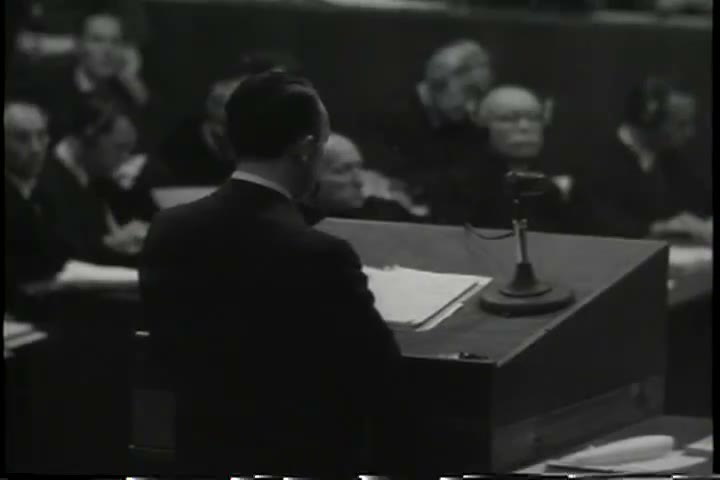
Courtroom recordings of the final speeches capture defendants claiming they worked solely for the welfare of workers, were completely surprised by foreign policy shifts, or acted to prevent excesses despite the directives of figures like Heinrich Himmler and Joseph Goebbels. One speaker claimed at the microphone:
I was naive enough to push through, against Himmler and Goebbels, my manifesto and many other directives for labor allocation, which made humane and correct treatment of foreign workers mandatory for all agencies.
These exculpatory assertions were dismantled by official exhibits introduced by the prosecution. Document 1405-PS, read aloud before the judges by Mr. Alderman, detailed how high-level military planning knowingly pushed autarchical endeavors beyond sustainable limits, recognizing that synthetic production could not support the war machinery:
The course of the war shows that we went too far in our autarchical endeavors. It is impossible to try to manufacture everything we lack by synthetic procedures or other measures. For instance, it is impossible to develop our motor fuel economy to a point where we can entirely depend on it.
The contradiction between administrative claims of clean hands and the brutal reality on the ground was further exposed by motion picture recordings filmed directly in the field. When Lieutenant Jack H. Taylor gave his recorded deposition following liberation, he provided concrete physical evidence of systematic murder executed under the authority of the Gestapo. Presenting military insignia and dog tags to the camera, Taylor stated:
Here is the insignia of one, a US naval officer, and here is his dog tag. And here is the Army officer’s, executed by gas in this lager. Five or six ways: by gas, by shooting, by beating, that is beating with clubs, by exposure, that is standing out in the snow naked for 48 hours and having cold water thrown on them in the middle of winter, starvation, dogs, and pushing over a 100-foot cliff.
The intelligence files declassified under the Nazi War Crimes Disclosure Act of 1998, analyzed in historical reports by Professor Richard Breitman, corroborate that early warnings regarding leadership megalomania had been circulating within German medical and professional circles as early as 1937. The report notes that surgeon Ferdinand Sauerbruch had warned Hans Bie—who subsequently delivered the intelligence to the OSS in 1944—that the regime leadership would escalate into unprecedented criminality. When compared against courtroom audio where prosecution quotes Hitler stating that ‘in starting and making a war, not the right is what matters, but victory,’ the intelligence dossiers establish a documented continuum of premeditation.
The convergence of motion picture footage showing courtroom defendants wearing translation headphones, visual exhibits of emaciated victims at Mauthausen and Gusen, and declassified name files preserved at the National Archives in Washington and College Park, Maryland, demonstrates that the defense of ignorance was mathematically and logistically impossible. The archival record proves that operational knowledge extended through ministerial, military, and police channels alike.
Transparency and Legal Framework
The documentation, filmed depositions, and audio recordings examined in this dossier originate from official government records held by the United States National Archives and Records Administration (NARA). These records were reviewed, cataloged, and made accessible under the statutory mandate of the Nazi War Crimes Disclosure Act of 1998, which required federal agencies, including the Central Intelligence Agency and the Department of Defense, to identify and declassify historical records relating to war crimes.
Motion picture footage produced by the United States military and the International Military Tribunal entered the public domain pursuant to Title 17, Section 105 of the United States Code (17 U.S.C. § 105), which establishes that works prepared by officers or employees of the United States federal government as part of their official duties are not subject to copyright protection. Preserving and cross-referencing these open-access records ensures the permanent availability of verifiable historical evidence for research and judicial analysis.