
A man has been in prison without interruption since June 27, 1998. He is serving a life sentence, with one year of daytime isolation, for mafia association, murder, concealment of a corpse and illegal carrying and possession of weapons: acts committed between 1996 and 1998 to assist a mafia association, with the aggravating circumstance of base motives, described in the judgment convicting him as the “aim of asserting the hegemony and prestige of the clan to which the defendant was affiliated”. In prison, the Court of Cassation writes, he has always behaved in line with the rehabilitation programme. He applies for prison leave, the benefit that Article 30-ter of the prison law grants to cultivate family, cultural and work interests. The supervisory judge of L’Aquila declares the application inadmissible without examining it, and the L’Aquila supervisory court rejects his appeal. There is only one reason: his offences are among those listed in Article 4-bis, paragraph 1, of Law no. 354 of July 26, 1975, and he has never cooperated with the justice system under Article 58-ter. Under that provision, without cooperation no benefit can be granted, and no judge can ask whether that prisoner is still dangerous.
The case reaches the First Criminal Section of the Court of Cassation, which on December 20, 2018 stays the proceedings and raises a question of constitutionality. Removing the “absolute presumption of dangerousness”, it writes, would be “the only way” to give back to the trial judge the task of checking in practice whether the conditions for leave are met, above all the absence of social dangerousness. The panel does not doubt that cooperating is, for someone who belongs to a mafia group, an unequivocal sign “of his definitive break with the organisation in which he moved”. It challenges the reverse: that silence always proves the opposite. The choice not to cooperate, it observes, may stem from reasons unrelated to rehabilitation, such as the “risk to his own safety and that of his family”, the “moral refusal to make accusations against a relative or persons bound by ties of affection”, the “rejection of a purely utilitarian cooperation”.
The prisoner, who joined the proceedings on May 13, 2019, added an argument that the Court would later take up in its own words. It is “inadmissible”, he argued, that the “right not to cooperate”, guaranteed at trial as an expression of the principle nemo tenetur se detegere, should turn during the enforcement of the sentence into a genuine duty, required to obtain “tools that should instead be the ordinary results of fruitful participation in prison treatment”. And it is “certainly questionable”, he added, that a purely utilitarian conduct should be proposed by the legislature itself as the condition for avoiding the “additional harm” of the bar, thus turning into “a genuine form of coercion”. In the brief filed on October 1, 2019 he insisted on the specific features of prison leave which, in his view, cannot be treated like the other prison benefits without breaching the constitutional principles invoked.
Five months later, on May 28, 2019, a second referral came from the Perugia supervisory court. Here the prisoner had been in custody without interruption since March 1995 and had “served more than twenty-four years of actual sentence”. He had earned 2160 days of early release for taking part in rehabilitation work and since 2005 had passed the ten-year threshold of sentence served that the law requires of a life prisoner seeking leave. He is serving a life sentence, with daytime isolation, for a set of convictions all falling within Article 4-bis. His position is more serious than the one examined by the Court of Cassation: he did not merely commit offences to assist a mafia association, he was found to be a member of it, with a role that grew over time and murders committed to ensure its survival. The Spoleto supervisory judge had declared his application inadmissible, and the Perugia court, hearing his appeal, decided to refer this case too to the Constitutional Court. Its reasoning starts from a practical observation: even today, when a prisoner cooperates, the supervisory court examines in practice how his personality has developed and the reasons that led him to speak; the Perugia judges asked “that this may also be done for the opposite choice”, that is, that the reasons for silence may be examined case by case. And they distinguished between benefits: the provision demands cooperation as proof of reform, a requirement proper only to conditional release, even for prison leave, which instead presupposes “the more modest requirement of regular conduct”.
The Perugia court knows exactly who is before it, and says so: for such a person, cooperation remains, according to settled case law, “the strongest proof that the bond with the association has been severed and therefore that the person’s social dangerousness has ceased”. But it argues that, at the enforcement stage, the absolute bar prevents “the examination of other elements which in the specific case could equally lead to a finding that social dangerousness has ceased and that the benefit sought is deserved”. The State Attorney General’s Office, intervening for the President of the Council of Ministers, pointed out in turn that this prisoner had never given any of the reasons for silence suggested by the court, and that in 2012 his request to have cooperation declared impossible or unenforceable had been rejected by a reasoned order. Both applicants have been finally convicted; the judgment refers to them only by their initials, and they are not identified on this page.
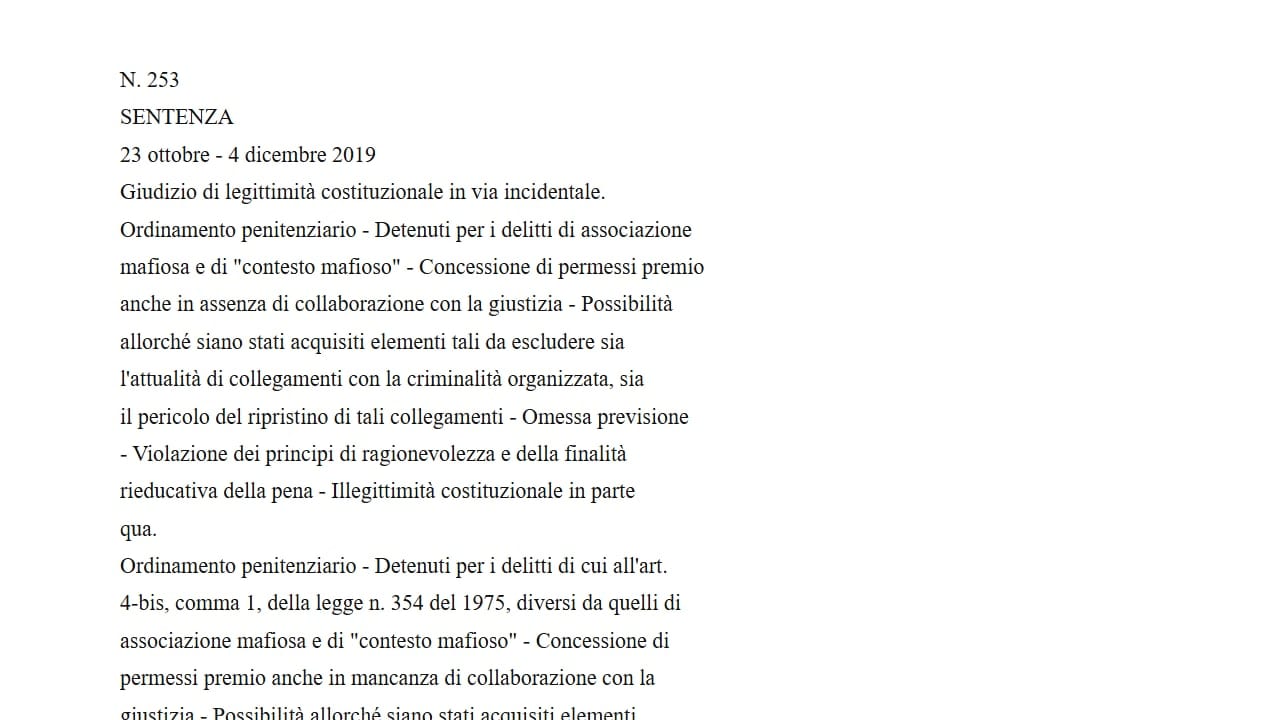
The public hearing took place on October 22, 2019, with Justice Nicolò Zanon as rapporteur and Giorgio Lattanzi presiding. The State was represented by State lawyers Marco Corsini and Maurizio Greco. The next day, October 23, the Court decided; judgment no. 253 of 2019 was filed on December 4 and published in the Official Gazette on December 11. It declares Article 4-bis, paragraph 1, unconstitutional insofar as it does not allow prison leave to be granted to prisoners convicted of mafia offences who do not cooperate, where evidence has been obtained ruling out both current links with organised crime and the danger of those links being restored. And, as a consequence, it extends the same rule to all the other offences on the list. It does not abolish the presumption: it makes it rebuttable. A prisoner who does not cooperate is still presumed to be tied to the organisation, but can now prove otherwise, under conditions the Court itself describes as “particularly strict”. The judgment concerns a single benefit, prison leave, and says so expressly: so-called “ergastolo ostativo” and conditional release remain outside the case.
A bar born after the Capaci massacre
To explain what it was touching, the Court traces the history of Article 4-bis, quoting its own judgment no. 68 of 1995: “The criminal policy reasons” that led to its introduction and then its tightening “are only too well known”. In the first version, from Decree-Law no. 152 of May 13, 1991, converted into Law no. 203 of July 12, 1991, prisoners were divided into two “tiers”. For first-tier offences, including mafia association and related crimes, kidnapping for ransom and drug-trafficking association, benefits were possible only if “evidence ruling out current links with organised or subversive crime” had been obtained. For second-tier offences it was enough that there was no evidence suggesting such links were current. Cooperation with the justice system, introduced through Article 58-ter, served only to shorten the minimum time to be served.
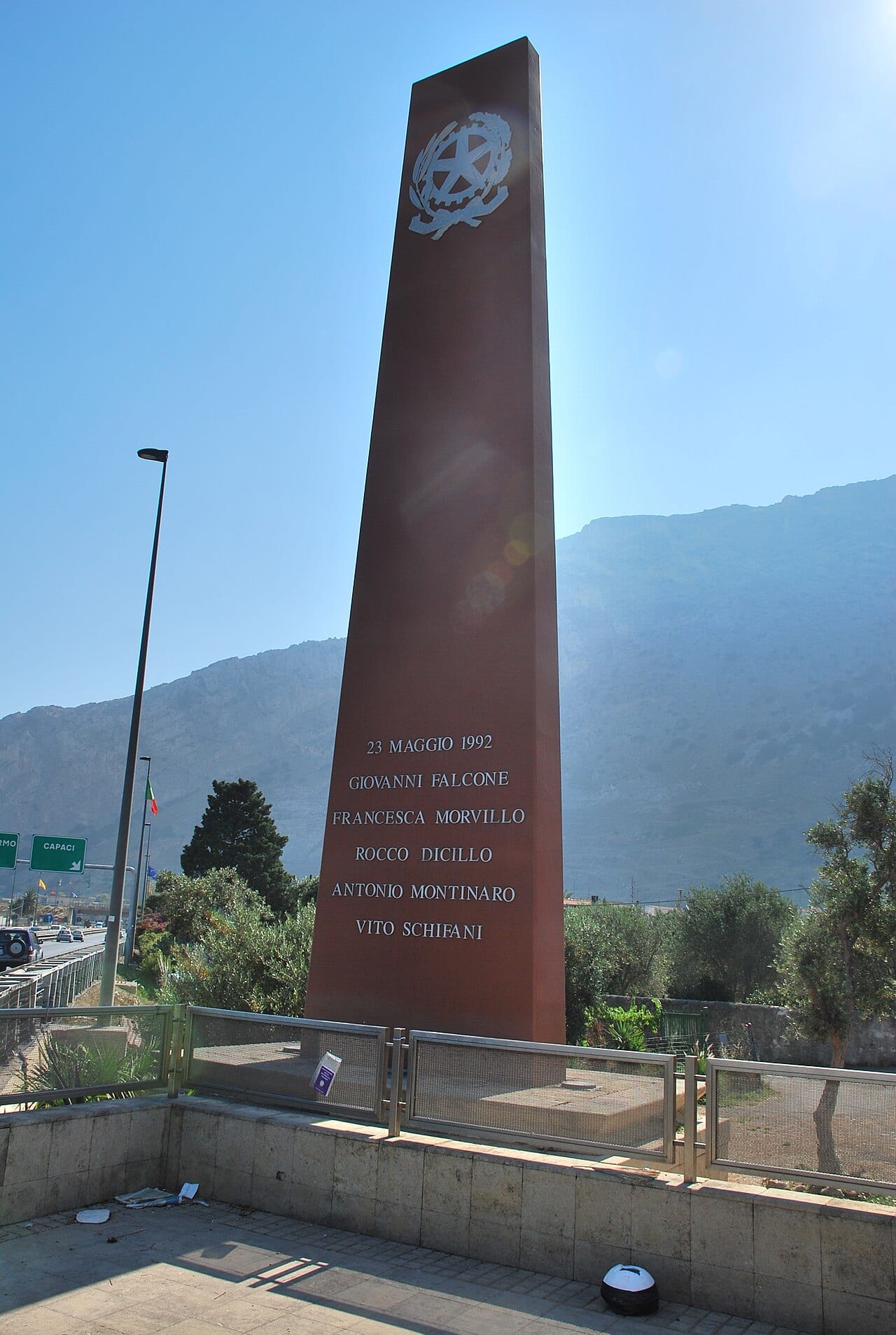
The change came “immediately after the Capaci massacre of May 23, 1992”. Decree-Law no. 306 of June 8, 1992, converted into Law no. 356 of August 7, 1992, provided that for first-tier offences outside work, prison leave and alternative measures, except early release, could be granted only to those who cooperate. This is the shift that judgment no. 68 of 1995 described as a move “from a system based on a regime of enhanced proof to establish the absence of a negative condition (no links with organised crime), to a model that introduces a bar for certain prisoners, removable only through a qualified conduct (cooperation)”. The law presumes that certain offences prove membership of organised crime; cooperation becomes the only way to disprove it, and at the same time an investigative tool. Later, following the Court’s indications, paragraph 1-bis opened benefits also to those who cannot usefully cooperate, because their role was limited or because the facts have already been fully established, provided no current links with organised crime are found.
The Court of Cassation’s reasons: the precedent of pre-trial custody
The Court of Cassation built its doubt starting from pre-trial measures. It cited judgment no. 57 of 2013, which had declared Article 275, paragraph 3, of the Code of Criminal Procedure unconstitutional insofar as it imposed prison as the only measure for anyone seriously suspected of offences committed using mafia methods or to assist an association, without allowing proof that other measures would suffice. The principle, the panel recalled, is that absolute presumptions limiting fundamental rights breach equality if they are arbitrary and irrational, that is, “if they do not reflect generalised experience, summed up in the formula id quod plerumque accidit”. Judgment no. 48 of 2015 had done the same for external complicity. Someone who commits an offence “in a mafia context” is not necessarily a member, and the presumption built on the member cannot be extended to him.
The panel then cited other decisions that had already chipped away at Article 4-bis. Judgment no. 239 of 2014 had removed special home detention for mothers from the ban; no. 76 of 2017 had struck out the ban for mothers convicted of listed offences, so as not to sacrifice entirely the interest of the child; no. 149 of 2018 had lifted the bar for life prisoners convicted of kidnapping resulting in the victim’s death, invoking the progressive nature of treatment and the flexibility of punishment “rooted in Article 27, paragraph 3, of the Constitution”. Against this background, the absolute bar of Article 4-bis seemed to the Court of Cassation incompatible with constitutional case law which, “just as it has banished absolute presumptions of dangerousness from the system, cannot endorse the conclusion that cooperation is the exclusive legal proof of reform”.
Then there is the nature of the benefit. Prison leave, the Court of Cassation wrote, has “a contingent character that does not allow it to be fully equated with alternatives to detention”, because it does not change the prisoner’s restrictive conditions: it lasts a few hours or days and serves to maintain relationships, study and work. And it added an argument aimed at the State’s own objective: “even a reward granted for a limited and contingent purpose could have the effect of encouraging the prisoner to cooperate with the prison institution”.
Perugia: even for those inside the association
The Perugia court went further than the Court of Cassation, because its prisoner was not an outsider but a member. Prison leave, it argued, is a “fundamental tool” enabling the prisoner to progress “in a sense of responsibility and in the ability to manage himself within the law”, and the judge to check the progress made and the ability to reintegrate, even briefly, into society. It also serves to guarantee rights that detention restricts, such as maintaining or restoring, after a long time, relationships with the family: not only the prisoner’s, but those of the spouse, children and elderly parents. And the absolute bar also empties early release of meaning, since for a life prisoner its main purpose is to bring benefits closer: if benefits are impossible anyway, taking part in treatment leads nowhere.
On silence, the court cited order no. 117 of 2019, which had described the right to remain silent as an “essential corollary of the inviolability of the right of defence, recognised by Article 24 of the Constitution”, and inferred a “significant friction with a mechanism that prevents access to any measure outside prison unless that right is waived”. It listed the concrete reasons that may lead someone not to cooperate: fear for the safety of family members who cannot leave the places where the crimes were committed, refusal to have people bound by family or emotional ties sent to prison, refusal to be accused of having spoken out of calculation. And it recalled that judgment no. 306 of 1993 had already spoken of a “significant compression of the rehabilitative purpose of punishment” and of a tendency to define “types of offender for whom rehabilitation would not be possible or might not be pursued”.
The State’s defence: cooperators and hardliners
The State Attorney General’s Office defended the provision as a criminal policy choice against “the odious phenomenon of organised crime”. The legislature had decided “to sharply separate the position of ‘cooperators’ from that of ‘hardliners’”, and cooperation, “in the judicial experience of national history”, had proven an “irreplaceable means” of finding evidence and prosecuting those responsible. Nor would it be an automatic mechanism, since those who cooperate regain access to the judge’s ordinary assessment. As for prison leave, its contingent nature would be irrelevant: the provision aims “to prevent prisoners who are probably still dangerous from leaving prison, even for just a few hours”.
In support, the State cited judgment no. 273 of 2001, under which cooperation “not unreasonably” serves as a criterion for establishing a break with organised crime, and judgment no. 306 of 1993, which had accepted the choice to prioritise general deterrence as meeting the need to fight “aggressive and widespread” organised crime. In the Perugia proceedings it added an objection on relevance: the prisoner had never explained why he remained silent, so the Court’s decision would change nothing for him. And it concluded that an intervention by the Court on choices entrusted to the legislature “would exceed the powers conferred on it”.
Who was kept out of the courtroom
The two applicant prisoners joined the proceedings. The first also asked for the provision to be assessed under Article 3 of the European Convention on Human Rights and cited the European Court’s judgment of June 13, 2019, Viola v. Italy; the second described that ruling as a “quasi-pilot” judgment, “given the numbers and the structural nature of ‘ergastolo ostativo’”, and asked for the decision to be extended to alternative measures, including conditional release. Others also sought to intervene: another life prisoner, in custody for more than twenty-seven years, whose case before the Court of Cassation had been adjourned pending the decision; the association Nessuno Tocchi Caino, which campaigns against what it calls “a sort of ‘disguised’ death penalty”; the National Guarantor for the rights of persons detained or deprived of their liberty; and the Union of Italian Criminal Bar Associations. An order read out at the hearing, confirmed by the judgment, declared all these interventions inadmissible, because they came from persons other than the parties to the main proceedings.
The Court then carefully defined its own scope. The complaint based on the European Convention was not examined, because the referring court had not raised it: the parties cannot widen the subject of the case. Above all, the questions “do not concern the constitutionality of the rules on so-called ergastolo ostativo”. That would have been the subject had the judges also challenged Article 2, paragraph 2, of Decree-Law no. 152 of 1991, which denies conditional release to a non-cooperating life prisoner who has already served twenty-six actual years, “thus turning a sentence that is perpetual de iure into one that is perpetual de facto as well”. What is at stake here is a single benefit, prison leave, for all those convicted of mafia offences, whether serving life or fixed-term sentences.
The State’s objection on relevance was also rejected. For a question to be admissible it is enough that the provision applies in the main proceedings; the decision need not bring the parties a concrete advantage. Under the current provision the judge must declare the application inadmissible; without it, he would have to decide under a different rule, and even if the outcome were the same, the reasoning would change. Precisely by removing the absolute character of the presumption, the Court observes, the judge could finally examine “the true reasons” for the silence.
Not the presumption, but its absolute character
The Court examined the Perugia questions first, because they also concern the member of the association, and found them well founded. It acknowledged that being barred from benefits is not a true automatic mechanism, since the prisoner, by choosing to cooperate, can break it; but the presumption weighing on those who do not cooperate remains absolute, because it “cannot be overcome by anything other than cooperation itself”. And it is precisely this absolute character that breaches the Constitution. The decisive sentence is short: “It is not the presumption in itself that is unconstitutional”. It is not unreasonable to presume that someone who does not cooperate keeps up ties with the organisation, provided the presumption can be rebutted by evidence to the contrary.
The starting point is judgment no. 306 of 1993, read in a new light. Even then the Court had rejected the view, set out in the parliamentary report, that only cooperation expresses with certainty the prisoner’s “will to reform”. Cooperation, it had written, “may well be the result of mere utilitarian calculations about the advantages the law attaches to it, rather than a sign of genuine resocialisation”. These are arguments, judgment no. 253 notes, that the European Court also considered in the Viola judgment. The reasons for unconstitutionality are three, “distinct but complementary”.
An exchange of information for treatment
The first concerns the nature of the provision. Article 4-bis expresses a “transparent choice of investigative and criminal policy”, which brings into the prison path elements foreign to the enforcement of punishment: it sets up “a sort of exchange between information useful for investigations and the resulting possibility for the prisoner to access the normal course of prison treatment”. Those who cooperate can access benefits even before the ordinary thresholds of time served; those who do not cooperate never can. Rewarding cooperation is legitimate, the Court writes; but “quite another thing is inflicting harsher treatment on the non-cooperating prisoner, presumed iuris et de iure to be a person rooted in organised crime and therefore socially dangerous”.
This is where the judgment uses its harshest wording. Setting aside the argument on the right to silence, the Court finds that the provision performs “a distorting transfiguration of the freedom not to cooperate”. Guaranteed at trial as a genuine right, an expression of the principle nemo tenetur se detegere, the freedom not to cooperate turns, at the enforcement stage, as a condition for the prisoner’s possible access to the ordinary regime of prison benefits, into a heavy burden of cooperation that not only requires informing on others (carceratus tenetur alios detegere) but also risks self-incrimination, even for acts not yet tried.
Leave as a first taste of freedom
The second reason is Article 27, paragraph 3. Declaring the application inadmissible at the outset, without allowing the judge to assess the prisoner’s situation, conflicts with the rehabilitative purpose of punishment. Prison leave, the Court recalls through judgment no. 188 of 1990, gives “the prisoner, for rehabilitative purposes, the first spaces of freedom”; it has a “‘pedagogical and driving’ function” and allows prison staff to observe the effects of a temporary return to freedom. Individualised, case-by-case assessment is a constitutionally binding criterion, all the more so when the law presumes greater dangerousness on the basis of the type of offence. The consequence, the Court writes, is that immediate inadmissibility “may halt the path of resocialisation at its very start, frustrating the prisoner’s own will to make progress along that road”.
Time passing, and an association that may no longer exist
The third reason is reasonableness. An absolute presumption is unreasonable when real cases contradicting it can be imagined: in particular, the unreasonableness of an absolute presumption becomes apparent whenever it is possible to formulate hypotheses of real events that run counter to the generalisation on which the presumption itself rests.
The Court does not play down the reasons for the generalisation. Membership of a mafia association implies a stable commitment to a group rooted in its territory, with a dense network of connections, strong powers of intimidation and a tendency to endure; and these reasons, it writes, “have by no means weakened over time”. The comparison with pre-trial measures explains the difference. Before conviction, for mafia association, the presumption that precautionary measures are needed is rebuttable, while the presumption that prison is needed is absolute; but there the assessment takes place close to the events. At the enforcement stage, by contrast, time matters, and it can transform both the prisoner’s personality and the world outside prison. At the enforcement stage Article 27 is the reference standard, unlike at the pre-trial stage.
The judgment gives an example that explains the whole decision: an up-to-date assessment must also look at the outside context, “since it may be supposed that the criminal association originally concerned, for example, no longer exists, because it has been entirely broken up or has died out naturally”. And it recalls that for those who really do maintain ties with the organisation there is another tool, the regime of Article 41-bis, which presupposes precisely that those ties are current and which is not at issue. Having absorbed the Court of Cassation’s questions, which sought to distinguish the member from those who commit offences in a mafia context, the Court declares unreasonable a presumption that treats the prisoner’s personality and the outside world as unchangeable.
A regime of enhanced proof
Overcoming the presumption, however, is not easy, and the Court says so explicitly. For mafia association and related offences, the assessment must follow “particularly strict criteria, proportionate to the strength of the bond imposed by the criminal organisation whose definitive abandonment is required”. Good conduct in prison, taking part in rehabilitation or a merely declared dissociation are not enough: “other, adequate and specific elements” are needed. Which ones, the history of Article 4-bis itself shows: the enhanced proof of the 1991 version, which survives in paragraph 1-bis for cases where cooperation is impossible, unenforceable or irrelevant.
In practice, the supervisory judge decides on the basis of reports from the prison and detailed information from the provincial committee for public order and security; and under paragraph 3-bis benefits cannot be granted when the National Anti-Mafia Prosecutor or the District Prosecutor reports that links with organised crime are current. The information must also cover economic and financial links. It is not enough to rule out current links: “the danger of their being restored” must also be ruled out, taking account of personal and environmental circumstances. The prisoner himself must make specific submissions on both; and if the provincial committee’s information is negative, he bears the burden of providing actual evidence.
Extended to every offence on the list
The last part of the judgment looks beyond the mafia. Over time, Article 4-bis has grown through criminal policy choices “not always coordinated with one another”, until it now contains a “complex, heterogeneous and layered list of offences”. Alongside organised crime offences there are now child prostitution and child pornography, gang sexual violence, aiding illegal immigration and, with Law no. 3 of January 9, 2019, almost all offences against the public administration: offences that do not necessarily have anything to do with organised crime or that are committed by a single person. If the decision applied only to mafia offences, a “paradoxical disparity” would follow: those convicted of offences with no organisation behind them would still have to cooperate and prove the absence of ties with a non-existent organisation.
For this reason the Court, under Article 27 of Law no. 87 of March 11, 1953, also declares unconstitutionality as a consequence for all the other offences on the list: for those prisoners too, prison leave may be granted without cooperation if evidence has been obtained ruling out both current links with organised, terrorist or subversive crime and the danger of their being restored. The operative part therefore has two heads: the first for mafia offences and offences in a mafia context, the second for all the other offences in Article 4-bis, paragraph 1.
What changes, and what does not
Judgment no. 253 of 2019 does not open the prison doors to anyone, and does not decide the two cases it started from: it gives back to the supervisory judges of L’Aquila and Perugia the power to assess two applications they previously had to reject without looking at them. It changes one precise thing: the prisoner’s silence stops being legal proof of his dangerousness and becomes one element to be weighed together with others, with a burden of proof that remains on him and information coming from the anti-mafia authorities. The Court confirms that the presumption is reasonable and strong; it removes only the impossibility of rebutting it.
Left out, by the Court’s explicit choice, are the other benefits, alternative measures and conditional release for life prisoners who do not cooperate. The judgment says so in section 5.2, explaining that “ergastolo ostativo” would have been the subject only if Article 2 of Decree-Law no. 152 of 1991 had also been challenged. That is why this page, which the earlier version presented as a story about “ergastolo ostativo”, stops at prison leave: that is what the source that was read decides.
The evidence file
- Decision: Italian Constitutional Court, judgment no. 253 of 2019, public hearing of October 22, 2019, decided on October 23, 2019 and filed on December 4, 2019; Lattanzi presiding, Zanon drafting, Milana registrar; full text in the Official Gazette, 1st Special Series - Constitutional Court no. 50 of December 11, 2019 (text, in Italian).
- Outcome: Article 4-bis, paragraph 1, of Law no. 354 of 1975 declared unconstitutional, for breach of Articles 3 and 27, paragraph 3, of the Constitution, insofar as it does not allow prison leave without cooperation where evidence rules out both current links with organised crime and the danger of their restoration; extended as a consequence to all the other offences on the list.
- Procedural steps: order of the Court of Cassation, First Criminal Section, of December 20, 2018 (register no. 59 of 2019); order of the Perugia supervisory court of May 28, 2019 (no. 135 of 2019); interventions by the President of the Council of Ministers; third-party interventions declared inadmissible by an order made at the hearing.
- Acts cited: Constitutional Court judgments no. 306 of 1993, no. 68 of 1995, no. 57 of 2013, no. 239 of 2014, no. 48 of 2015, no. 149 of 2018; order no. 117 of 2019; European Court of Human Rights, June 13, 2019, Viola v. Italy. Judgment no. 57 of 2013 and order no. 97 of 2021, listed among this entry’s sources, were not read for this rewrite.
- People: the two applicants, finally convicted and serving life sentences, and the prisoner who sought to intervene are identified in the judgment only by initials; they are not identified here.
- Basis for reproduction: Article 5 of Italian Law no. 633 of April 22, 1941, which excludes official acts from copyright.