
For years a man from the Agro Nocerino-Sarnese area near Salerno had his trials postponed by faking an illness. Italy’s Anti-Mafia Investigative Directorate (DIA) says so: from the late 1990s the target of the confiscation carried out in Salerno on May 8, 2023, in prison for numerous final convictions including repeated aggravated murder and Camorra-type association, had obtained, through expert reports, recognition that he was unfit to stand trial because of severe cognitive decline. Investigations by the Nocera Inferiore prosecutors, including wiretaps and video surveillance, disproved that condition entirely, as it was incompatible with the criminal activities the man kept carrying out; the trials resumed and convictions followed. Then came the confiscation: real estate worth more than two million euros in Angri and Sant’Egidio del Monte Albino, plus about 160,000 euros by equivalent value. On September 10, 2024 the DIA executed it as final, after the Salerno Court of Appeal and the Court of Cassation, which made it irrevocable on July 1, 2024.
It is one of the cases the DIA’s Salerno section made public between 2023 and 2025. Read together, the statements show an area where asset prevention mostly hits businesses, bars, fuel stations and event companies, and where the test is always the same: the gap between assets and income. The second thread is local politics, with the investigation into political-mafia vote trading in Capaccio Paestum.
The Tempesta clan and the Nuova Famiglia
For the Salerno court’s Review and Prevention Measures Section, the man’s social dangerousness is qualified: it stems from his final convictions, from a personal prevention measure never enforced because he was in prison, and from his membership, in a leading role according to the DIA, of the Tempesta Camorra clan, part of the Nuova Famiglia federation that operated in the Agro Nocerino-Sarnese. The request was signed jointly by the Nocera Inferiore prosecutor and the DIA director. The case shows that time does not protect assets: according to the DIA, neither long procedural standstills nor the time elapsed prevented investigators from reconstructing the assets and their origin.
Cava de’ Tirreni: bars, fuel and front men
On August 8, 2023 a confiscation targeted a man from Cava de’ Tirreni with an irrevocable conviction for mafia association and, according to the DIA, involved in investigations into links with the Bisogno clan. The court had already ordered a precautionary seizure; the confiscation covers food and fuel-distribution businesses in Cava de’ Tirreni, registered partly to relatives and to a front man, plus bank accounts and vehicles, worth more than one million euros. The statement, signed by prosecutor Giuseppe Borrelli, adds that the man was recently subjected to a new precautionary measure for extortion, loan-sharking and fraudulent transfer of assets: for these charges the presumption of innocence applies.
From Nocera Inferiore to Tuscany
On February 26, 2025 the DIA seized assets worth about three million euros from a businessman from Nocera Inferiore, finally convicted of extortion in 1999 and convicted at first instance of mafia association in 1997, an offence later declared time-barred by the Naples Court of Appeal. The court found him socially dangerous, both generically and in the qualified sense, and the order covers five companies based in Campania and Tuscany, in agri-food and construction, registered over time to various front men. The statement explains that the order followed a complex investigation by the DIA’s Salerno section to reconstruct the man’s profile of generic and qualified social dangerousness.
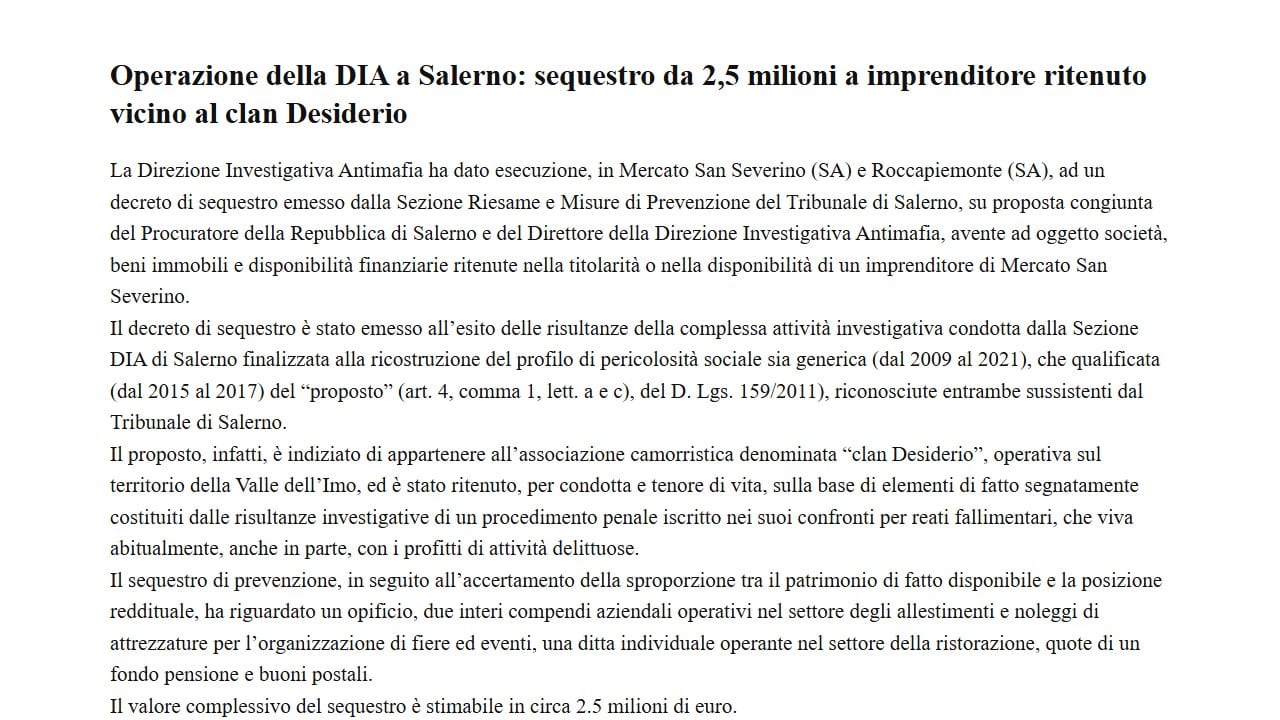
On November 4, 2025, in Mercato San Severino and Roccapiemonte, a seizure worth about 2.5 million euros hit a businessman the DIA describes as suspected of belonging to the Desiderio clan, active, according to the statement, in the Mercato San Severino area: a factory, two companies that set up and rent equipment for fairs and events, a catering business, pension fund units and postal savings bonds. Generic dangerousness was found for 2009 to 2021, qualified dangerousness for 2015 to 2017. The order, the statement notes, can of course be appealed.
The smallest seizure on the list shows the same method on a smaller scale: on January 30, 2024 the DIA carried out an order of the Salerno Court, requested by the Prosecutor’s Office, on shareholdings and a plot of farmland in the municipality of Scafati, worth over 250 thousand euros.
Loan-sharking against Avellino’s tanners
Alongside asset measures, the Salerno Section also works on the crimes that generate those assets. On October 21, 2025, in the provinces of Salerno, Naples, Avellino and Potenza, it carried out an order for the detention of suspects issued by the Salerno District Anti-Mafia Directorate, for usury and extortion aggravated by the mafia method. According to the Prosecutor’s Office, the investigation, which began in July 2025, uncovered a network of people inside or close to three Camorra groups in the provinces of Salerno, Avellino and Naples, who allegedly extorted large sums from two young tannery owners in the Avellino area who were in serious financial difficulty, as the profit of usurious loans granted earlier. The detention, the press release explains, was urgent also because of the increasingly pressing threats made against the victims in recent weeks; 120 officers were deployed, including four DIA drone pilots. The measure, the Prosecutor’s Office stresses, implies no final finding of guilt: everyone detained is presumed innocent.
Capaccio Paestum, the 2019 vote
On March 27, 2025 the DIA in Salerno executed a precautionary order by the Salerno preliminary investigations judge against 10 suspects, including the outgoing mayor of Capaccio Paestum, Francesco Alfieri, placed under house arrest. According to the prosecutors, the investigation, which lasted about two years between 2022 and 2024, concerns an alleged political-mafia electoral pact linked to his candidacy for mayor in the June 2019 elections: votes in exchange for keeping a beach establishment already subject to seizure measures. The charges, the prosecutors write, will be examined by the court: Alfieri and all the suspects are presumed innocent until a final judgment.
Lazio, and the limits of the sources
The previous version of this page presented the Campanian and Lazio investigations as a single axis. The statements do not document one. The only explicit point of contact is the Pomezia seizure of September 19, 2025, carried out by the DIA in Rome: the businessman targeted, arrested in July 2024, acted according to the DIA as a link between groups that included members of Campanian and local organized crime. That is a sign of relationships, not proof of a network; saying more would require the trial records.
The evidence file
- Sources: Anti-Mafia Investigative Directorate (DIA), Salerno operational section, statements of May 8, 2023, August 8, 2023, January 30, 2024, September 10, 2024, February 26, 2025, March 27, 2025, October 21, 2025 and November 4, 2025 (official feed, in Italian); DIA Rome operational centre, statement of September 19, 2025.
- Orders: Salerno court, Review and Prevention Measures Section (confiscations and seizures under Legislative Decree 159/2011); Salerno Court of Appeal and Court of Cassation (confiscation irrevocable since July 1, 2024); precautionary order of the Salerno judge of March 2025.
- Status of proceedings: final confiscation in the Agro Nocerino-Sarnese case; irrevocable conviction for mafia association for the man from Cava de’ Tirreni, under investigation for more recent events; the 2025 seizures are provisional and open to appeal; the Capaccio Paestum suspects, including the former mayor, are presumed innocent.
- Corrections: the quotations in the previous version were not verbatim; names of private individuals and family businesses have been removed; the Campania-Lazio axis is not documented by the sources.
- Personal data: the DIA statements give names, years of birth and towns of residence of suspects; this page names only the former mayor, because of the public office he held, and no private individuals.
- Basis for reproduction: Article 5 of Italian Law no. 633 of April 22, 1941, which excludes official acts from copyright.