Skip to content
Investigative Journalism
ARKA
Unclessify — Journal of Investigation and Declassification, Founded by Graziano Costantino

Public Procurement and Anti-Mafia Interdictions: Inside the Prefectural Screening System

Redazione Unclessify · edited by Graziano Costantino

An investigation into the operational enforcement of Italy’s Anti-Mafia Code across prefectural jurisdictions. The analysis dissects data screening, agricultural fund controls, and statutory override mechanisms.

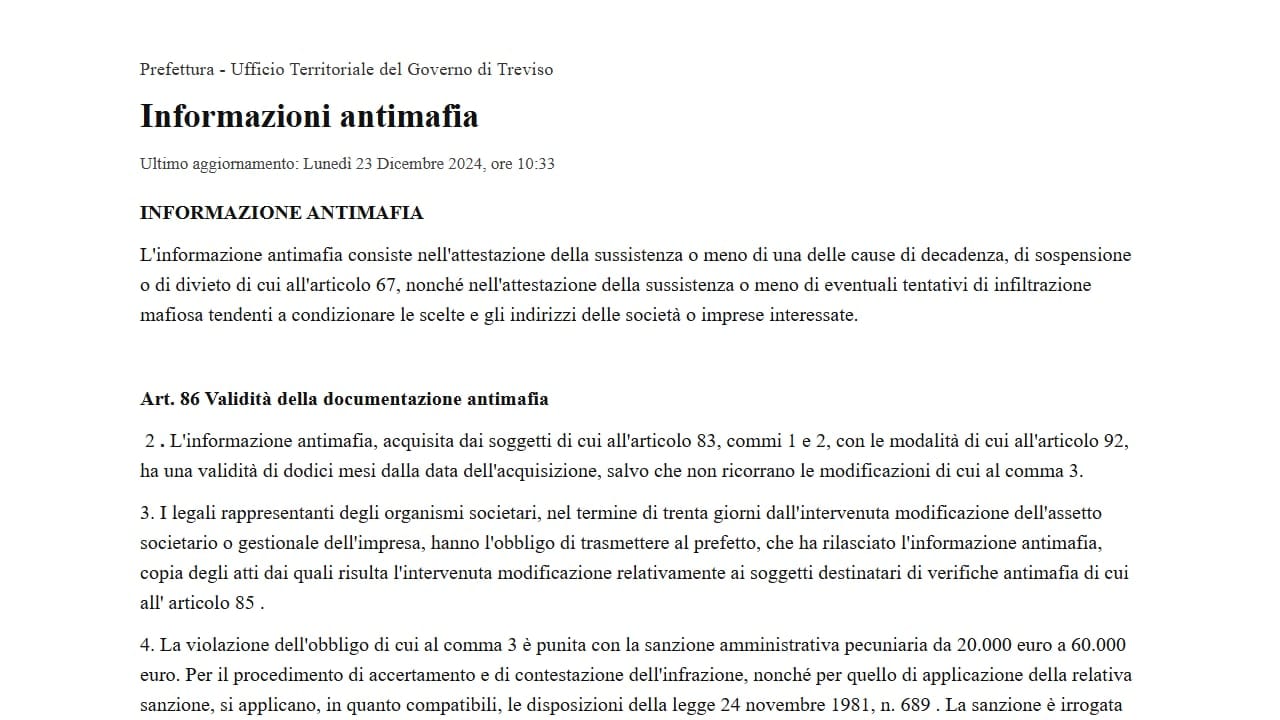
Black text on white: "Prefettura - Ufficio Territoriale del Governo di Treviso", the title "Informazioni antimafia", "Ultimo aggiornamento: Lunedì 23 Dicembre 2024, ore 10:33", then "INFORMAZIONE ANTIMAFIA", the definition and "Art. 86 Validità della documentazione antimafia" with paragraphs 2, 3 and 4
Acquired Record: prefettura.interno.gov.it

Prefecture of Treviso, "Anti-mafia information" page, last updated Monday 23 December 2024: the definition and Article 86 The "Anti-mafia information" page of the Prefecture of Treviso, updated 23 December 2024: the definition of anti-mafia information and Article 86 of Legislative Decree 159/2011, with the twelve-month validity and the duty to report changes in a company within thirty days. Photo: Prefettura - Ufficio Territoriale del Governo di Treviso (Ministero dell'Interno), Atto ufficiale (art. 5 L. 633/1941), via Wikimedia Commons

prefettura.interno.gov.itItalia2014Public
#antimafia#appalti-pubblici#prefetture#bdna#politica-agricola-comune

Primary source: prefettura.interno.gov.it — Italia

Share:

Official Records & Declassified Dossier

When a public body in the province of Treviso queries the National Single Database of Anti-Mafia Documentation and the system flags a problem, the Prefect has thirty days. Within that time he must order checks and, if he finds an attempt at mafia infiltration, issue a prohibitive anti-mafia information; if the checks are particularly complex, he informs the administration and provides the information within the following forty-five days. But the contract does not wait: once the thirty days have passed, or straight away in urgent cases, the body goes ahead even without the information. Grants and financing are paid subject to a condition subsequent, and if the prohibitive measure arrives later, the body revokes the concession or withdraws from the contract, while still paying for the work already done. This is the rule of Article 92 of the Anti-Mafia Code, Legislative Decree no. 159 of September 6, 2011, and the Prefecture of Treviso publishes it word for word, together with Articles 86, 90 and 91, on a page updated on December 23, 2024.

That page comments on nothing: it reproduces the rules. But lined up, the rules tell the story of the compromise on which anti-mafia screening in public procurement rests. On one side a strict filter, which looks not only at convictions and preventive measures but at attempts at mafia infiltration aimed at influencing the choices and direction of the companies concerned. On the other, the need for public works not to stop while waiting for an answer. In between there are deadlines, thresholds and an obligation the system entrusts to the companies themselves.

A certificate that lasts twelve months

The anti-mafia information, the page says, consists of a statement on whether any of the grounds for disqualification, suspension or prohibition of Article 67 exist, and on any attempt at infiltration. Once obtained it is valid for twelve months, unless the company changes in the meantime. And this is where the law shifts the weight: under Article 86, legal representatives must, within thirty days of any change in the company’s ownership or management, send the Prefect who issued the information copies of the documents, for the people subject to the checks of Article 85.

Those who fail to do so risk a great deal: the breach is punished with an administrative fine of 20,000 to 60,000 euros, under the procedure of Law no. 689 of November 24, 1981, and the fine is imposed by the Prefect. The limit lies in the very structure of the obligation. If a company changes directors or shareholders and does not report it, the Prefect has no way of knowing until the next database consultation: the fine hits the omission when it is discovered, but does not prevent an information issued to one company from applying, for months, to a different one.

The thresholds, and two pages that do not match

Article 91 sets out when the information must be requested. According to the Treviso page, before signing contracts for public works of 5,548,000.00 euros, excluding VAT; for services and supplies of 211,000.00 euros, except for the “special sectors” of water, energy, transport and postal services, where the threshold is 443,000.00 euros; above 150,000 euros for concessions of public water and state property, for grants and financing to businesses and for the authorisation of subcontracts, assignments and piecework. Paragraph 1-bis adds agriculture: the information is always required for state-owned agricultural land falling under the support schemes of the common agricultural policy, regardless of its total value, and for all agricultural land receiving European funds of more than 5,000 euros.

Here there is a detail worth noting. The Prefecture of Milan’s page on the same tool, consulted on the same day, gives different figures both for the services and supplies threshold and for agricultural land receiving European funds. Two offices of the same ministry, explaining the same rule, publish thresholds that do not match: at least one of the two pages is not aligned with the text in force. For a company or a small municipality relying on those pages, the difference is not theoretical.

Two rules close the loopholes. Splitting contracts, concessions or payments to evade the rule is prohibited on pain of nullity. And the request must be made when the contract is awarded or thirty days before a subcontract is signed, stating its subject and value, the details of the award decision and the full particulars of the party concerned, of the technical director and of the other people listed in Article 85.

Thirty days, then go ahead

The heart of the page is Article 92. If the database flags nothing, clearance is immediate, and the clearing information states that it was issued through the database connection. If it flags Article 67 grounds or an infiltration attempt, or if the party is not registered, the Prefect orders the necessary checks and issues any prohibitive measure within thirty days. The measure must be notified to the company within five days of its adoption. The Prefect also checks whether the conditions exist for the measures of Article 32, paragraph 10, of Decree-Law no. 90 of June 24, 2014, converted by Law no. 114 of August 11, 2014, and if so informs the President of the National Anti-Corruption Authority: this is the route that makes it possible not to halt a work of public interest, by placing the contract under extraordinary management instead of dissolving everything.

Paragraph 3 is the one that governs time. After the thirty days, or immediately in urgent cases, public bodies go ahead even without the anti-mafia information. Grants and financing are paid subject to a condition subsequent; if the prohibitive measure then arrives, the bodies revoke authorisations and concessions or withdraw from contracts, while paying the value of the work already done and reimbursing the costs incurred for the rest, within the limits of the benefits obtained. Paragraph 4 extends revocation and withdrawal to cases where infiltration emerges after signature. Paragraph 5 leaves one safeguard: payments can be suspended until the clearing information arrives.

Read plainly, the rule accepts a calculated risk. A company under scrutiny can start working and getting paid, and if the outcome is negative the administration must still pay for what has been done. The choice is explicit, and it belongs to the legislator, not the Prefecture: the page simply makes it readable. One oddity of the reproduced text is the reference, for how the prohibitive measure is notified, to Article 79, paragraph 5-bis, of Legislative Decree no. 163 of April 12, 2006, the public contracts code of that year.

Who decides, and where

As a rule the information is obtained by consulting the database, by the bodies listed in Article 97, paragraph 1, duly authorised. When the file goes to the Prefect, competence follows the company: it is the Prefect of the province where the person resides or the company has its registered office, or where a foreign company under Article 2508 of the Civil Code has a permanent branch; for companies set up abroad with no branch in Italy, it is the Prefect of the province where the requesting body is based. For clearance, prefectures use the same connection to the national single database.

The evidence file

  • Document: Prefecture - Territorial Government Office of Treviso, “Informazioni antimafia” page, last updated December 23, 2024 (full text, in Italian).
  • Rules reproduced: Legislative Decree no. 159 of September 6, 2011, Articles 86, 90, 91 and 92; also cited Prime Ministerial Decree no. 193 of October 30, 2014, Law no. 689 of November 24, 1981, Decree-Law no. 90 of June 24, 2014 (Law no. 114 of August 11, 2014) and Legislative Decree no. 163 of April 12, 2006.
  • Comparison document: Prefecture of Milan, “Informazione Antimafia” page (full text, in Italian), which gives different thresholds for services and supplies and for agricultural land with European funds.
  • Personal data: the source is an information page and does not concern specific people or companies.
  • Basis for reproduction: Article 5 of Italian Law no. 633 of April 22, 1941, which excludes official acts from copyright.

What this piece rests on

The text was checked against the facts listed below, extracted from the act above. It does not yet carry corroboration from independent sources.

The 31 facts verified in the text
  1. INFORMAZIONE ANTIMAFIA L'informazione antimafia consiste nell'attestazione della sussistenza o meno di una delle cause di decadenza, di sospensione o di divieto di cui all'articolo 67, nonché nell'attestazione della sussistenza o meno di eventuali tentativi di infiltrazione mafiosa tendenti a condizionare le scelte e gli indirizzi delle società o imprese interessate.
  2. L'informazione antimafia, acquisita dai soggetti di cui all'articolo 83, commi 1 e 2, con le modalità di cui all'articolo 92, ha una validità di dodici mesi dalla data dell'acquisizione, salvo che non ricorrano le modificazioni di cui al comma 3. 3.
  3. I legali rappresentanti degli organismi societari, nel termine di trenta giorni dall'intervenuta modificazione dell'assetto societario o gestionale dell'impresa, hanno l'obbligo di trasmettere al prefetto, che ha rilasciato l'informazione antimafia, copia degli atti dai quali risulta l'intervenuta modificazione relativamente ai soggetti destinatari di verifiche antimafia di cui all' articolo 85 . 4.
  4. La violazione dell'obbligo di cui al comma 3 è punita con la sanzione amministrativa pecuniaria da 20.000 euro a 60.000 euro.
  5. Per il procedimento di accertamento e di contestazione dell'infrazione, nonché per quello di applicazione della relativa sanzione, si applicano, in quanto compatibili, le disposizioni della legge 24 novembre 1981, n. 689 .
  6. L'informazione antimafia è conseguita mediante consultazione della banca dati nazionale unica da parte dei soggetti di cui all'articolo 97, comma 1, debitamente autorizzati, salvo i casi di cui all'articolo 92, commi 2 e 3. 2.
  7. L'informazione antimafia è sempre richiesta nelle ipotesi di concessione di terreni agricoli demaniali che ricadono nell'ambito dei regimi di sostegno previsti dalla politica agricola comune, a prescindere dal loro valore complessivo, nonché su tutti i terreni agricoli, a qualunque titolo acquisiti, che usufruiscono di fondi europei per un importo superiore a 5.000 euro. 2.
  8. È vietato, a pena di nullità, il frazionamento dei contratti, delle concessioni o delle erogazioni compiuto allo scopo di eludere l'applicazione del presente articolo. 3.
  9. Il rilascio dell'informazione antimafia è immediatamente conseguente alla consultazione della banca dati nazionale unica quando non emerge, a carico dei soggetti ivi censiti, la sussistenza di cause di decadenza, di sospensione o di divieto di cui all'articolo 67 o di un tentativo di infiltrazione mafiosa di cui all'articolo 84, comma 4.
  10. L'informazione antimafia interdittiva è comunicata dal prefetto, entro cinque giorni dalla sua adozione, all'impresa, società o associazione interessata, secondo le modalità previste dall'articolo 79, comma 5-bis, del decreto legislativo 12 aprile 2006, n. 163.
  11. Il prefetto, adottata l'informazione antimafia interdittiva, verifica altresì la sussistenza dei presupposti per l'applicazione delle misure di cui all'articolo 32, comma 10, del decreto-legge 24 giugno 2014, n. 90, convertito, con modificazioni, dalla legge 11 agosto 2014, n. 114, e, in caso positivo, ne informa tempestivamente il Presidente dell'Autorità nazionale anticorruzione. 3.
  12. Decorso il termine di cui al comma 2, primo periodo, ovvero, nei casi di urgenza, immediatamente, i soggetti di cui all'articolo 83, commi 1 e 2, procedono anche in assenza dell'informazione antimafia.
  13. Il versamento delle erogazioni di cui all'articolo 67, comma 1, lettera g), può essere in ogni caso sospeso fino alla ricezione da parte dei soggetti richiedenti di cui all'articolo 83, commi 1 e 2, dell'informazione antimafia liberatoria.
  14. Lgs. 6 settembre 2011, n. 159, Art. 67 D.P.C.M. 30 ottobre 2014 n. 193 Ultimo aggiornamento Lunedì 23 Dicembre 2024, ore 10:33
  15. QUANDO NON ACQUISIRE LA DOCUMENTAZIONE ANTIMAFIA La documentazione antimafia (comunicazione o informazione) non deve essere acquisita nei seguenti casi ( art. 83, co. 3 D.
  16. Lgs. 159/2011): 1. per i rapporti tra i soggetti pubblici di cui all'art. 83, comma 1 del D.
  17. PROCEDURA PER L’ ACQUISIZIONE DELLA DOCUMENTAZIONE ANTIMAFIA La documentazione antimafia deve essere acquisita: - attraverso la consultazione dell’elenco dei fornitori, prestatori di servizi ed esecutori di lavori non soggetti a tentativi di infiltrazione mafiosa istituiti ai sensi della legge 190/2012 (c.d. white list provinciali).
  18. I soggetti previsti dall'art. 83, commi 1 e 2, hanno l'obbligo di acquisire la comunicazione e l'informazione antimafia liberatoria attraverso la consultazione, anche in via telematica, dell'elenco dei fornitori, prestatori di servizi ed esecutori di lavori non soggetti a tentativi di infiltrazione mafiosa istituiti presso ciascuna Prefettura.
  19. I soggetti di cui all'art. 83, commi 1 e 2, devono comunicare alla Prefettura territorialmente competente, esclusivamente con modalità telematica, gli estremi identificativi delle imprese in relazione alle quali hanno acquisito la documentazione antimafia tramite la consultazione degli elenchi.
  20. La Banca Dati Nazionale Unica della documentazione antimafia (BDNA), istituita dall'art. 96 del D.
  21. Lgs. 159/2011, regolamentata dal D.P.C.M. 30.10.2014, n. 193 e divenuta operativa dal 7 gennaio 2016 costituisce lo strumento attraverso il quale le Pubbliche Amministrazioni/Stazioni Appaltanti possono richiedere la documentazione antimafia.
  22. Le richieste di concessione delle credenziali, da effettuarsi utilizzando la modulistica disponibile sul sito istituzionale di questa Prefettura, dovranno pervenire esclusivamente all'indirizzo __________________________________ TERMINI PER IL RILASCIO DELLA DOCUMENTAZIONE ANTIMAFIA Ai sensi dell’art. 88 del d.
  23. Lgs. 159/2011 il rilascio della comunicazione antimafia è immediatamente conseguente alla consultazione della BDNA.
  24. Decorso detto termine le amministrazioni interessate procedono anche in assenza della comunicazione antimafia, previa acquisizione dell’autocertificazione ex art. 89 D.
  25. Lgs. 159/2011 il rilascio dell’informazione antimafia è immediatamente conseguente alla consultazione della BDNA.
  26. La violazione dell’obbligo di comunicazione delle variazioni societarie è punita con la sanzione amministrativa pecuniaria da 20.000 a 60.000 Euro.
  27. Gli elenchi dei fornitori, prestatori di servizi ed esecutori di lavori non soggetti a tentativi di infiltrazione mafiosa istituiti presso questa Prefettura ai sensi della legge 190/2012 (c.d. white list provinciali) sono consultabili sul sito web istituzionale.
  28. AUTOCERTIFICAZIONE La comunicazione antimafia può essere sostituita da apposita dichiarazione - sottoscritta con le modalità di cui all'art. 38 D.P.R. 445/2000 – con la quale l’interessato attesta che nei propri confronti non sussistono le cause di divieto, di decadenza e di sospensione ex art. 67 del D.
  29. EFFETTI DELL’INFORMAZIONE ANTIMAFIA INTERDITTIVA Ai sensi dell’art. 92, comma 2-bis del D.
  30. Lgs. 159/2011, al Prefetto che adotti un’informazione antimafia interdittiva spetta il compito di verificare la sussistenza dei presupposti per l’applicazione delle misure di cui all'art. 32, comma 10, del D.L. 24.06.2014, n. 90, convertito con modificazioni dalla legge 11.08.2014, n. 114.
  31. L’eventuale rescissione dei contratti o la revoca delle concessioni è pertanto subordinata all'espletamento del procedimento diretto alla verifica della sussistenza dei presupposti per l’applicazione dell’art. 32 del D.L. n. 90/2014, inteso ad accertare la presenza di preminenti interessi pubblici da tutelare.
Click to switch theme:

Comments (0)