
In the province of Genoa, a woman runs a laundry and ironing business on her own. It is her only source of income, and with it she supports herself and a disabled son who lives with her. The Prefect of Genoa serves her with an anti-mafia interdiction notice: according to the prefectural measure, a local ‘Ndrangheta organisation had tried to infiltrate the business. The interdiction is not a conviction and does not establish any crime, but its effects are immediate: the municipality starts proceedings to revoke the licence that lets her keep the business open. She appeals to the Regional Administrative Court for Liguria on five grounds, all against the Prefect’s assessment. The judges find no error in that assessment, but they suspend the interdiction as an interim measure, because barring her business would cause her “serious and irreparable harm”, and on March 10, 2025 they ask the Constitutional Court whether it is lawful that the Prefect cannot take her economic survival into account.
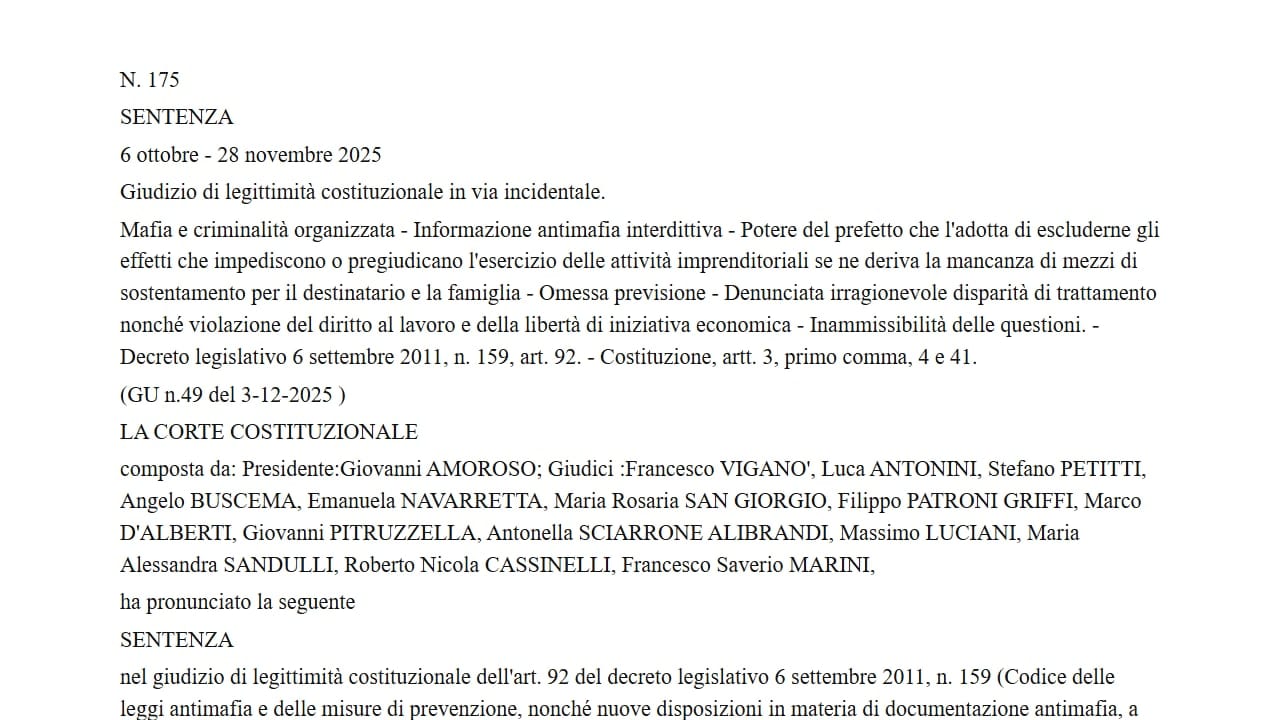
A few months earlier, in Reggio Calabria, another company had lost a public works contract with ANAS, the state road company, for an opposite and mirror-image reason: it had completed, with a positive outcome, a clean-up programme under court supervision, and at that very moment the interdiction had started producing effects again. The two cases reached the Constitutional Court a few months apart and produced two judgments, both written by Judge Filippo Patroni Griffi with Giovanni Amoroso presiding. The first, no. 109 of 2025, sides with the Calabrian company and changes the law. The second, no. 175 of 2025, closes the Ligurian case without ruling on the merits. The previous version of this page merged them into one; the full texts, published in the Official Gazette, tell two different stories.
The Calabrian company, which the Court refers to as C. P. srl, had already been served with an interdiction dated February 26, 2020, which became final with the judgment of the Council of State, Third Section, of April 15, 2024, no. 3390. However, by a decree of July 15, 2021 of the Court of Reggio Calabria, prevention measures section, it had been admitted to so-called voluntary judicial supervision under Article 34-bis of the Anti-Mafia Code. The measure is designed for businesses touched only occasionally by criminal organisations: the owner stays in charge, but under the court’s instructions and the oversight of a judicial monitor, for a period of one to three years. While it lasts, the effects of the interdiction are suspended, and thanks to that suspension the company had won the ANAS contract.
The measure expired on July 15, 2024. On June 7, 2024, before it expired, the company asked the Prefect of Reggio Calabria to update its position through an application to remain on the white list, and the client had also pressed for a decision. The Prefecture did not answer in time: on July 11, 2024 it had only notified the company of a forthcoming interdiction. Once the supervision ended, the original interdiction became effective again and ANAS first halted the works, then, on August 1, 2024, terminated the contract because the contractor no longer met the requirements. On September 13, 2024 the Court of Reggio Calabria declared the supervision closed because its maximum term had run out, finding no grounds for further measures.
The company challenged the termination before the Administrative Court for Calabria, Reggio Calabria branch. Its main argument was that the suspension under Article 34-bis should last until the Prefect decided on the review. The judges did not accept this as a reading of the law: the text says that the order placing a company under judicial supervision “suspends” the effects of the interdiction, and administrative case law consistently infers that the suspension ends with the supervision. But in an order of October 11, 2024 they nonetheless granted interim relief, raising the constitutional doubt of their own motion, and on October 28, 2024, by the order entered as no. 235 in the 2024 register of orders, they asked the Constitutional Court to extend the suspension until the Prefect’s decision.
The referral order describes the effect in words the Constitutional Court quotes: “a genuine regulatory short circuit”. The legal system lets the owner continue under a judge’s supervision precisely because the situation is considered fixable, and then, at the end of the monitoring, lets the interdiction kick back in automatically, without waiting for the Prefect to assess whether the programme worked. The administrative court adds two practical points. The review procedure requires a lengthy inquiry, and prefectures tend to wait for the judicial monitor’s final report, a practice the court does not share because the review could also rely on interim reports. And whatever the outcome, the damage cannot be undone: a clearance only applies to the future, and even the annulment of a new interdiction does not cover the period between the end of supervision and the new measure.
The Calabrian judge then compares three companies. One that has obtained from the administrative court a suspension of the interdiction can keep contracting with the public administration. One that, its interim application having been rejected, has been admitted to judicial supervision can continue its contracts and, under the 2023 Public Contracts Code, even stay in a tender. One that has successfully completed supervision, with the interdiction by then upheld by a final judgment, has no remedy at all: it cannot go to the administrative court until the Prefect decides, and it cannot apply for a new admission to supervision, which requires a pending appeal. For the court, this is worse treatment reserved precisely for the company that underwent the clean-up, and the return of the effects also forces contracting authorities to replace the contractor in a hurry, with delays and costs.
ANAS joined the proceedings and asked the Court to declare the questions inadmissible. Its first argument was factual: on October 25, 2024, at the end of the review, the Prefecture of Reggio Calabria had issued a new interdiction against the company; the Council of State had rejected ANAS’s appeal against the interim relief, holding that the new measure concerned “supervening grounds”; and on December 11, 2024 ANAS had terminated the contract again. In ANAS’s view, the company no longer had an interest in challenging the first termination. Its second argument was one of principle: tying the suspension to the Prefect’s review meant intruding on choices reserved to the legislature. On the merits, ANAS argued that the company could have applied earlier or sued over the Prefect’s silence, and that a longer suspension would let it exploit the administration’s inaction to keep its contracts.
The Court rejected both objections. The new interdiction, although it predated the filing of the referral order, came after the administrative court’s decision to stay the case and raise the question, and it remained outside the subject matter of the administrative case. As for the legislature’s discretion, the requested solution finds in the legal system, the Court writes, “precise points of reference” and “already existing solutions”. Meanwhile, the company reported in a brief, on March 7, 2025 the Court of Reggio Calabria admitted it to judicial supervision again after it challenged the second interdiction.
A measure to save businesses, not to expropriate them
Before deciding, the Court reconstructs what judicial supervision is. It is a preventive measure on property introduced by Law no. 161 of October 17, 2017, part of a legislative trend to respond to infiltration of the economy with graduated tools: in less serious cases, instead of confiscation, the rescue of the contaminated business. Under supervision the owner is not expropriated, as with seizure and confiscation, nor stripped of management, as with judicial administration: the business follows a programme supervised and assisted by the State, provided it keeps an adequate margin of independence from criminal groups.
That is why the measure is granted only if help given to dangerous persons is “occasional”, and the Court cites the Joint Criminal Sections of the Court of Cassation, judgment no. 46898 of 2019: the judge must understand and foresee the company’s potential to free itself from its pathological ties. It is a “dynamic” assessment, a prognosis, whereas the Prefect’s assessment when issuing an interdiction is “static”, a diagnosis of a risk that has already materialised. The difference has consequences: a final judgment upholding the interdiction does not end the supervision, because the need to clean up the company remains, and a successful supervision does not make the interdiction unlawful, since it is judged on the facts at the time it was issued.
The legislature later strengthened the link between the two systems. Decree-Law no. 152 of November 6, 2021, converted into Law no. 233 of December 29, 2021, introduced collaborative prevention measures that the Prefect can adopt instead of an interdiction when infiltration amounts to occasional help: organisational requirements for six to twelve months, which lapse if the court orders judicial supervision. And the 2023 Public Contracts Code, Legislative Decree no. 36 of March 31, 2023, provided that an interdiction does not exclude from a tender a company admitted to judicial supervision by the date of award. The Court calls this a “saving” effect: the supervised bidder is deemed by law reliable and deserving of contract opportunities that lead it to a clean-up.
“The legs to walk it”
On the merits, the Court sides with the Calabrian judge, finding a breach of Articles 3 and 41 of the Constitution: an unreasonable regime and a disproportionate sacrifice of economic freedom. Suspending the interdiction, it writes, is the indispensable means for a company to actually go through supervised management: without it, the legal system “would point out the path to recovery, but would not provide the legs to walk it”. Closing the supervision with a positive outcome and immediately restarting the interdiction is, for the Court, a mechanism that is “plainly discordant and punitive for the company”.
The judgment sets out the contradiction in three steps. The system creates an innovative measure and invests in it to bring businesses back to legality; it admits the owner, once his potential is recognised, to a recovery programme of one to three years, which has a cost not only for the business but also for the justice system; and then, even if the programme ends well, it does not prevent the effects of the interdiction from returning at once, while the Prefect’s reassessment is pending. The risk is concrete, and the Court names it: restoring the incapacities “may not only lead to an irreversible economic crisis for the company, but may also bring the struggling business closer again to the criminal world, from which state intervention sought to separate it”.
The Prefect’s review as the link
The link, for the Court, is the update of the interdiction under Article 91(5) of the Anti-Mafia Code. An interdiction is valid for a limited period of twelve months, which does not mean automatic lapse but a duty to check whether the circumstances behind it still exist: judgment no. 57 of 2020 had already said so, in order “to avert the risk that a measure no longer justified persists, and thus of truly irreversible harm”. A successful supervision is precisely one of the new facts that oblige the Prefect to review; if the Prefect stays silent, the company can sue over the silence. The Prefect is not bound by the outcome of the supervision, but must assess it with reinforced reasoning.
The model already exists: for collaborative prevention measures, Article 94-bis(4) makes the end of the supervised period coincide with the review, and in that case the system allows no gap. The judgment also mentions a bill in the 19th Legislature, A.C. no. 1405, which would require an automatic review lasting at most six months, extendable by another six, with the suspension maintained in the meantime.
The ruling declares Article 34-bis(7) unconstitutional “insofar as it does not provide that the suspension of the effects of the interdiction resulting from admission to judicial supervision continues, where supervision ends with a positive outcome, until the procedure for updating the interdiction has been concluded”. The protection applies only if the supervision ends well: that is the qualification the Court added to the administrative court’s request. The other questions, on the right of defence and the European Convention, are absorbed.
The Ligurian laundry and the power the Prefect lacked
The Ligurian question was different. The administrative court wanted the Prefect, when issuing the interdiction, to have the power to exclude its effects when they deprive a person and her family of the means to live. The Anti-Mafia Code has long given that same power to the prevention court applying personal measures: Article 67(5) allows it to exclude forfeitures and bans “where, as a result of them, the person concerned and the family would be left without means of subsistence”. For the administrative court, both measures are equally anticipatory defences of legality, and the disparity becomes obvious precisely for those running a sole-trader micro-business.
The Ligurian judge also ruled out the alternative remedies. The review of the interdiction after twelve months is not enough, because the Prefect might find no new facts and because a year’s stoppage may already have destroyed the business. Judicial supervision is not enough, for three reasons: it is granted only in cases of occasional help; it has no retroactive effect, except in tenders; and the monitor’s fee is paid by the owner, whose income for the family is reduced. Finally, the court recalled that the Constitutional Court had already flagged the disparity in judgment no. 180 of 2022, and before that in no. 57 of 2020, without the legislature acting, and it invoked the right to work, recognised even for prisoners and so, all the more, for someone with no established criminal liability.
Shortly after the referral order, the legislature did act. Article 3 of Decree-Law no. 48 of April 11, 2025, converted into Law no. 80 of June 9, 2025, inserted Article 94.1 into the Code, expressly to follow up on the warning in judgment no. 180 of 2022. The provision allows the Prefect, on a documented application by the owner of a sole proprietorship and after checks by the inter-agency group, to exclude one or more bans when the interdiction deprives the owner of the means of subsistence. The Court notes that, according to early administrative case law, in Sicily and Lombardy, and to prefectural practice, even those served with an interdiction before the reform can apply for this limitation.
Why the Court did not decide
That is precisely why judgment no. 175 of 2025 does not rule on the merits. The Ligurian case concerns the lawfulness of a measure adopted before the reform, which must be assessed under the rules in force when it was issued, under the principle of tempus regit actum. Above all, the five grounds of appeal challenged only the Prefect’s assessment of the risk of infiltration, not the effects of the interdiction: the power the court wanted to add concerns limiting the effects, not the conditions for the measure. The court, in other words, was asking to add a rule it would not have had to apply. The Constitutional Court puts it this way: “the necessary relationship of instrumentality and preliminarity between the resolution of the constitutional doubt and the decision of the dispute in the main proceedings is lacking”.
The Court also closes the last route. The administrative court could not declare the interdiction void of its own motion after a ruling of unconstitutionality, because administrative case law recognises an “absolute lack of power” only when the rule conferring the power falls, not one governing how it is exercised. The questions are inadmissible for lack of relevance. The Court also notes that the referral order does not mention any application by the claimant to the Prefect to limit the effects.
What changes for businesses
Read together, the two judgments say one thing about the relationship between the State and businesses brushed by organised crime: administrative prevention stays strict on its conditions, but it cannot needlessly destroy what judicial prevention is trying to save. For a company that completes judicial supervision successfully, since July 2025 the effects of the interdiction remain suspended until the Prefect decides. For a sole trader at risk of losing the only source of income, the route is the application to the Prefect under Article 94.1, not an appeal against the interdiction.
Two things remain that the records do not say. Judgment no. 109 sets no deadline for the Prefect to decide: the suspension lasts until the update, and a company left waiting can challenge the silence through the remedy provided by the Code of Administrative Procedure, as ANAS had pointed out. And judgment no. 175 does not say whether the Ligurian business owner later filed the application: what is known is that her laundry, at the time of the decision, was still protected by the administrative court’s interim suspension. It is an observation of this investigation that the 2025 reform came after two warnings from the Court that had gone unheeded for years.
The evidence file
- Decision 1: Constitutional Court, judgment no. 109 of 2025, decided May 20, 2025, filed July 17, 2025; president Giovanni Amoroso, rapporteur Filippo Patroni Griffi; Official Gazette, 1st Special Series, no. 30 of July 23, 2025 (full text, in Italian).
- Outcome 1: Article 34-bis(7) of Legislative Decree no. 159 of September 6, 2011 unconstitutional for breach of Articles 3 and 41 of the Constitution; other questions absorbed. Referring court: Administrative Court for Calabria, Reggio Calabria branch, order of October 28, 2024 (no. 235 of 2024); parties C. P. srl and ANAS spa.
- Decision 2: Constitutional Court, judgment no. 175 of 2025, decided October 6, 2025, filed November 28, 2025; president Giovanni Amoroso, rapporteur Filippo Patroni Griffi; Official Gazette, 1st Special Series, no. 49 of December 3, 2025 (full text, in Italian).
- Outcome 2: questions on Article 92 of Legislative Decree no. 159 of 2011 inadmissible for lack of relevance (Articles 3(1), 4 and 41 of the Constitution). Referring court: Administrative Court for Liguria, First Section, order of March 10, 2025 (no. 58 of 2025).
- Rules and records cited: Articles 34-bis, 67, 86, 91, 94, 94-bis and 94.1 of the Anti-Mafia Code; Law no. 161 of 2017; Decree-Law no. 152 of 2021; Legislative Decree no. 36 of 2023; Decree-Law no. 48 of 2025, converted into Law no. 80 of 2025; Constitutional Court judgments no. 57 of 2020 and no. 180 of 2022; Court of Cassation, Joint Criminal Sections, no. 46898 of 2019; bill A.C. no. 1405.
- Corrections to the previous version: there are two judgments with different outcomes; filing date of no. 175; the earlier block quotations were not verbatim and have been replaced.
- Personal data: the Ligurian business owner, subject to an administrative measure and not to a conviction, is not identified; the Calabrian company is referred to only by the initials used by the Court.
- Basis for reproduction: Article 5 of Italian Law no. 633 of April 22, 1941, which excludes official acts from copyright.